Monday, July 11, 2005

Northwest Redux and Other Random Musings From The North Woods

(My Temporary Shingle)

I try to be flexible when possible, and this week I am playing Pediatrician at my son's camp in northern Wisconsin. The territory up here is nothing short of spectacular, lots of trees and lakes and clear blue skies. The camp itself is a rustic paradise, about as far from a Ritz Carlton as you can get, but still peaceful, placid, and comfortable. Maybe I'll stay up here for a while....

Northwest redeemed itself in getting me here. There were absolutely no glitches whatsoever. Flights were ontime and smooth, and personel were friendly. Special thanks to Sergio at our originating airport, who went out of his way to help us redistribute items in an overweight bag, thus avoiding a penalty. Sergio's behaviour compensated for that of the other Northwest employees to a very significant degree. He "got it" as they say. All I ask is that I be treated with kindness, understanding, and dignity; this is how Sergio treated me, and how I hope I treat my patients.

On the PACS front, the big news is the purchase of Stentor by Philips, for $280 Million. That's a lot of cash, folks. The big question I have is this: What happens to all of those Sectra installs? The Sectra folks seem to be assuming the worst:

Since 1997, Sectra has had a global cooperation with Philips Medical Systems, which has sold Sectra's software for processing digital X-ray images worldwide.

"We have several project agreements with Philips that extend up to ten years and our cooperation will successively be terminated," relates Sectra's President and CEO Jan-Olof Brüer. "We assess that the termination will impact on our sales and earnings in the current fiscal year. At this time, however, it is difficult to provide any reliable view of the financial effects, since this depends on how much time the termination will require."

The change provides Sectra the opportunity to review its sales channels. Sectra's sales of PACS are handled on a proprietary basis in Scandinavia and other selected markets as well as through partners, of which Philips was the largest. Sectra's largest sales together with Philips have been in the US.

"Part of the sales for which Philips is currently responsible will be taken over by other partners that today are active in the same markets as Philips," says Jan-Olof Brüer. "At the same time, we gain the opportunity to advance our positions and will increase our focus on own sales in important key markets, as we do today in Scandinavia, where we have captured more than half of the total PACS market."


Sounds to me like Philips is dropping Sectra (or maybe it will turn out to be the other way around) like a hot potatoe, and Sectra will find some "other way" to service its sites. Uh Oh. I've lived through that sort of thing with our Elscint CT scanners. Elscint sold its CT division to Picker (actually happened while I was visiting their main offices in Haifa, Israel), which then was gobbled up by none other than Philips. Service was pretty good, considering, but it just isn't an optimal situation. In this case, Sectra will have to bring in some other outfit to do its service. Perhaps they should contact Banctec, the outsourced Dell service provider, or maybe the Geek Squad from Best Buy.

I know of several sites that had purchased Philips/Sectra, or were close to doing so. Wouldn't go there at this point, at least until the market stabilizes. If they were buying because of the Philips name, they would of course still get that, but a completely different product. To buy Sectra means diving into a very murky future. I personally wouldn't go near either one for the time being, but that's just me. Your milage may vary.

I had the chance to play with the Philips/Sectra system, and it isn't bad. It was neither my most or least favorite. The team was (and I emphasize was) a formidible player in the PACS field. I've asked people why they liked the PS system so, and invariably I get one of the following answers:
  1. It's made or marketed by a company that makes scanners, so it must be good.
  2. It has an easy pull-down preliminary report menu.
  3. Their embedded 3D lets you select exact slice thickness on MPR.

My answers to the above are probably predictable. First, GE and Siemens make scanners too...I don't consider the PACS product from either company, um, great at the moment. Secondly, one should never, ever make a major purchase based upon one or two perks. Would you buy a Peugot over a Mercedes because it has, say, a prettier hood-ornament? You have to take all factors into account, not the least of which is the overall usability of the entire system. Having the hots for one specific component has the potential to send you down the completely wrong path. Pull-down preliminary report generators are dandy, and I have a rudimentary version on Agfa Impax 4.5. I rarely use it, because I can type my prelim much faster without any help. As far as MPR slice thickness, I don't know anyone who finds knowing the exact numerical value of the thickness that valuable in actual use. Frankly, I suspect a lot of potential PACS purchasers, especially those who are new to the game, are so overwhelmed by whizbang gadgets, they don't stop to think about how they might actually use said toys.

My advice remains this: use the product as much as you can before making a purchase. Web-based systems lend themselves very well to trial-runs in your own office or home setting. Vendors...can you accomidate this?

Anyway. For the moment, all is well in the North Woods. That is until Sick-Call, which is right after dinner.........

Wednesday, July 06, 2005

Pod Casting

I saw this in Walt Mossberg's column in the WSJ and I couldn't resist giving it a try. Just click the "Play" button....

Monday, July 04, 2005

Fuji Synapse Not HIPAA Compliant?

CI writes:

Our group of 7 FTE Radiologists is in an interesting predicament. We have been using Fuji Synapse for over 3 years for in-house PACS and we are filmless for all modalities. We do a total of 140K exams a year. For the last three years our group has been pushing the hospital to provide web access to the referring docs using Synapse and they refused claiming that Synapse, outside of the intranet, is not HIPA compliant. (Synapse uses Internet explorer which can leave copies of the downloaded images on the browsing computer). So, the hospital started looking at Stentor a year and half ago. Initially we were all excited but w found out that Stentor was not able to display the Fuji CR images properly on their system. Stentor was able to fix this for new images comparisons still look pretty bad. Most radiologists also do not like the scrolling in stentor (it is too fast when you hold the mouse down or too slow to scroll one image at a time). Our referring docs are finding it a pain to navigate stentor, and clearly it is not as intuitive as Synapse. The rads want to keep Synapse and the hospital is pushing for Stentor. The rest of the hospitals in our system have gone with Stentor. (interestingly none of them have used Synapse before). Any body out there with any experience with these systems or have any general advice please post.....


This is certainly a new one on me! I replied: Yours is the first complaint of that sort I have ever heard about Synapse. It seems an extreme measure to bring in another (expensive) system to do what Synapse will already accomplish for the cost of connection. Your hospital/IT people have taken a view that is more extreme than any other hospital in the country using any web client. They ALL cache stuff on the home computer in some form. It is possible to clear the cache on any IE set-up, and probably this could be automated with a very simple script, thus saving you literally thousands if not millions of dollars. I'll be glad to collect 10% for my trouble.

If your IT folks are correct, every last system using a web-client for call isn't HIPAA compliant, and millions of dollars are out the window. I really don't think so. Yet another example of IT not totally understanding how something in PACS functions, but shoving their view down our throats anyway. I don't know about the HIPAA regs that specifically mention cached images. In general, (and I am far from an expert on this), the regs are there to make sure that images only are available to the intended viewing party. Thus, there should be nothing limiting the access of your rads at all. The only question would come if they temporarily installed Synapse on, say, a friend's computer. In any case, I think your IT department is way, way off base here.

Addendum: I just did a Google search...I couldn't answer the question specifically, but I came across the instruction sheet to connect to a Synapse system over the web in the manner we are discussing for three separate radiology groups. I am familiar with two of these groups, and I seriously doubt that your IT people have found something these huge groups have neglected. Ask them why they think Stentor is any better in this regard. I am not a fan of the Synapse interface, as I have posted many times before, and in some ways I am a little surprised that you find iSite harder to use. Still, the key to all this may be in the last lines of your first post, "The rest of the hospitals in our system have gone with Stentor." I'm guessing your IT people would rather have just one platform, and are looking for a way to get the product they know into place. (I'm assuming the same IT people cover all your places...)

There's More than One Way to Scan a PET...

Actually, there are numerous options out there for those in the market to purchase a PET scanner. I've directed the purchase of three over the years. My first "PET" scanner was a coincidence device from ADAC, which was replaced with a Siemens ECAT Exact 47, and then with a Siemens Biograph 16 Hybrid PET/CT. As I mentioned in a prior post, GE lobbied me heavily to buy a Discovery ST instead, but I was convinced that the faster LSO crystals in the Biograph made it the best choice.
Fast-forward to the present. My group has today a rather unique situation: we read PET/CT studies from the Siemens I chose, and from a Discovery ST placed several months later at the oncology clinic we cover. So, we can do some near-direct comparisons. I say "near-direct" because we don't have the workstations for the competing systems side by side, and even when a patient has a prior exam, comparisons are done with a CD-ROM or on PACS, which is not the optimal way to do this. (I should, of course, add that about 99% of the time, the new scan is at the clinic and the old was from the hospital, which shouldn't surprise anyone.)

I'll give you the punchline first, and then we'll go into the boring discussion of what's behind it. My educated, although still subjective, opinion is that the Biograph produces better images. Sorry, GE, but Siemens gives us images with less noise which are overall more pleasing and easier to read, again, in my opinion. The faint of heart can leave now.

A word about the proprietary workstations attached to each camera is in order. GE provides the Advantage Workstaton 4.3, the AW, and Siemens uses the Leonardo with eSoft. To be fair, I find the Linux-based AW about the same in ease of use for this application, although it helps that the apps people set me up with my own hanging-protocol. The Windows-based Leo got a slightly different version of my custom display. I don't really like the AW for other purposes, but for PET/CT it works well enough. There are numerous differences in the overall approaches, and I tend to prefer the Leo for CT. Both lack mouse-wheel scrolling, which would be a welcome addition.

The two scanners themselves are quite different in their hearts, their detector crystals, and their approach to the actual acquision of the image.

For those unfamiliar with positron scanning, a very brief primer is in order. Positrons are positively-charged particles that are otherwise identical to negatively-charged electrons. The positron is technically antimatter, which does exist outside of the Star Trek universe. Isotopes that emit positrons when they decay are made by cyclotron, and the most common is 18F, or Flourine-18, which has a half-life of 110 minutes. (Half-life means that half of the stuff is gone or transformed, within that time.) For PET scanning, we label a glucose analogue with 18F to get 18-FDG, fluorodeoxyglucose. This can be used to map metabolism, taking advantage of the fact that most tumors and other bad things burn glucose faster than most normal tissues.

When the 18F decays, it shoots off its positron, which quickly comes in contact with one of the vastly more numerous electrons in the adjacent tissues (or air, or whatever). When a positron meets an electron, they annihilate each other, with a very tiny "bang," and in the process sends out two photons, each with the energy of 511 KeV (Kiloelectron Volts) which just happens to be the amount of energy contained in the mass of the electron or the positron. As it turns out, it is these photons, which are sent out at 180 degrees opposed to each other, which are detected, and not the positrons per se. Thus, we really should call this whole process "Annihilation Imaging" and not PET scanning, but I doubt that anyone would stick their head in an "Annihilation Scanner"!


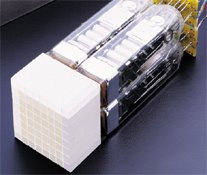
Siemens uses Lutetium Oxyorthosilicate, or LSO, crystals, pictured below, while GE uses Bismuth Germinate (which looks quite similar.)


OK, a crystal is a crystal, right? Well, not really. The purpose of the crystal is to turn those 511 KeV photons into light, which is then turned into an electrical signal, and then into the picture. To make a long story short, LSO does a better job of turning the radiation into light, and does it more quickly than BGO, so it can handle a higher amount of radiation. Now, GE insisted that BGO is just as good, and sent me a barrage of articles to prove this. However, GE is working on its own version of LSO, called LYSO, and rumor has it that Duke, the main showsite for GE PET, will not get another PET/CT scanner until GE can deliver the LYSO unit. (The GE people tell me that they are making LYSO to accomodate future PET pharmaceuticals, and BGO is really great for now.)

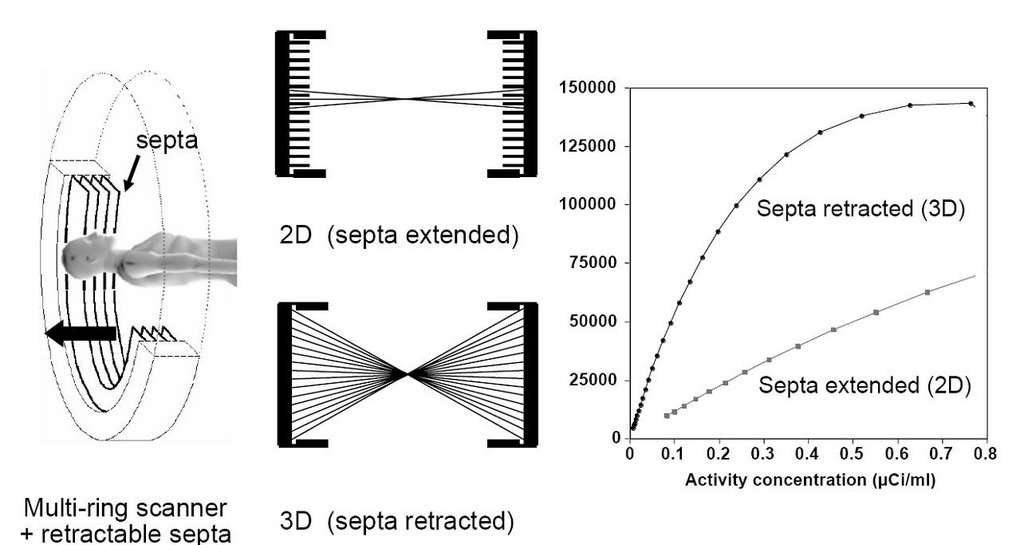
But there's even more to the story. The PET portion of a PET/CT gantry isn't just a big tube-shaped crystal, but rather a collection of smaller crystals arranged in rings. When a detector senses an annihilation photon, it tries to match it to another one that came in at the same time. The simultaneity allows the machine to figure out where the detonation occurred and then it can paint the picture of the distribution of the tracer. But sometimes the radiation gets scattered within the body, or two unconnected (random) photons happen to hit at the same time. To prevent this, thick lead septa are introduced as in the image below..this is the so-called 2-dimensional approach. With faster crystals, it is theoretically easier to discriminate on the time of arrival, and so one can open up the whole array of detectors to receive all possible photons, the so-called 3-dimensional approach. Siemens LSO PET/CT's use 3D exclusively, while GE's BGO machines can run in either 3D or 2D mode.


“From 3D PET to 3D PET/CT: what did we learn?” Peter Valk Lecture given by David W. Townsend, Ph.D.,
Department of Medicine and Radiology University of Tennessee, Knoxville


All well and good. Again, to make a long story very short, the 3D approach allows a lot more scatter radiation and random counts to be, well, counted. On the other hand, 3D picks up a whole lot more photons overall. Do these balance out? The answer depends on the article you read. Here is one from a recent article in the Journal of Nuclear Medicine by Lodge, et. al.:

Comparisons of 2D and 3D performance are very sensitive to the specific conditions under which the data were acquired. Counting rate, scatter, activity outside the field of view, reconstruction algorithm, and scanner characteristics all influence relative performance. In this study 2D and 3D data were compared under clinically realistic conditions and effects that may introduce bias were minimized. The mean ratio of 3D to 2D image values was 0.94 with 95% limits of agreement of 0.63–1.41. All noise comparisons were made under conditions of matched lesion target-to-background ratio as measured in patient images. A statistically significant reduction in image noise was found with 3D acquisition compared with 2D, suggesting reductions in scan duration of 33% or more are feasible.
Italics are mine, as usual. Now GE cited some other articles contradicting this one. One in particular by Laritizien, et. al., states:

In this study, we performed an AFROC analysis to evaluate the impact of the acquisition mode (2D vs. fully 3D) on human observer detection performances. Three acquisition protocols were selected to provide a fair comparison between the acquisition modes. Results showed that the fully 3D acquisition mode allowed better or equivalent detection performance than the 2D mode for a same injected dose typical of the clinical practice (about 440 MBq) in a standard patient. The 2D acquisition protocol combined with higher injected doses (about 740 MBq) resulted in higher detectability than those achieved with the fully 3D acquisition mode for approximately half the injected dose. Changing the patient size or the PET scanner model will potentially change the lesion detectability results of this study.

Now, wait just a second. This says you have to double the dose to get 2D to work better in the clinical setting than 3D! That's problematic enough, but, BGO has a slower response than LSO, and the "dead time", the time it takes the crystal to "recover" from the last event could get to be a problem if you really crank up the dose. I won't even go into the wisdom of doubling the radiation dose, although 18F is short-lived. Basically, we are not comparing apples and apples here.

One way to improve your pictures with either system is to scan longer. We had a 2D BGO system, as you may recall, the Siemens ECAT Exact 47, and we scanned at 7-minutes per bed position, i.e., how long each segment of the patient is within the ring of detectors. GE has advised its Discovery ST customers that 2-3 minutes is plenty adequate. Now, I'll grant you that some significant electronics improvements have occured between the introductions of the two devices, but have there been enough to drop scan time by more than half (not counting the time for the attenuation scan, either with the old germanium transmission or with the faster CT version)? I don't know. What I do know is that the images from the Biograph are better, at least to me, than those from the Discovery. That's my story, and I'm sticking to it.

GE made a last ditch effort to change our minds by reminding us that they won the Frost & Sullivan Market Leadership Award for the PET/CT in 2004. This is a monumental achievement, true, but take a look at the press release from Frost & Sullivan:
Frost & Sullivan’s recent analysis, U.S. PET and PET-CT Markets, selected GE Healthcare as the recipient of the 2004 Market Leadership Award. This Award acknowledges the company’s exceptional marketing strategies that helped it capture the largest percentage of the U.S. positron emission tomography-computed tomography (PET-CT) market in 2003 and maintain its robust lead since the market’s inception.
I have to agree 100%. GE certainly has exceptional marketing strategy. No question about that. But I don't think Frost & Sullivan is really qualified to evaluate the scanners themselves. That needs to be left to those of us who actually have to interpret the images. You might ask, "Will the Discovery fail to demonstrate something that the Biograph would show?" Now that's one question I can't honestly answer, and it's probably the most important of all. Time will tell on that one. But you can bet it will become obvious eventually.

Friday, July 01, 2005

1999 Happy Visitors; One Less So

Congratulations to visitor number 2000, from Mesa, Arizona. Maybe someone from AuntMinnie.com?

Sadly, not all of my readers seem to be enjoying my musings. "Anonymous" posted this comment on my entry about the KLAS survey just this afternoon:

Did you ever consider that Blogging in a medical environment would be so crude as to bash vendors. Besides, it is easy to jump on a bandwagon of the top 1, 2 or 3 with little market share and history, yet to bash others in a cowardly fashion is outright fake. What is your total combined compensation (including free meals) for promoting the top 3? Just need to know so I can budget for this when we crush them with slow steady forward progress and you turn your vote. This will remain anonymous so long as you continue to hide your identity behind an outrageous title that should belong to people to have acutally contributed something to the medical profession.
Cheers!

Gee, where do I start? I hate to dignify such a posting with a response, but what the heck. I have to note at the outset that Anonymous' IP localizes him to Milwaukie, WI, the home of GE Medical systems. Coincidence? Gotta wonder... As to the rather personal comments....I would just as soon keep my name off of the blog, but my full name is revealed in the AuntMinnie article, so I am not "hiding" behind anything, thank you. If Anonymous had bothered to read some of the other entries, he would have found that I do indeed deny being in any company's pocket. Adding up all dinners and so on received from PACS vendors (which include Agfa, Amicas, Fuji, and GE) over the past five years would yield the grand total of $500. If I can be bought, it would take a lot more than that! Finally, as to my contributions to medicine, I am responsible for the introduction of PET imaging to South Carolina. Tell me, Anonymous, what have you contributed?

Sigh. I guess you just can't please everyone. But I'll keep trying anyway.

I can't directly link Anonymous to GE, and I should mention that GE PACS headquarters is in Chicago. Perhaps Anonymous owns GE stock (I do too, by the way). He is obviously worried about my "bashing" of big-iron vendors, but in reality, the only vendors I "bash" regularly are GE, Fuji, and ScImage (sorry, guys). I don't push Stentor or DR. My only experience with Stentor was at a past RSNA, where I went through an excellent demo, but concluded that the pricing structure was not what was needed for the hospital that ultimately went with Amicas. We called upon DR Systems once to see if they would be interested in providing an "interim solution" for multislice CT reading. They responded that if they couldn't sell us a full system, we were not worth their time.

I "bash" whom I "bash" usually due to my dislike of their interfaces, which is the part of the PACS I actually use. It is clear in many cases that the products were designed and tested by engineering types (I can say that because I am one) and perhaps a few docs who didn't actually try to do their day-to day work with the system. This is why I am calling for an open exchange of ideas about PACS GUI's. Every PACS system has room for improvement, and the more we work together, the better things will be for the industry and end-users alike.

Cheers!

Thursday, June 30, 2005

Jog Wheelin', Trackballin', and Mousin' Around


Sherbondy, et. al., writing in the journal Radiology (2/2005) had a bunch of radiologists try to find a lesion on a 3D display using a mouse, a trackball, a tablet, and a jog-shuttle wheel. The jog-shuttle won, with the fastest detection time of the four input devices, and provided less stress on the hand and wrist than a trackball.

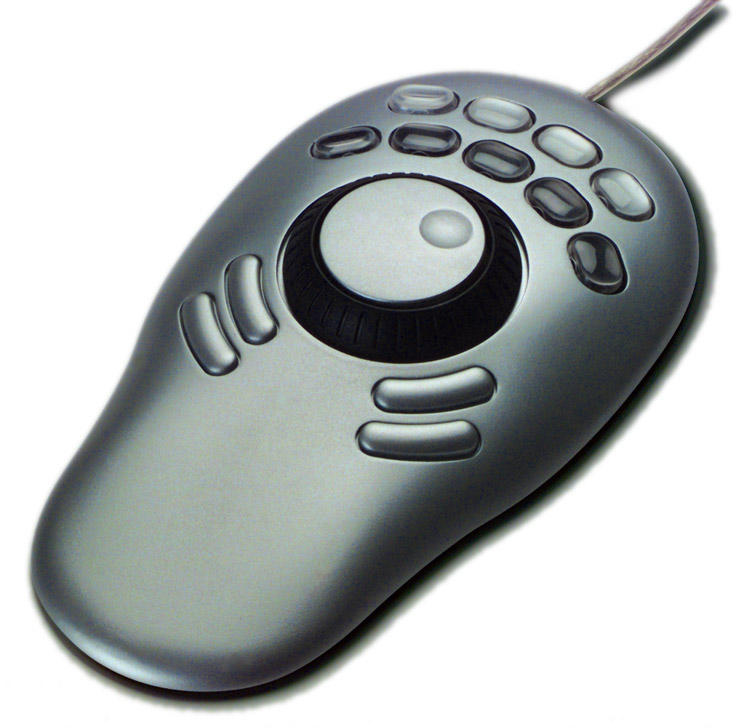
The jog-shuttle device chosen was the ShuttlePro2 from Contour Designs:

"Jog-shuttle wheel (mixed-control mode): The ShuttlePro jog-shuttle wheel is designed for video editing and allows one to view image sequences both in motion and frame-by-frame. The inner jog wheel rotates freely with detents every 36°, advancing the image one frame per detent in the corresponding direction (position map). The outer wheel can be rotated continuously 90° in either direction from a starting position. We mapped the displacement of the outer wheel (in terms of its rotation from 0°) to control the rate of continuous scrolling with seven linearly increasing increments from eight to 400 sections per second (velocity map). A spring provided a force feedback proportional to the displacement. Because the spring actively forces the wheel back to the zero position when no force is applied, it was not necessary to have a dead zone.....the ShuttlePro jog-shuttle wheel ranked highest in the subjective ratings and was among the set of fastest devices (the devices in that set were not significantly faster than one another). It is likely that the ease of accurate positioning with the inner wheel, which led to the lowest overshoot distances, was a key factor in the ease and satisfaction with this device. "

Well, after reading this, I just had to try it! The ShuttlePro2 retails for around $100, but I got mine for $60 from eBay, very gently used, but nearly in near-perfect condition anyway. Once out of the box, it rather resembles Darth Vader's cod-piece, but it turns out to be much more functional. (My friend Zach wants to know how I know this. His skepticism could be on target; there must be some reason Darth is always breathing so hard....) Anyway, you plug the ShuttlePro in to an unused USB port (becoming harder to find on my laptop these days), and load the software. If you happen to be using it for its intended purpose of video editing, there are a number of preloadedaded configurations for the inner and outer wheels and the fifteen other buttons.

I am in the beginning stages of setting it up to function with Amicas LightBeam. So far, it is working as advertised in the Radiology article. My only complaint/concern to this point is that I still have to move my hand back to the mouse (or trackpad on my laptop) for a lot of things. I have the buttons set up to change window and level settings, to change sequences, and to close the study. I have not yet tried the ShuttlePro with the embedded Voxar, but I suspect that is where it will shine.

I'll let you know how it goes.

Addendum: I haven't had as much luck with the 3D software, mainly because the embedded Voxar apparently lacks keyboard shortcuts to move from the coronal to the sagittal to the axial planes, and the ShuttlePro2 software depends on keyboard commands. I've got Amicas looking into this.

Wednesday, June 29, 2005

Overdose (of Imaging) in the ER

Dr. Joel Schwartz, writing in response to an article in Diagnostic Imaging about subspecialty ER radiology, touched upon a nerve. He writes, in part,


What Dr. Trefelner (in the original DI article) does not mention is the very low rate of positive studies for ER patients. (At our hospital, ER and private physicians order studies on patients in the emergency room.) A recent review of 1600 studies ordered from our emergency room between 5 p.m. and 8 a.m. over a 10-week period revealed pulmonary embolism in just 6.25% of pulmonary angiograms, acute findings in just 7.1% of cervical spine CTs, and acute findings in just 6.7% of pediatric emergency room head CTs. None of 27 patients who had combined chest, abdomen, and pelvis CT scans had acute surgical abnormalities. The conclusion is obvious: There is an extremely low percentage of acute findings on studies ordered from the ER. The problem is not on the interpretation side but on the ordering side....

It would be unacceptable for any radiologist in my group to recommend additional imaging that would be negative 90% of the time. Yet, after an initial ER evaluation, ER physicians are sending patients for radiological evaluation where 90% have no significant abnormality identified.

The reason for the high ordering of studies is most likely multifactorial. Dr. Trefelner talks about lack of subspecialization in radiology, when, in fact, a lack of expertise by ER physicians and nurse practitioners accounts for some of the overordering. The subject of liability always arises during discussions of utilization with our ER physicians. Staffing and limited time may also contribute to the ER's reliance on imaging. I do not think radiological interpretation plays a significant role.

Now, I have many friends among our ER staff, and I don't want to slam them in this manner. (They might well find ways to get revenge at 3 AM the next time I'm on call!) Still, I have run similar reviews on CTA's for pulmonary embolus and on head CT's at our main hospital, and lo and behold, we too have an approximately 5% rate of positives.

As Dr. Schwartz notes, there are numerous reasons for this overload of mostly negative studies, and he seems to place blame squarely at the feet of the ER docs. I think there is much more to it than that.

A bit of history is in order. In 1986, Congress enacted the Emergency Medical Treatment and Active Labor Act (EMTALA), which mandates hospitals (especially ER's) to treat anyone who needs care, whether or not the patient can pay. Depending on how you look at it, this could well be the most expensive unfunded mandate in United States history, essentially establishing a limited form of socialized medicine. Unlike Hilary's plan, or the Canadian or British systems, funding comes from the providers, the hospitals and the doctors, rather than the federal government. There are ways the hospitals are compensated by tax money, but the docs have to simply write off the care of those who cannot pay. The bottom line here is that anyone who walks, crawls, or otherwise arrives at the ER gets care. Period. Now, don't get me wrong, this is definately a good thing. In the bad old days, acutely-ill patients could be dumped to another (usually the county) hospital, and on occasion they didn't live long enough to get there. EMTALA was designed to eliminate this horrendous practice, and it has done so. In the process, however, we have created somewhat of a monster. My fellow blogger, Mad House Madman (an internist) puts it thus:

...unfortunately, many in our community have made the Emergency Department their primary care provider. They come to the emergency room to obtain care for non-emergent problems. This is unfortunate because the ER was not intended to provide this care and, often, they will simply stay out in the waiting room for hours on end to obtain a prescription, or seek medical advice about routine medical issues. More worrisome is the fact that many will end up receiving unnecessary tests to rule out emergent disease, as this is the primary goal of the emergency room physician. These tests carry risk, and increased cost. For example, last night a lady waited in the emergency room for treatment of acute diarrhea that she’s had from the morning. She was finally seen at ten at night. She was given Imodium, which stopped the diarrhea. However, someone noticed that her oxygen saturation was low, which led to a Doppler, and then a spiral CT scan. Nothing turned up. Forty hours and four hundred dollars later, she finally went home, free of her bowel difficulties.

There are two things working against common sense here. First, you have a patient who comes into the ER expecting to be fixed (as in made well, not the other definition). Second, you have the ER doc who wants to fix the patient. The patient comes in with certain expectations: "My (fill in the blank) hurts, the doctor needs to do something that looks at my (fill in the blank) so he can fix it. And by the way, since I've waited four hours to see the doctor, I would like this done NOW." One of my friends among the ER staff told me that he used to have patients with clearly non-acute abdominal pain return at 7AM for their obligatory gallbladder ultrasound. Many of the patients subsequently complained to the administration of the hospital that my friend "didn't feel their pain". He was forced to order emergent studies after that. I'll wager he never got a surgeon to remove those few hot gallbladders he might have found until well after 7AM the next day. Sadly, there are those patients who abuse the system, although they might not see it that way. Consider the patient whose X-ray jacket (or PACS study-list) contains 20 head CT's over the past 5 years, all of which are negative. He presents today with a "really, really bad headache, the worst I ever had, Doc!" I will guarantee that he will receive his 21st scan, and it will be negative. Again. (This is not an exaggeration, by the way.)

The ER docs feel they must "give" the patient something so they will leave happy; patients expect such treatment as a reward for their, uhhh, patience. Add that to the fear of litigation for missing something, and you have a recipe for the 95% negative scan rate.

How do we solve this? It is far from easy, but I think the first step is to recognize that the vast majority of these scans are negative. That is not to say that 95% of the scans were unnecessary, but obviously there must be a significant percentage of studies that simply didn't have to be done. Dr. Schwartz concluded in his letter:

I would like to see the ASER, ACER, or American College of Radiology develop imaging algorithms for emergency room patients. These could serve as acceptable guidelines and hence act as reasonable standard of care. These would protect the emergency physician from liability, protect patients from unnecessary imaging, and maximize resource utilization. I would also like to see guidelines for measuring the utilization of the more expensive and resource-hungry examinations. Guidelines that set targets for the number of studies with positive results could serve as goals for ER physicians.

Certainly a good place to start. Now, how do we keep the public from using the ER as their primary physicians, coming in with every little complaint? That is probably the harder question. Education will help, but in the end, Americans have come to believe that high-level health care for any and all problems at any time of the day or night is their God-given right. It's a nice idea, but sooner or later, we may run out of resources to make that happen. Then what?

Saturday, June 25, 2005

You Got KLAS, Kid!

When I buy a car, or a computer, or a digital camera, I want to tap into the experience of others who have purchased a particular model. Hence, I subscribe to Consumer Reports, and peruse Internet sites such as CNET.com. For PACS systems and other healthcare needs, the KLAS report from KLAS Enterprises at HealthComputing.com is perhaps the most publicized of the few available "consumer" reviews. KLAS surveys those who have purchased or are in the market for various medical systems, and compiles reports regularly. I have actually filled out a survey on some of the equipment I use, although physicians comprise only about 5% of their respondents. KLAS does make it very clear that:

'This report is a compilation of data gathered from interviews with healthcare provider executives and managers. Data gathered from these sources includes strong opinions reflecting the emotion of exceptional success and, at times, failure. The information is intended solely as a catalyst for a more meaningful and effective investigation on your organization's part and is not intended nor should it be used to replace your organization's due diligence."


Responding gives one access to their data, although

"...(t)his report, and its contents, are provided under copyright by KLAS Enterprises, LLC and are intended solely for your organization. Any other organization, consultant, investment company or vendor gaining unauthorized access to this report will be liable to compensate KLAS for the full retail price of this report...."

Therefore, I won't be cutting and pasting anything here from KLAS. In brief, KLAS asks several dozen questions, and compiles individual scores of "Primary" and "Detail" indicators, and also yearly Business indicator trends. These are then distilled into a final grade.

Vendors who have paid the full retail price of the report are allowed to publish snippets and they do so if it suits their needs. The latest Interim, Midyear, Early 21st Century results from the KLAS surveys are in, and Stentor iSite wins the coveted Number One spot. (This was e-mailed by Stentor to the zillions of folks on their lists. Amicas was number two, although they are touting more the areas in which they were number one rather than their overall standing.) For the past two or three years, Stentor, Amicas, and DR Systems have jockeyed for first, second, and third, leaving some of the "Big Iron" vendors far behind.

I looked at the data from the following vendors: Agfa, Amicas, DR Systems, Fuji, GE, ScImage, and Stentor. Finding a true trend is difficult, and discussing it here is certainly impaired by the fact that I'm too chicken to quote the actual numbers. Still, one thing seems clear: the web-based products are prevailing over everything else. The ease of deployment and cost-savings with this approach cannot be ignored. There is another interesting trend: those who have done well in the KLAS survey over the past few years (Amicas, DR, and Stentor) are showing a minor down-tick in their indicators beginning in mid-to-late 2004. Amicas and DR show reversal of this trend as of early 2005, but Stentor's Primary/Detail indicators continue to fall, with plateauing of their Business indicators. I'm going to hazard a guess that these three at the top of the list have had an explosion of business generated in part by the KLAS results themselves, and are having to scramble to support the new demand. AGFA and GE actually show up-ticks on average in the same time frame, perhaps due to having a well-established sales and service force. Fuji had a bump-up around late Summer 2004, but has been down ever since. ScImage didn't make the survey until Fall 2004, and has one up-tick in May; KLAS gives the caveat that ScI's numbers are statistically below their confidence level, and one or two responses could skew the curve.

The individual rating components give a little more insight into a PACS purchase, but really not so much as I would like. There are many questions about support and contract negotiations, and keeping of promises. As far a promise-keeping, the web-based products (including Fuji) seem to do far better job than "big iron". DR, ScImage and Stentor do the best with items such as complete and fair contracts. DR gets the best rating in on-time implementation. And so on and so on....

To me as the end-user, the most important question is only partially covered by the question of "product quality". Every product on my short list is average or above, with Stentor winning by a very, very small margin. This still doesn't address how the bloody things actually work in practice. There are a few comments here and there, generally on the order of "our docs love it", but no real review of the details themselves. Maybe that is for the best. Selection of a PACS, for me the GUI, is a personal thing. I would rather test out the program under working conditions than rely on someone else's opinion anyway. To that end, would the vendors consider easier availability of on-line demos? But you all have to promise not to peek at each other's wares....

Thursday, June 23, 2005

Chiropractic Anatomy

A billboard near my home touts the benefits of chiropractic therapy, with this very picture. I am not terribly impressed. The x-ray that was artfully superimposed upon the model's photograph is an IVP, a kidney study. Notice the bright areas to either side of midline: these represent dye within the renal collecting systems. Apparently, chiropracters think that kidneys are located somewhere near the armpits, well above the heart. Could that be why they stand at arm's length when they squeeze your upper back?

Wednesday, June 22, 2005

Dalai's PACS Blog's 1000th Visitor!

Congratulations to the 1000th visitor to this blog, who comes to us from HBOC/CareBridge. If I knew who you were, I would send you a prize...like an autographed photo of me! OK, ok, maybe something really valuable, like a free BE....

Many thanks as well to the folks from ScImage who are visiting up to twice a day and more. Hope I'm keeping you guys amused....

Sunday, June 19, 2005

Night Call

PACS: n. (acronym)
Picture Archiving and Communications System. A device or group of devices and associated network components designed to store and retrieve medical images.


This four-letter acronym has totally changed how we radiologists practice our trade. Gone are the days of huge sheets of film, developing trays and machines, and even file rooms. We are freed to work with the actual information of the radiograph or scan; no longer is this data irreversibly coupled to a sheet of plastic. I can view the image from my office 50 feet away from the scanner, from my home 5 miles away, or from literally anywhere in the world where internet access is available. Simply put, I can sit here and read from there, wherever here and there might be.

There are more consequences to this portability than the inventors of PACS might have envisioned. Early on, we heard a lot about "Swoop and Snatch" operations, wherein big, national operations might convince a hospital to turn over all imaging to their central office, shunning the local rads. We hear about this periodically today, but unlike the banking industry, Radiology has not yet consolidated into a few big national operations ala Wachovia and BankAmerica. There is at least one curious attempt at a franchise in PACS, Professional Radiology Solutions, having the underlying implication that the state-by-state owners are to scour their region for business. They require in their contract that a radiologist devote 10 hours per week in marketing, on top of a pretty hefty initial fee (hundreds of thousands of dollars). So far, we have received "courtesy" calls from the local state franchise rep informing us that they have contacted sites we cover, but of course they wouldn't think of trying to grab our business, they just want to provide PACS services. Uh huh.

PACS also changes the face of night work, more for better than for worse. Night call has become somewhat of a nightmare for most of us. A "good" night involves taking only 4 or 5 studies after midnight, but on an average night, we get at least 10-15 exams. One solution for this PM overload is to hire an in-house nighthawk; great if you can get one. Here in our "average city in the South" with nothing much interesting to do, we aren't going to find someone willing to do nothing but night-work. Just won't happen. Most groups now use some form of teleradiology, now incorporated into PACS, to allow the rad on call to read from home, certainly better than being stuck in the hospital, right?

If you can send the images to the guy (or gal) on call at home, you can send them anywhere the rad might happen to be, and of course, you can send to anyone else who has the proper equipment and authorization to receive them. So, it made sense to form companies that do nothing but take night call, affectionately called "nighthawks", a generic term which includes the largest such operation, Nighthawk Radiology Services. You pay them per night or per study, and they give preliminary reports (unless you make arrangements for them to do final interpretations.) These services usually place their rads on the West Coast, or in Hawaii, or in Australia, or in Europe or Israel; when it's night here, it's daytime there, and wouldn't you rather have your head CT read by someone who is fully awake at the time? I would. As an aside, some groups are establishing outposts in other time zones and hiring someone there or sending someone weekly to staff them. My group toyed with this idea but ultimately figured that by the third or fourth required rotation, most of my partners would balk at making the trip. Nothing like a 9-hour flight to dampen your enthusiasm about a trip to Hawaii.

Hiring a nighthawk service cannot be taken lightly. Their rads will be the face your group presents to your referrers at night. To me, it is very much like hiring a partner. You have to get someone with the right abilities and such; you don't just hire the first one that applies. There is a lot being said online about foreign nighthawk companies using untrained physicians (or nonphysicians, for that matter..cough cough Wipro cough cough) reading under sweatshop conditions. Obviously, your night-readers should have the same qualifications as your day-readers, i.e., US training, and certification, and medical licensure in your state. One could argue that some of these 'hawks become better at the usual ER studies, e.g., trauma radiology, having tremendous experience over time.

The decision to use or not to use a call-service becomes purely political, once you ensure the quality of the readers. We are about to take on a new site that has a nighthawk service in place. (The new place is an academic/county hospital, by the way.) Our plan is to phase out the call-service, and eventually have a rad in-house all night long, reading from the new place as well as all other sites in our own little "war-room". Why revert back to in-house call? It is a problem of perception. Some of my partners perceive that the surgeons and other "real doctors" will see us as "weenies" or "lazy" if we stick with the call-service. There has been some negative talk about the service, though it seems mainly to involve comments about radiologists who would "shirk their responsibilities" rather than the quality of the nighthawk service's reads. But I have a question: Why would it be OK to hire someone to do nothing but night call, but we are "weenies" if we hire a service, staffed by equally (or more) competant radiologists to do the same thing?

So far, we have had luck recruiting new members, but some recent threads on AuntMinnie.com lead me to think that the new crop of radiologists coming out of residency won't even look at a job that doesn't use nighthawks. I guess we'll find out....

Sunday, June 12, 2005

NorthWorst Airlines

I spent the entire day trying to get my daughter to Minnesota for her job as a camp counsellor. It should have been easy, but the disgruntled employees of Northwest Airlines made it a rather trying time.

The string of problems started with equipment malfunction. My kid was actually on the plane at 8AM, ready to go, when they announced a "mechanical failure" involvolving the navigation system, and cancelled the flight. (I have to wonder why they didn't discover this when the aircraft came in last night...really gives me great confidence in their maintenance people and procedures.) Like a house of cards, their entire flight schedule came tumbling down. Among several "solutions" the Continental Airlines staff cross-covering Northwest found was a transfer to Delta, routing my daughter to Minnesota via Orlando. It would have worked, except Delta couldn't find the transferred ticket. There was considerable finger-pointing on that one, and as yet I'm not sure if Delta wouldn't or couldn't find the data in the computer. I tend to think the latter. After a few more false starts, and notice from the camp that they couldn't pick her up at the late arrival time, I ended up driving the kid to another city to attempt to catch a flight that might have worked. I averaged about 85 MPH in this attempt, and actually made it to the other airport 20 minutes before flight time. I shoved the kid out the door with her rolling duffles, and parked the car with the valet service (a real life-saver). By the time I got to the ticketing desk, the kid was in tears. The agent, whose English was somewhat lacking, had assumed that my daughter had insulted her: the kid had asked to speak with someone who "might be more capable" to get her on the flight after saying, "PLEASE help me!" The woman, Elizabeth L., was not going to help her at all until I got there, and my daughter grovelled with apology for her "rude" behaviour. She finally made it to Minnesota about 9 PM, and has a 3 hour shuttle ride to camp sometime tomorrow. Friends of a cousin are sheltering her tonight.

I may be old fashioned, but I expect service from the service industry. Anybody hear of Nordstrom's? The customer is always right? We are the customers of the airlines. Sadly, the attitude has become, "it is a pleasure for you to be served by us". My daughter did NOT sass the agent; Ms. Elizabeth L.'s poor command of the language added weight to the chip on her shoulder, and she was quite ready to withold service to a 4'10" 17 year old who just wanted to get to her job as a junior-counsellor at a girls' camp.

I am currently holding 3 more tickets on NorthWorst. I will move Heaven and Earth to change airlines for these trips. Northwest's employees are not acting like they want my money, and I'm not giving them any more. I would strongly urge all of you to avoid this poor excuse for an airline as well, and tell your friends to do the same.

And now, back to PACs....

Dalai's Sprint PPC 6600

I recently replaced my old Treo 600 with an Audiovox PPC-6600. Love the sliding keyboard. Windows Mobile 2003 has a great deal more power than PalmOS, although the phone can be a little fickle at times. Still, I am pleased with it overall after a month of "testing".

Saturday, June 11, 2005

Thanks to HIStalk!

The author of HIStalk, a blog about hospital IT services, thought my blog worthy of mention, and I see many of you have come here to have a look. Welcome! I hope you find my babbling interesting, or at least amusing.

Greetings also to visitors from Amicas, GE, HBOC, Mitra, ScImage, Siemens, and various PACS and IT professionals from around the world! (And apologies to those surfing blogs with the "next blog" button that land here by accident!)

Thursday, June 09, 2005

No, I am NOT paid by Amicas....

Our Amicas install has become a favored destination for site visits. We had a group come through the other day, and I was more than happy to wax poetic in favor of Amicas and to, um, dissuade them from purchasing Evolved (see below..) In the middle of my anti-Evolved spiel, one of the top Amicas guys gently suggested that I get back on the Amicas track, lest the visitors think that I am paid by Amicas to say bad things about their competitors. Let me assure everyone that I am NOT paid to say (or not to say) anything. I do own stock in one company that makes a PACS system: GE! That doen't keep me quiet about them, now does it? I do have my price, but none of the PACS vendors can afford it...well, maybe GE can, but they haven't made any offers as yet.

In the spirit of fair and balanced reporting, here are some minor changes I would like to see Amicas make in the LightBeam product. Yes, some of this is borrowed from other systems I have seen, and some I made up all by myself. Likely many are already in the pipeline...

  1. Unify the function of the measurement tool so it works the same as its counterpart within the Voxar tools...both need to be click and then drag or drag and then click. My two neurons get confused very easily, you know. There should be a way to drag the label out from over something interesting, too.
  2. Add the ruler function to the right-click options.
  3. Lock the display window to maximum size within designated monitor(s). Right now, the viewer is within a regular Windows window, and can be (too) easily resized. Might as well use all that monitor real-estate we purchased.
  4. Add some additional markup tools.
  5. Use the mouse-over state to decide which window is active.
  6. Bring the comment window to the front, or create a button for one-click access instead of two-click access (radiologists are lazy if you didn't already know that!)
  7. Make a second great big "X" on the left side of the screen as well as the right so I don't have to move the cursor all the way to the other side (see comment on #6.)
  8. DO NOT CHANGE ANYTHING ELSE!!!!!!!

See, I don't think Amicas is perfect, just darn close.

Sunday, May 29, 2005

Sign-Off Icons We'd Like To See...


Posted by Hello

Some new sign-off icons...
"Sign and go to next exam", "Sign and quit", "Unsign and return exam to unread status"

Kinda cute, huh? I'm just a frustrated graphic artist, I guess...Posted by Hello

Friday, May 27, 2005

The Ideal GUI...It Doesn't Get In My Way

For me, the reading radiologist, the GUI, or the Graphic User Interface, IS the PACS system. I don't (usually, anyway) tap into the service areas or play with the RAID, or even shove a CR cassette into the reader. What I do, day in and day out, is sit at the workstation and interpret images. As a Nuclear Radiologist, and not an interventionalist, I spend about 80+% of my working time with the mouse in my right hand and the microphone in my left. If I'm not talking into the mike, I'm not making money for my group, right?

It is no secret that I do like the Amicas LightBeam system, and Agfa Impax 4.5 to a lesser extent, and I don't like GE Centricity or ScImage. I won't bore anyone with a feature-by-feature comparison, and I don't want to reveal anything proprietary anyway (although I would be bloody surprised if any major company out there doesn't know most of the details of the competition's products). So, what makes a good GUI? In my humble opinion, the key is to provide functionality without breaking my concentration on the image itself. In other words, the system needs to help me do my work without getting in my way.

There are a lot of little functions Amicas provides that really speed things along. Let me cite just one: the spine-labeling tool. I can label an entire MRI of the spine in less than 5 seconds. Amicas seems to have been one of the few companies to notice that three-dimensional localizing data is included in the DICOM header; they use this to propagate the label to all other planes after you have manually labeled the levels of one image of one projection. With Agfa, this simple procedure is painful and takes several minutes instead of seconds.

But I digress. To avoid getting anyone (more) upset with me, let's stick to generalities. The following description includes elements of systems I've worked with, demo'd, or read about, as well as some elements I've just made up all by myself. The guts beneath the system are left to those better versed in such things, but I think there is no turning back from the web-based or TCP/IP approach. It makes sense not to reinvent the wheel. The web was designed to move data back and forth seamlessly and safely. True, the old ARPANET could never have envisioned transmission of gigabit-size datasets, but today, this is routine.

The Dalai-PACS system has two main elements, the worklist and the viewer. Both have to be customizable to user sign-on. The worklist has to show important information, name, exam, priors, etc, have some alert mechanism for status, such as color-coding, and must of course let other users know if an exam is in use. Many vendors have something like this today, and Amicas has the best implementation in my humble opinion. The distribution of exams to individual sign-ons makes no sense today, even less-so distribution to designated workstations. That made sense back in 1997.

The viewer is what makes or breaks the thing. The Dalai-PACS viewer is intuitive, and as automated as possible without taking control away from the user. Automation basically is a step beyond most of today's implementations of hanging protocols, though some hanging protocols are getting pretty smart. I want my system to know what prior(s) I need pulled and how to display and link them to the viewer. Obviously, linkage of CT's must be done by table position. With today's technology, the user will still have to match the position manually. I have heard about an attempt to use surface mapping and contour matching to do this automatically. That would be most welcome. I should be able to link studies with a minimum of effort; select matching slices and click a button. I have this with Amicas today, with instant, one (maximum two) click synchronization even if I have 3 different windows of the same exam, or three different sequences for that matter. With Centricity, just linking a dual-window study with its prior takes about 10 clicks on a good day: you must go to a little drop-down menu, and select link or break link, and you have to have each and every window set at the proper level, or you're not going to get what you want.

The next question is the display of 3D. Do we launch a Voxar or TeraRecon window, or should it be incorporated as window within the regular viewer? I personally like to view an exam with simultaneous displays of soft-tissue, bone, and lung windows; in a 2x2 display, the fourth window could be a volume rendering or a coronal reconstruction. The major 3D programs from Voxar, GE AW, TeraRecon, Siemens InSpace/Leonardo etc., can all be set up to do this, with varying degrees of difficulty. (Note that I don't mention Vital Images...We own three Vitreas; one blew a hard disk drive, and Vital would not respond to TEN calls requesting service. They won't be considered for anything in my place again.) One of my former colleagues believes that dual 3D display is the way to go for each and every CT, with isovolumetric voxel acquisition. Personally, I tend to be a little hesitant about acquiring sub-mm sections and doing full-fledged 3D analysis on a 500-1000 slice dataset on every single abominable pain witch-hunt. To my knowledge, dual 3D display is available today from ScImage, GE AW, and Philips, and is said to be in development by Siemens. Honestly, I don't use it when I have to use ScI, since setting up a viewing session is a pain, and keeping the two exams synched is a bigger pain. My former colleague who believes in this approach I think does it more for speed, and probably syncs the axial images only with a thick MIP. To me, 3D is for problem-solving, and new and old studies can be satisfactorily compared for now with linking of the axial images. I'll likely change my mind when someone comes up with the automatic matching thing.

Every system has to have the requisite markup, windowing, series and image tools, and these just need to be logically arranged, not scattered like one of my son's LEGO constructions. The most often-used functions should be available with a right click; the user should be able to determine which those should be. However, I'm not sure I like the approach of having ALL functions user-customizable. Agfa 4.5 gives me literally 500 tweakable features, and these change with the modality; in the end, most would be better off with a bit narrower set of options. Likely 95% of users would want very similar deployments. There should be integration with the HIS/RIS and instant availability of prior reports and demographics, and in the age of the IHE, perhaps Pathology and other results as well.

It goes without saying that the thing has to work every single time, without losing studies repeatedly in transmission, or requiring the three-finger salute 20 times a day. If I click something as "Dictated", it had better stay clicked. The "skin" of the GUI should look professional, but not distracting. I really don't need the bridge of the Enterprise, unless someone can include a transporter in the whole package and beam me to the beach in time for my sunset margarita. The buttons and icons need to be similarly clean and clear, and not done with Microsoft Paint by a junior-high student. It is clear that some companies expend a great deal of their graphic arts dollars on their web-sites and AuntMinnie.com ads, and very little on the interface of their products.

There are about a thousand other factors to include, not counting all the tiny little details that are critical to making a system a success. Consider this a primitive first-pass at a very complex topic. I would welcome your comments.

Monday, May 23, 2005

Empiric RIS

I have been perusing a demo of the Empiric Systems Encompass RIS, and I just went over some of the details via WebX presentation. So far, this is an impressive product. Its interface is clean, simple, and intuitive, and it actually does much more than I need it to do. Still, it seems like a good solution for managing reports with our erstwhile virtual PACS system. More to come.

Saturday, May 21, 2005

Going Independent With PACS..Guru Needed

We have the very beginning stages of our own PACS system, an Amicas spoke server tied to the Amicas PACS database of one of our hospitals. While this seemed like a great idea at the time, we are thinking of going independent for several reasons:

  • The other, bigger hospital in town won't send images to our server for call purposes because an employee of the competing hospital might get cooties on their data. We absolutely HATE using Agfa Web1000 on call, and would love to have a unified AMICAS client for all call work instead.

  • The Amicas hospital has had numerous delays in upgrading the communications lines, including ours, due to a complete move of the entire IT and telecom departments to another location. In the meantime, referrers who would like to use our system have been put off, in one case for well over a year. Of course some of the delay was due to the Agfa hospital deciding that they didn't have space for us on their database afterall about a year ago.

I have always felt that it is better to be one's own master, and in charge of one's own destiny. We have hitched our wagon to the hospital's horse, and I don't have hold of the reins. Time to get our own horse.

The problem, of course, is money. To set up a full-blown proper PACS with SAN's and redundancy and tape backup for 7 years and a RIS to go with that (hold the fries) will cost in the neighborhood of $300,000 to $350,000. That does not include a place to put the rack of stuff, the power to run the stuff, and most importantly, the people to make it all work. This is going to get expensive, but if I'm going to do it, I'm going to do it right.

I still need a guru to make it all happen. I have had a few leads, but with the various delays and what not, I still haven't found just the right person. If you are a guru (or a Jedi master of PACS for that matter), and you might be interested in all this, let me know! Use the comment button below. Please!

Tuesday, May 17, 2005

ITL Strikes Back


I received this response from the imaging center owner:

I've shared your thoughts with the ITL group that we met with on May 4,2005. The enclosed attachment is their response to your concerns. Based on their response as well as the points I've listed below, I feel that I must go forward with the purchase of this product.
* I've signed a contract
* (Imaging Center) has the opportunity to save a significant amount of money vs. other PACS systems.
* The product is on a single platform which has benefits that none of the others have.
* Several of the Radiologists in (your) group that I've asked about time saved, said 20% to 40%. If you weigh that against 4 or 5 calls a day until they get used to it, your group comes out way ahead.

Now, the response from the president of ITL:

Dear (Imaging Center Owner):
It was great to see you Wednesday, and we appreciated the time and courtesies extended to us by the entire (Imaging Center) team in discussing implementation of Image Technology Laboratories WarpSpeed seamless RIS/PACS. We are eager to see (Imaging Center) realize improved business efficiencies and quality through the deployment of the WarpSpeed system.
We appreciated the time, albeit brief, that Dr. Dalai afforded us, and respect his radiology expertise. While we are disappointed and disagree with his conclusions, it underscores the traditional distinction between image management products and information system solutions. Given his experience with, and knowledge of, particular image management/storage systems this is not surprising. While we don’t question the sincerity of his intentions, it does not provide license for him to make incorrect pronouncements as fact when commenting on RS/PACS in general, and ITL in particular.
Many of Dr. Dalai’s opinions may have certain relevance in his environment. We do not mean to trivialize them, nor do we wish to engage in a technology debate of image management products and our seamless RIS/PACS solution. However, please allow me to comment on some of the incorrect conclusions expressed relative to ITL:
Within the simple context of an image management system, one might understand some of his assertions. For example, while some image management products omit the “... computer between each modality and the main server”, RIS requirements generally dictate use of a computer at or near each modality. In a seamless RIS/PACS environment, a computer strategically placed at this important “pressure point” improves quality by automatically ensuring data consistency and integrity. Historically, non-seamless RIS/PACS data inconsistencies are handled by a manual downstream QA “exception” resolution step. Billing quality is enhanced by allowing the person closest to the procedure, namely the technologist, to provide the CPT codes as the study is pushed into the workflow from this computer. The technologist can also specify study priority, hold / preliminary push status.
Dr. Dalai’s comment that “...I am assuming that the radiologists with whom they partnered had little PACS experience “when he raised the issue of CT slice thickness when looking at comparison scans is incorrect as well. One of ITL’s founders was the radiologist assigned to bring PACS to Albany Medical Center. Moreover, within an imaging center or community hospital, the majority of the comparison scans are intentionally performed using the same protocol, including slice thickness. Slight differences in patient position on the table between scans, as well as the natural variations associated with the human respiratory cycle, were important considerations to our team when that area of function was designed. It is a rather trivial matter to automatically adjust the linked comparison scrolling based upon the DICOM Frame of Reference and Image Plane Module information. While this is not an issue in most installations, we are incorporating that change as part of our commitment to (Imaging Center).
“...data distribution structure is reminiscent of Agfa and Siemens designs from five to eight years ago” Our internal enterprise-class architecture uses many technologies that didn’t even exist five to eight years ago, such as transactional asynchronous message queuing, high-performance distributed file systems and distributed objects to implement a unique hybrid push-pull data model that is impossible to convey and understand properly in a short 10-minute drawing session. We are confident that no other industry player has implemented such an architecture. It is precisely this workflow architecture that gives us our strength in delivering value to the entire medical imaging business.
“The majority of systems today are web-based, relying on the architecture of the Internet itself, rather than reinventing the wheel” The Internet is an implementation of a homogeny of RFC (Request for Comment) “standards”. We utilize as many of these RFCs as is necessary and appropriate and our system can and does run within a LAN environment as well as across the Internet via VPN.
We constantly reevaluate “web-based” technologies (whatever one chooses that phrase to mean), especially those associated with Linux and Windows, such as the .Net infrastructure. It is not our intention to enter into a debate with Dr. Dalai over the virtues of thick-client vs. thin-client or two-tier vs. three-tier architectures, since it is a very complex set of issues, especially with respect to security, viruses/spyware and performance. The medical imaging community is just now waking up to the inherent security issues and starting to produce white papers and articles necessary to more widely appreciate these problems. Dr. Dalai stated “Most systems today use the web approach for remote access, which has proven to be safe if implemented properly.” This isn’t about proper implementation techniques, rather it really is an issue of security exposures in the underlying web-enablement technologies. See http://www.microsoft.com/security/default.mspx. We will be happy to discuss our web-portal capabilities with you privately under an NDA.
“From a hardware standpoint, I would be very concerned about their proprietary assembly of the core of the system” There is a distinction between configuring the “off the shelf” server systems we procure and integrate with our software versus Dr. Dalai’s allegation that we assemble the system around Intel server motherboards. Dr. Dalai mis-understood what we were trying to convey. We do procure our servers from a major rack-mounted “off the shelf” supplier. Our choice of servers happens to use Intel SMP motherboards, reflecting our positive experience with Intel, along with other standard components that we specify. There are no custom ITL components in any of the computers we supply. ITL is a software developer and systems integrator, and we deliver turnkey medical imaging business solutions.
“...their product is for all intent and purpose in beta” The ITL WarpSpeed seamless RIS/PACS system is employed and has been in production since 2001. The study volumes at each of these locations equal, or in some cases significantly exceed, the current volume at (Imaging Center). The reliability track record of these systems and our software has been excellent. Our comments regarding the Company’s dedication to always looking for feedback and improvements were misinterpreted as a sign of weakness and immaturity of the system. However, our years of experience while at IBM has instilled in our engineering team the value of seeking feedback as a means of ensuring a constantly improving product that provides real value. Any feedback from Dr. Dalai in such a context would be appreciated, obviously subject to his time constraints, but is not required.
Dr. Dalai’s group has evidently struggled through some unfortunate history with specific image management vendors. I share his irritation with systems that require additional personnel and resources to manage daily operation. These challenges are increased significantly when stand-alone image management systems attempt to incorporate RIS and workflow enhancements as add-ons. Our seamless RIS/PACS WarpSpeed system and commitment to (Imaging Center) will ensure that you realize an improvement in the efficiency of your business without experiencing the same frustrations.
Finally, SEC regulations on selective disclosure preclude discussions on the Company’s financial position beyond our public filings. ITL became a publicly traded company in 2000 and the management of ITL remains optimistic about its future.
The ITL team is excited about starting the installation as soon as possible and establishing a long-term productive relationship with (Imaging Center).

Sincerely, President & CEO
Well. I guess I've been told, huh? I am rather disturbed by the whole thing, especially the total trust the owner of the imaging center places in this little company because they are willing to give it to him cheap. This comes after he promised he would not go through with the purchase if I honestly felt it was not a good idea. I guess money talks louder than most other factors. The CEO's response assumes either that I would never see his letter, or that my opinion has little bearing on the ultimate purchase. Seems to me it's probably not the best idea to refer to criticism as having a "license to make incorrect pronouncements". You know, the whole tone suggests a company at the edge. There are probably better ways to tell someone he is, in your opinion, filled with feces (even though I'm not at the moment). Perhaps that is the way business is done in the state of New York.
I'm not going to go through each point and re-refute it. I stand by what was said in the initial letter, and I am NOT convinced that any item was settled by the ITL response. I am most amused by the stonewalling behind SEC regulations as an excuse for not discussing the financial status of ITL.
ITL brought their entire engineering team down here. They took 20 minutes to get their demo running. Even then, they didn't bring a touch screen, which they describe as the key to navigating their client. Buying this product on this basis is like buying a car from a brochure without ever driving it, and that's being kind. Add to that equation that the car in the picture of the brochure has no steering wheel, but they promise your car will have one, and of course it will work perfectly.
This software, from my point of view, is just not there yet. It's cute; they made it look rather like the graphics from Star Trek, complete with appropriate sounds, and this is certainly endearing to me. But cute doesn't get the work done.
I am far from a PACS guru. What I know I have learned through a lot of research on the web, reading what I can about the various products out there, and various approaches. I missed SCAR last year, but I'll try to make it this year and learn some more from the real gurus. That being said, I do have some pertinent knowledge of PACS, and I know my partners. I conclude that this purchase is a very, very bad idea.

Monday, May 09, 2005

Paper Requisitions and PACS/RIS Reports

A site we cover (side by side with another group) is one of the most advanced clinics of its type in the nation, but still uses paper requisitions. These are being printed in duplicate, stapled together by the techs, and brought to the interpreting radiologist by the technologist performing the examination. The radiologist then has to rip the packet apart, sort the sheets from multiple exams if applicable, and slot one copy for the clinic and the other for us. This system adds a great deal of inefficiency for the technologists and to our radiologists. I would think we can do better than this. The techs are great (I knew most of them before they came to the clinic), and I really enjoy working with them. I would prefer, though, that we not have the continuous stream of people in and out of my office simply to deliver the paperwork. I need to use BOTH of my brain cells when reviewing the CT's, and the distractions just don’t help. I admit with some embarrassment that I find the traffic in and out of my office very distracting, especially while trying to read some of the rather complex cases we see at this site. To add to the situation, one of the techs thinks it’s cute to pirouette into the office and wave the requisition around like a fan.
The dual-paper system was originated by our own group’s business manager (who is no longer with us) in the belief that it was the "safest" way to ensure that we could account for all exams we interpret. I have a little more faith in the technology than he did. I am certain the PACS or the RIS system can provide a print-out of daily or weekly activity. They are not integrated per se, but are provided by the same vendor. The site administrators have been told that the system cannot generate a report of daily activity with a guarantee of accuracy.
Am I the only one out there who would rather NOT have somebody coming into my office every three minutes? Maybe it’s my ADHD coming through. But, is it too much to ask for a PACS and/or a RIS system to be able to generate a report of daily scans read by each group? Do I even need to name names?

Saturday, May 07, 2005

ITL

One of the sites we cover signed up for WarpSpeed from Image Technology Laboratories. After meeting with just about their entire cadre of execs and engineers, here are my thoughts (sent by letter to the owner of the site in question):

I would like to thank you for yesterday’s opportunity to visit with the Image Technology Laboratories team. The meeting was quite interesting, and their engineers are obviously quite knowledgeable. I would go so far as to say that were I independently wealthy, with a lot of extra time on my hands, I would buy the company myself and with the expertise available, create a super product.

I promised you an objective assessment of the WarpSpeed product, and I will do my best to provide this. In brief, the software that is most important to me, the radiologists’ reading client or viewer, is not ready for deployment. In all honesty, based on our discussions yesterday, I would place their product about two to three years behind industry standard. While they have many good (even superb) ideas, ITL has not yet assembled them into a system that I would be comfortable using in day to day practice. There are a number of factors that lead me to this conclusion, and I would be glad to discuss them with you at length if you really want to take the time to do so. Let me cite one example which really tells the story. You might recall my question about linkage of two CT studies, and whether they use image number or table position. They really seemed to have no idea about the difference between the two approaches. The use of table position linkage allows the comparison of scans performed at differing slice thicknesses, which is a fairly common situation. Linkage by table position has been industry standard for at least the past 2-3 years. I think this is really telling of the entire direction of ITL. They are an assembly of very sharp and high-level engineers, but I am assuming that the radiologists with whom they partnered had little PACS experience. The entire approach ITL is using with their product shows innovation, but also near-complete isolation from competing approaches. Their data distribution structure is reminiscent of Agfa and Siemens designs from five to eight years ago. The majority of systems today are web-based, relying on the architecture of the Internet itself, rather than reinventing the wheel. Their concept of a thick-client viewer is still used by some systems, although many today use web-based clients or viewers. Placement of a computer between each modality and the main server is an approach very rarely seen today. Finally, the method that was outlined for remote access is close to unworkable. It attempts to isolate the user’s computer to “prevent transmission of viruses” and does so with a great deal of effort. Most systems today use the web approach for remote access, which has proven to be safe if implemented properly, and requires no significant modification of the remote computer.


From a hardware standpoint, I would be very concerned about their proprietary assembly of the core of the system. The fact that they use “Intel motherboards” does not assuage this worry. The majority of vendors have gone to using “off the shelf” servers, storage, and the like, lowering the cost and allowing easier service. A proprietary collection of components (even if those components themselves are common) could present a service nightmare.


I do not claim to have the business expertise you possess, but a quick review of ITL at
http://finance.yahoo.com/q?s=IMTL.OB&d=t raises several further concerns. According to SEC filings, they had a significant net loss last year in spite of increased revenue. The contract with you is very prominently mentioned, and it is rather obvious that there have been no other recent sales. This is a company operating at the very edge. Their future existence is really in question. They will depend on sales to sites with no PACS expertise, and those are becoming fewer and further in between as the technology continues to grow.


What concerns me the most with this company is that their product is for all intent and purpose in beta. It is NOT ready for a group with our level of PACS experience. To get them there will require an amount of testing, time, and patience that we simply do not have. Your operation is very busy, and your scanners churn out a rather significant number of images. We cannot just stop reading those studies to call up the folks in Kinsgston and work out
problems. We do not have the time (or in the case of most of my partners, the expertise) to develop this product. We have been down this road before with ScImage. When my former partner first brought it to us, it was buggy, it crashed constantly, and it was very painful to actually use. This was a company that should have gone out of business. My partner was enamoured with their 3D module, and was willing to ignore the poor programming of the entire remainder of the system. Rumor has it that he invested a substantial amount of his own money to keep ScImage afloat, and they are still around today with a more stable (though still poorly interfaced in my opinion) product. You may have seen our new computer in the reading room which we use for the orthopedic studies. This utilizes the StorComm MedView client, which is again very tedious and completely unintuitive. I am fielding about 4-5 calls per day from our radiologists struggling with this less-than-optimal software.

With the above in mind, I must urge you in the strongest possible terms to reverse your purchase of the ITL system. There are other alternatives which I would be more than happy to help you pursue. Please contact me at your earliest convenience so we can discuss this situation further.

Wednesday, April 13, 2005

Uncooperative Vendor??

chuckg writes on AuntMinnie.com:

Hello:
We are installing a PACS system in our smaller rural hospital. We do around 30K exams per year. Our HIS company has been very difficult to work with. They also offer a PACS solution we chose not to go with. Now they will not allow our PACS server to be accessed from their web based EMR program. The field appears to designed to be linked to the server. The answer we get from the HIS vendor is "We will not assist in the success of a competitors PACS product." Has any one heard of this attitude from a HIS provider?
Thanks.


Dalai Lama replies:


The words "uncooperative" and "vendor" should not have to be used in the same sentence. It certainly sound like they are being petulant about losing the sale. I have a philosophy about that: there will be other sales in the future, and your behaviour as the vendor NOT chosen is far more telling than that of the winner of the bidding. I would get in touch immediately with the president of the HIS company and let him know how his staff is behaving. If you get no satisfaction there, I would do whatever it takes to replace the system if there is any financial possibility of doing so.

We tend to forget that WE are the customers in this business.


Saturday, April 09, 2005

Back to PACS....

I'm noticing that the Google ads above are governed by the uppermost postings, so they have turned to links for Peter Island and such. So, here is an attempt to reset the list:

PACS, Agfa, RIS, HIS, Amicas, Fuji, GE, Centricity, Radiology, CT, PET, Nuclear Medicine, Siemens, etc.

......These are a few of my favorite things......mixed in with a few of my UNfavorite things.....

(Feel free to click any and all ads...monies generated all go to my favorite charity, the Old Radiologist's Retirement Fund, me being said Old Radiologist!)

By the way, I have just discovered a new remote access program, "logmein", which can be found at: http://www.logmein.com. Think "Log Me In" rather than some weird Mandarin dish. The basic version (which allows full remote control, but does not include file transfer) is FREE! It is as functional, and is said to be more secure, than GoToMyPC, which is $15-20 per month. Yes, Windows XP does have remote access built in, but it cannot handle network access across a router as most of us have at home to split up our broadband access. Logmein has no problem with this. Give it a try!

Wednesday, April 06, 2005

Doc Sam's Virtual Colonoscopy Prep


Posted by Hello
I used to grow hot peppers in my back yard, habaneros, jalepeno's, seranos, and whatever else the garden shop had for sale. A few years ago, I put some up pickled in vinegar in small glass canisters, and labeled them appropriately. Still have a few if anyone needs some dynamite....

Saturday, April 02, 2005

Peter Island


Deadman's Bay, Peter Island, BVI
Posted by Hello

My wife and I, as well as my 16 y/o daughter and my 10 y/o son just spent 5 days at Peter Island. It was a great experience, but there were a few glitches. Still, we will likely return someday.

First, the high points. The resort is the only inhabitant of an 1800 acre island. Most of the island is accessible only by boat and the beaches at that end are rocky. The main portion of the resort is nestled between the marina and Deadman's Bay, the latter containing a spectacular white sand beach. We stayed in regular hotel rooms, which are housed in two-story A-frames fronting on the marina, and opening onto the pool area in the back. We requested an upgrade to a junior suite, which sits at the edge of Deadman's Bay, but these were filled. The rooms are spartan compared, say, to the cookie-cutter luxury of a Ritz Carlton, but at the high end of typical Caribbean accomidations. Our rooms were immaculate, even the bathrooms, which we have usually not found in this part of the world. Beds were comfortable, though nothing spectacular (i.e., not one of the miracle beds the larger luxury chains are advertising these days.) Linens were clean and comfortable. The room was stocked with sandals, a flashlight, and a CD of island music which could be played in the CD/clock radio. There was no TV. For those that cannot escape completely from the outside world, the room telephone has a dataport for Internet access, though it was quite expensive at $2 for connection and $.75 per minute. (There was a spare office that was hastily converted into an Internet room; it had a huge desk with two computers hooked to the resort's T1 line, but only one worked. There was no charge for this.)

There were two restaurants, Tradewinds, which was near the pool and our rooms, and Deadman's Bay Beach Bar and Grill right on the beach. We ate breakfast and dinner each day at the Tradewinds, and had lunch most days at Deadmans. Breakfast included a wonderful Caribbean buffet with an omlette station, and there was ala carte available as well. Lunch at Deadmans usually had a buffet as well with various salads and entrees. Dinner at Tradewinds was always excellent, with the best food we have had in the Caribbean. Service was mostly superb, especially after our waitress, Maxine, took us under her wing. Under the American plan, all food is included, but alcohol is not, nor are the obligatory beach-side smoothies or even Cokes. The rooms are initially stocked with 6 sodas, two bottles of water, and two beers; they are supposed to be restocked during one's stay, but ours never were. Bottled water sometimes was free, and sometimes was not, but after a day we drank tap water, and there were no ill effects from doing so.

There is no nightlife at all, and that was fine. There was usually live music at dinner however. While the resort "discourages" children, at least half the guests had children with them, and this did not detract in the least from the ambience. We spent our days swimming, snorkeling, resting, eating, and hiking. A good time if that's what you expect to be doing. There are several miles of hiking trails, with one trail leading to a wonderful sunset view, and another to White Bay beach, a spectacular but secluded stretch of white sand and blue water. Snorkeling off the beaches was disappointing, but there were some interesting features here and there, with the best snorkeling actually off of Deadman's rather than White Bay as we had been told. We also chartered a deep-sea fishing boat for our last day there ($800/4hrs), and I caught a 65 pound mahi mahi!

And now, the "glitches".... Service was generally very good, but there was something lacking giving the rather high price of the resort and the exclusive reputation. The resort can hold a maximum of 100 guests, but I never got the feeling that any of the staff (beyond Maxine, that is) even knew our names. There was just no personal touch. I compare this to the Concierge-level service at a Ritz Carlton (which comes out similarly priced), where we were immediately made to feel totally at home. We had phoned the resort prior to arriving to warn them about my daughter's shellfish allergy, and we were assured that all restaurants would be alerted. This didn't happen and we had to remind everyone at virtually every meal to help us with food precautions for her. At one point, a different waitress at Tradewinds (not Maxine!) didn't seem to even comprehend what I was requesting, and I had to ask to speak to the chef (who was very understanding as well as a fantastic chef!) This exemplifies some of the problem...many members of the staff do not speak English as well as some of the others. I am usually good with accents and gently making myself understood (I try not to be a stereotypical American tourist!), but there were times I just couldn't get through. Some of the other glitches (and they were minor) relate to this, I think. We had ordered drinks to be delivered to us at the sunset lookout point, but the message did not get through. We had lunch packed for the deep-sea fishing expedition, but while there were four full set-ups with pasta salad and fruit, there was no cutlery, and two of four sandwiches never made it to the lunch bag.

Peter Island is a haven for yachters, and they were all over the place, some with children that were, ummmm, less well-behaved than the resort guests. They would crowd the bar at lunchtime. This was, however, a minor irritation.

Perhaps the most disappointing, or maybe just annoying, problem involved the attitude of the entire resort about the Spa. It is a beautiful building, but the services are very pricey, and you can't go in if you don't purchase a massage or some such thing. I was not going to spend $130 or so for my 10 year old to get a massage. The VERY WORST part of all this is that the spa has taken over Big Reef Bay, one of the most picturesque beaches on Peter Island, and those of us not using the spa are not allowed. Frankly, this might violate the laws of the British Virgin Islands, which declare all beaches public. Spa personel were minimally apologetic when tellling us we could not walk on the beach, and frankly the attitude left us with a rather bitter taste overall. I would urge the management (Sandra and Tom) in the strongest possible terms to reverse this policy. I don't know who they are trying to appeal to with this resort within a resort mentality, but it is generally not a good idea to shove aside part of your clientelle to appeal to a smaller subsegment.

So, the Peter Island experience is a good one, though with a few glitches. Some are just part of a Caribbean vacation. I prefered Peter Island to Caneel Bay, although my wife feels the opposite. It is definately more upscale than Bitter End, and has overall better service. We will probably try some other resorts, such as Little Dix, but I do expect to return to Peter Island someday.