
Tuesday, September 13, 2005

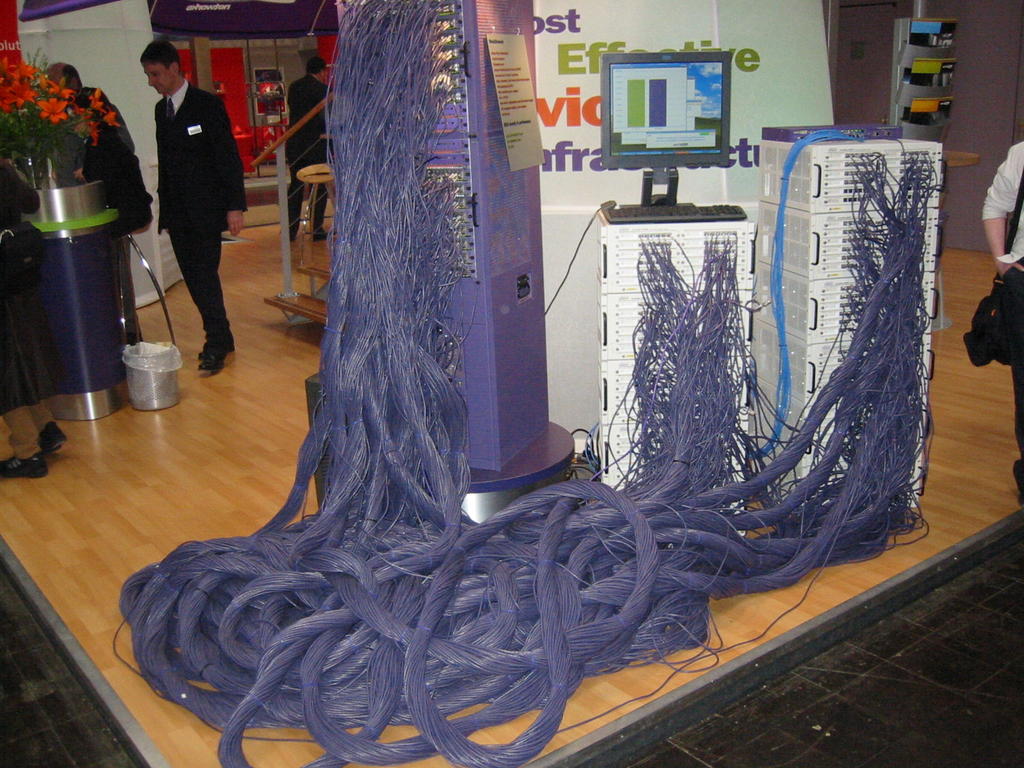
And You Thought They Were PACS Companies!

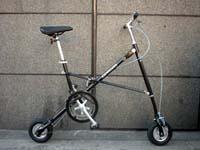
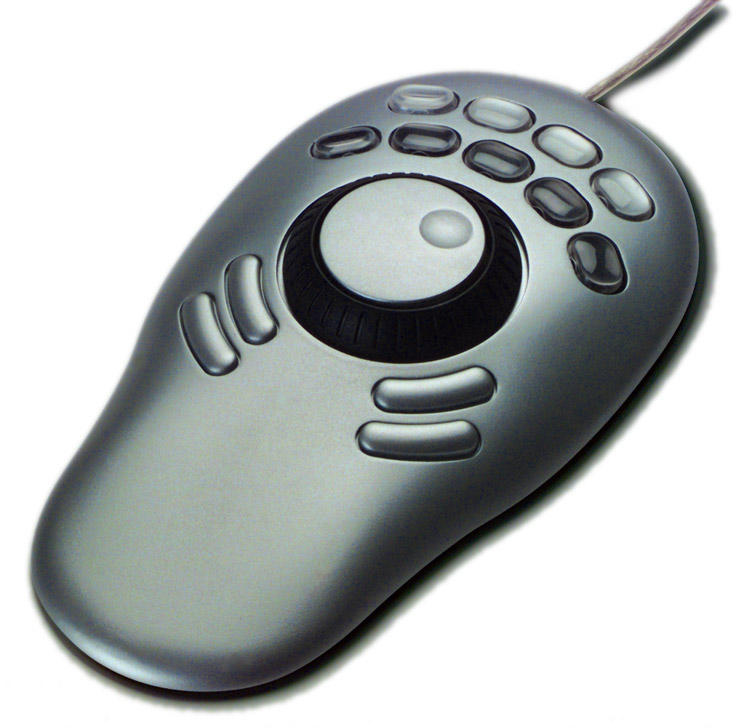
These are all unretouched photos harvested from the Internet.....

AGFA


Amicas


DR Dominator (both vehicles are called "Dominator")


Fuji


General Electric


McKesson



Philips
Sectra

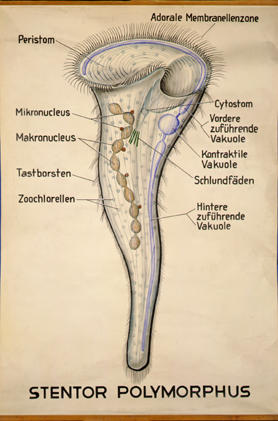
Stentor


Addendum...Marc from Mitra, I mean Agfa, says he's seen one of these driving about:


Anonymous sent this one:

Thursday, September 08, 2005

3000 Visitors...and some Firefox Woes

Congratulations to visitor number 3000, who comes to us from Karolinska University Hospital in Stockholm, Sweden. Tack själv för besöka min blog!

Anonymous, from Copenhagen, Denmark, via TDC Bredbaand, notes that with Firefox, the venerable blog looks like "rubbish". Now we can't have that, can we? I must confess to using Internet Explorer 6.0, mainly out of sloth, since our good friends at Microsoft do try to update it almost as fast as the hackers crack it, and their updates come automatically. To check out my Danish friend's complaint, I did download and install Firefox. I'm working with it right now, as a matter of fact. The only glitch I am seeing involves the sidebar, where the Google Group and Search windows are overlapping the adjacent text. If no one minds, I'll simply delete those two items, and all should be well. Anonymous is using UNIX, but hopefully that won't make any difference. Tak for lån , Anonym , nemlig lade mig kende herom!

Wednesday, September 07, 2005

Chocolate-Covered Rants

A couple of things just got my goat, so I feel compelled to share them.

First, I received my very first "blog spam". This is where spammers use the comment field of a blog to advertise their garbage. I left a telephone message on the number listed for the owner of the advertised site, nicely requesting that she cease and desist from this behaviour. If it happens again, I'll consider publishing her number...well, that wouldn't be nice, but I'll think of something effective. In the meantime, I have turned on the "word verification" function, so anyone interested in leaving a comment must type in the word they see in a distorted picture before the post will be accepted. I apologise in advance, but I'm sick of spam!

Second, I have just signed in to ScImage PicomOnline for the 20th time today. Guys, the HIPAA regulation refers to a period of INACTIVITY! You are not checking to see how long your program has been idle! Please, please, PLEASE fix this! I know you can do it!

Rant over. Thank you very much.

Tool Time Part II:
Magnifying Your Problems,
Zooming Around,
And Panning for Gold


Does anyone actually use the Magnifying Glass tool? You know, the one that lets you hover a magnified window over your image? Some of these are pretty complex, as seen with Centricity and Impax, giving the user the ability to adjust the size of the "glass" and the degree of magnification. Those controls would be pretty cool on a physical magnifying glass. However, I usually just use the zoom and pan functions.

You wouldn't think there is much new with zooming and panning; you just, well, zoom and pan, right? Well, that's about all Centricity and Picom let you do with these functions. Agfa and Amicas have a little different take on this classic. Instead of just zooming from the center of the image, both zoom from the location of the cursor. This takes some getting used to, but it sure makes more sense than zooming, selecting another tool, and then panning. Agfa takes this one step further in Impax 4.5: The zoom/pan tool is effectively combined. You pan with the left mouse button, and zoom with the mouse wheel. This actually works very well. The Amicas tool simply zooms. You can pan with this tool in a round-about way by zooming out, selecting another point on the image, and zooming in again. There is an alternative pan-only tool available.

I would give Agfa the win on this tool as it stands. I do have a major disagreement, however, with the way Impax deploys many of its controls. You have to select the tool either from the top tool bar or the right click menu by left-clicking it. It then stays on until you right-click, which "drops" it. As noted, the wheel does the zooming. So far, so good. Sadly, this approach is not consistent throughout their entire tool pallette, and that drives me insane (well, more insane). With the window/level tool, you left-click, and then you must left-click again to toggle the tool into active mode, then left-click yet again to toggle it off. But you don't have to do so with every tool. This toggle-on/toggle-off stuff gets old. Therefore, the ideal zoom/pan tool in my book combines the best of Amicas and Agfa: Select the tool from the toolbar, left-click and drag pans, mouse-wheel zooms with the cursor as the origin. Easy. I would like to have this tool replace the pan-only and zoom-only tools Amicas now uses, and it should of course go on the "short-right-click" rotation that brings up the most commonly used tools without a trip to the toolbar.

Tune in next time when we shred rulers and other measurement devices on "This Old PACS", I mean Tool-Time!

Monday, August 29, 2005

Jog-Shuttles vs. Joysticks, and Other Weird Ideas...


From the cyberworld back to the hardware world for a moment...

I have yet to get the Contour Jog-Shuttle Wheel (remember Darth Vader's codpiece?) to work the way I would like with my PACS. Fortunately, it does work with my video editing software, so it isn't a total loss.

I've been thinking about the problem of navigating a 3D dataset, which can be a dangerous and expensive thing (me thinking, that is). How is this done in real life? First, we have to find an analogous situation. Airplane pilots have to navigate their aircraft through three dimensions, though, in general, they had better be going forward, and they have to deal with gravity. Helicoptors don't have to go forward, but the collective, the up-and-down control, adds complexity to this discussion. So, how about video games where one pilots a spaceship around, well, space, without regard to gravity? Most use some form of joystick navigation, though this might manifest as a limited D-pad on an X-Box or Game-Cube controller. The joystick was the one device Sherbondy did not test for his article.

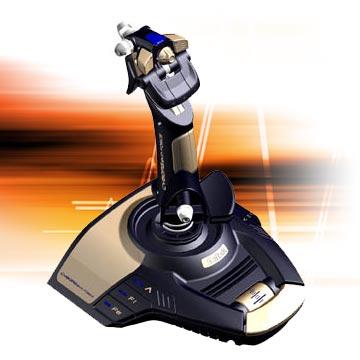
An overwhelming number of joystick options are available. Take a look at the Saitek "Cyborg evo Force" pictured above. This joystick has lots of buttons as well as mini-joysticks mounted on it, and some of the buttons themselves even have switches. Our younger generation is being prepared for something, although I'm not sure we're going to like it when it arrives. But I digress.

Seems to me that this is the way to pilot through the inner space of the body, and would be especially valuable with virtual colonoscopies. I haven't, of course, worked out the logistics of this approach as yet, but one could use the main stick for navigating the slice you are in, be it axial, coronal, or sagittal, and one of the little mini-joysticks for diving up and down or in and out of the plane you are in at the moment.


My son has an old Sidewinder joystick, and since he has lost his computer priviledges for a week (forgot his homework or some other onerous offense), I'm going to confiscate the stick for my experiments. We'll see how it goes.

Sunday, August 28, 2005

Tool Time!
Part I: Spine labeling

With apologies to Home Improvement...

I am starting a new series of blog-installments discussing various tools within PACS viewers. I'll try to describe the versions of the tool I use, with my (biased) evaluations and suggestions for improvement. At least this gives me material for the forseable future!

Let's start with the spine labeling tool. By the way, here is my stylized icon which I will be glad to sell to any interested PACS company for a really reasonable price:

Hands-down, my favorite incarnation of this tool comes from Amicas. This is the way it should be, simple, intuitive, quick, and effective. You click the button on the menu bar, and then point at the middle of S1 and click. Then you point to the middle of L5 and click...and so on until the spine is labeled. The magic of this is that 3D information within the DICOM header is utilized to deploy labels in the axial plane:
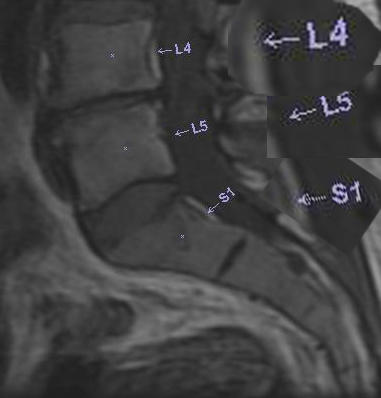
This whole process literally takes 5 seconds.

A drop-down menu gives several options with further control available from the labeling dialogue:
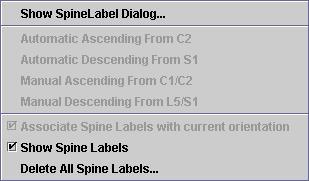
Now this is really neat: "Preferences" lets you set up a degree of automation. If the spine study is properly named(cervical, thoracic or lumbar), the labeling tool automatically starts at the level you choose. (This is actually an unusually deep level of adjustment access for Amicas tools, by the way, and the initial set-up will probably be adequate for the vast majority of users.)
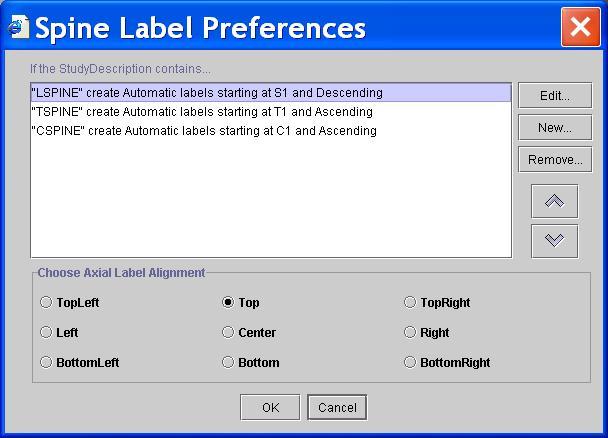
The other systems we use either don't have this tool at all, or have a such a poorly-designed version that using it would take 10 minutes; therefore, we don't.

I don't have any significant improvements to suggest for this tool; Amicas did it right. I would perhaps like to have the ability to change the font, or at least the size, of the labels. It would also be nice if they would propagate to the coronal projections as well if these are available. Finally, it would be really nice (but really difficult to accomplish) to have the labels appear within the embedded Voxar 3D window. I can dream, can't I?

Tune in next time, when Heidi and Al get caught up in the magnification tool!

PACS Porn!!!!


Photo of nekkid PACS components! What were you expecting?

Thursday, August 25, 2005

"Geek Squad" and The Dalai Manifesto On Expert Witnesses

Voice of Reason writes on AM.com:

Sorry to get on a tirade but I just got handed a bill from the Geek Squad serviceman for a service call on my Gateway that I have had for 2 years now. I just had a service call last week where a piece was replaced that was worn out and my contract states that I get 1 service a year for free. Well the hard drive failed as they sometimes do, and I needed it repaired.Here comes the fun part, for a 50 gig hard drive I was charged $667.18. Yes that is correct over 600.00 for a hard drive I could get for less than 100.00. I was charged at a rate of $240.00 per hour to install it which took 3 hours and $325.00 for them to drive to my office which is less than 25 miles from there office here. I was told that all of these are the standard rates.
Well I asked the rep if I charged him 667.18 for a contrast injection would he be upset, he said of course he would, but he has no control over the pricing. As far as I'm concerned this is all horse shit, I'm sick of being charged $95.00/ hour for IT support while they sit at one of my computers and wait 30 minutes for a download to finish or for a program to scan my hard drive. Plus they charge me 1/2 the hourly rate for travel to my office.We (physicians) have been taking in the shorts for way too long and I for one am pissed off ( sorry about the language). I want to organize just like every other business in the free world. I would like to see them put all of us in jail for collusion. I have said it before but it is time to strike!!!!!!!!!!!!!Close the doors for 2-3 days don't answer the phone, all of us go see our families take them fishing or go play golf, round on your hospital patients if you have them, but otherwise stop, Only by a massive shut down will anyone, inscos and gummit, see that we aren't going to take this crap any longer.My prices just went up 50% and no more free work of any kind unless it is something I want to do, not what some patient or inscos think I have or should do!!!!!!!!!Sorry but I'm pissed!


Among other posters, Dalai responds:

Shoulda got a Dell with a 4 year service policy. Or learn to open the can of your computer and swap the drive yourself. 5 minute hardware procedure, 1 hour or so to reload the drive.
On the more serious medical front, I think in the end docs are their own worst enemies. How 'bout them expert witnesses? Without them, the lawyers are SOL. But Google the term "
medical expert witness" (I've made it easy by linking it for you), and you get 40,000+ sites that will connect you with a doc that will say the sun didn't come up this morning if you pay him/her enough. My personal solution is to make it ILLEGAL to pay for such expert testimony beyond travel expenses and such. Some of these plaintiff whores make $5,000-$20,000 per case that goes to trial, so they have every motivation to drag your sorry backside into court, even if there is no case. This must stop. The tort-reform bills going through various state legislatures, and even Congress, are not dealing with this issue as strongly as they should.
For us imagers, the clinicians with their own scanners are presenting an interesting problem. They are generating more imaging business, and the more upstanding of them contract real rads to read their stuff, but their out-of-control self-referral is bringing down the house on ALL of us. This baby doesn't want to go out with the bathwater. Then you have the ERs that order everything but a corpora-cavernosagram in the middle of the night (at least I haven't had to do one yet), and want the answer yesterday, overtaxing the system at that end.
$700 for an hour of work to replace a hard-drive? Maybe I'll join the Geek Squad....

I've been wanting to post something like this for a while, but just never got around to it. I've been sued twice, both for rediculous reasons. Don't get me wrong: I make mistakes, as do all rads and even all doctors, and all human beings in general. However, the tort system in this country, especially with the contingency basis upon which many of these cases are pursued does nothing to correct mistakes, it simply pads lawyers' pockets. In my first case, I and two of my colleagues were accused of missing a lesion on a mammogram that wasn't there. The "expert" was a general radiologist that had been sued 7 times before himself. His deposition would have been funny if it wasn't directed at ME. That case was dropped. The second case, which is awaiting summary judgement, accuses me and another rad of not seeing a chest tube on a radiograph that wasn't there. I kid you not. It is one of those classic "shotgun" suits where every doc that had the bad fortune to get his or her name on the chart was sued, with no regard for level of involvement with the patient. Once I get summary judgement, I will seriously consider seeking sanctions for the litigating attorney. I think he was expecting all NINE of us docs to settle just to make him go away. He is in for a bit of a nasty surprise.

I am very serious about my solution to the "expert witness" problem. Look at it this way: if you can pay for testimony, then it can be bought. If I am called to testify, I refuse payment, and I require a subpoena. Therefore, I am there as a free-agent, not paid by anyone, and I can speak the truth. Period. Now, the standard answer an "expert" gives when asked on the stand how much he is being paid is something like, "(muffled thousand dollars) for the time I put into this case, but I am here to give my expert opinion and payment doesn't change what I'm going to say." Sorry, I don't buy it.

Many professional societies are starting to sanction their members that grossly perjure themselves on the stand. That's a start. However, the ONLY way, in my humble, simplistic opinion, to completely stop the abuse of (and by) the legal system is to decouple the testimony from payment. That is what I practice personally. I have had lawyers look at me like I have three heads when I tell them this, which maybe is indicative of how it impacts them.

I refer to this declaration of independence of testimony from reimbursement as the "Dalai Manifesto". Outrageous? Yes, but I haven't heard a better idea yet.

Saturday, August 20, 2005

RSS Feeds and Fellow Bloggers

There has been a request for RSS feed for my humble blog by Anonymous (I wouldn't admit interest either). I haven't dabbled much in such things, but Blogger publishes the RSS feed as http://doctordalai.blogspot.com/atom.xml. I plugged this into SharpReader, and it appears to work properly.

Docderwood has joined the league of Bloggers with his new blog NuclearVision. Check it out...it is very nicely done. Like me, Doc is a Nuclear Radiologist, double boarded in Radiology and Nucs. His blog is a lot more erudite than mine!

Stentor? Who's That?


Take a look at the former Stentor website....It is now called the "Philips Global PACS Business Unit", and barely refers to Stentor by name at all. The introductory paragraph says it all:

Introducing Philips iSite PACS
Philips iSite® PACS is the leading enterprise-wide medical image and information management system on the market today. iSite® PACS is an innovative image and information management system that delivers on-demand diagnostic-quality images over existing hospital networks, advanced radiology reading stations for radiologists, and "always online" long-term storage.

Sure sounds like Stentor to me. Now don't get me wrong, I have the utmost respect for both companies, but the rapid transition feels a little like Orwellian doublethink. Oh well. Good luck to all Philips users, both the Sectrans and the Stentorians.

Wednesday, August 17, 2005

Hello, Freeman Health System!

I noticed a great deal of traffic today from the Freeman Health System of Joplin, Missouri. They seemed to be particularly interested in my ScImage posts. Freeman bought ScImage for Cardiology and Radiology PACS in 2003. Maybe their experience has been better than mine, and perhaps they got a good laugh out of my ranting. I hope so, anyway, for their sake.

ADDENDUM...I just couldn't resist posting FHS's response....

FHSPACSADMIN said...
We enjoyed your rants about ScImage! Our favorite was "Dear ScImage." Don't know how many times i have had to walk our radiologists over the phone at night how to re-inistall picom client. One them asked in a huff one night...."now why do i have to keep doing this?!?" I do not know sir.We enjoy your site and will most certainly be keeping up with it!Take Care!
Tuesday, August 16, 2005

Tholian Web-Based PACS


Inside joke for Star Trek fans....

This blog is finally starting to stimulate the kind of banter I had in mind. The discussion of web-based PACS has generated even more commentary. You can read the full versions by clicking on the "Comments" link below the last post. Here are some pertinent exerpts:

Anonymous writes:

Once you are in the application (after it is launched), the web is really out of the equation. You are running an application that is installed on your local machine. Most (all I would hope) applications have some capability to auto download new clients as they are available. So, to make a long story short, web or not, if an application can be downloaded and installed/configured from a web browser and if that same application will communicate on standard web ports, then to me everything else is the same."

Peter then comments:

I would much rather see a well designed, small fat client install which uses the internet to communicate to a backend database than...a “thin” web app.....An easily available web site with a small, intuitive install would be so much more preferable to a web app. Limiting the customizations possible by the end-user saves a lot of support time in the long run."

Uhhhh...can a client be small and fat? Sorry, don't set me up with a straight line! I think we all may be talking about the same thing, but with different buzz words. Let's take a look at the way a generic "web-based" system functions, and see where we might have some common ground on this part of the wider issue....

Those I've tried all seem to work a good deal like both Anonymous and Peter suggest. You go to a web-site with your browser which acts as a gateway. Once you have logged in, the actual viewing client is examined and updated if needed, then launched. This client is generally a Java applet or Active X control or the like. A third component acts as a conduit for the image transmission through the web (usually on https port 443), and a worklist of some sort is displayed within the brower, either with HTML or maybe Java. If you have Voxar 3D, that is a completely separate program that either taps your PACS database or intertwines somehow with locally-cached images.

Now, what do we mean by "thin" and "thick" clients? Here is one of the better definitions I found whilst Googling, from
"Solving the ‘thin client’—‘thick client’ dilemma" by Robert Barnett in "A Forms Perspective":


‘Thin Client’
A simple program or hardware device that relies on having most or all of its functionality supplied by a network server. It is similar to a dumb terminal in that it gets all of its information from the network. For example, a simple HTML form filled out in a web browser is considered to be processed by a ‘thin client’ since much of the form's functionality is supplied by the server.


‘Thick Client’ (or ‘Fat Client’)
A program that is stored locally on the user's computer rather than the server. For example, word processing software used to write letters and other documents generally resides on the user's computer rather than the server. Even when the software resides on the server it is actually on space allocated to the user and is, in reality, just an extension of the user's computer. The term can also be hardware related, referring to fast stand alone PC's that have large amounts of memory and high volume hard drives that run programs locally rather than off the server.

I think we will find that essentially all systems use mainly thick clients for viewing. You are not just tunneling into the server and watching the images being manipulated there, but rather you are pulling the images to your client, and playing with them on your very own computer. I can think of two instances in which I have used a thin client, based on the above definition: First, when I was in junior high sometime in the last century, we had the great priviledge of using a mainframe via acoustic-coupled modem over POTS (Plain Old Telephone Service) with a teletype at 110 baud. Much more recently, I have tried out a TeraRecon Aquarius via internet. I loaded a thin client on my laptop, and all the image manipulation was done on the Aquarius, wherever it was. The images were, of course, spectacular, but the process was completely bogged down by bandwidth. Therein lies the problem with thin-clients...while it might be feasible to do all the crunching on a central computer, you still have to get the results out to the viewers in the boonies. Not a big problem in-house, especially with gigabit ethernet, but even DSL or cable speeds may not be up to the task. I'm going to go out on a limb on this one, and come down hard in favor of the thick(er) clients. I just bought a number of Dell Precision 670 computers from the Dell Outlet Site for my group. For $4000 each, we get dual Xeon 3.6 GHz processors with 1 MB cache, 4 GB of RAM, 200 or so GB hard drives, and a 256 MB dual-DVI nVidia graphics card. That's more computer power than all of NASA had at the time of the moon shots (and probably more than the Shuttles themselves have today). These machines can do a great job with 3D processing and cine-style viewing of 8 or 16 windows simultaneously. In the end, they represent a cheaper approach. Bandwidth to accomplish all this would be prohibitive, at least to deliver it outside the main hospital, anyway. So, to me, the thick client approach wins. A thick-client viewer is not bound to a web-browser, but the two can play nicely. Think of Adobe Reader, a client used to read .pdf files. It is downloaded (though the user has to initiate this) from the web, and its various incarnations can work as a plug-in within the browser, or as an independent app. Most importantly (and depending on its timing, sometimes annoyingly), Adobe will give you the opportunity to upgrade to the latest and greatest when such is available. Likewise with PACS viewers: usually they are downloaded with the initial connection, and the opportunity to upgrade is usually given upon subsequent sign-ons.

As far as communications are concerned, many transmission problems have been solved by the internet long ago. The 'net is designed to transmit information from one point to another in packets with self-healing redundancy. If one route is cut, another is found. From the computer's-eye view, the transmission of data via the 'net is not particularly different than through the local intranet; the same TCP/IP protocol is utilized by both. For those who have suffered through dial-up and even ISDN connections, home broadband is nearly a miracle for telerad/remote PACS applications.

I think most of us agree that a web-based system should operate from one main database. There should be direct access to this archive, whether from within the enterprise or without. Here seems to be the main differentiator between classic and web-based systems: The old architecture requires an additional "box" with a partially-mirrored database for outside consumption. I have posted elsewhere that a web-based system should have each slice or image addressed by its URL, thus adhering to the internet's conventions.

The sum of all this drivel is that a web-based PACS system mimics any other web product; it uses the web's protocols and tools rather than reinventing the wheel. The example of Adobe Reader actually is quite pertinent...instead of reading .pdf files, we look at DICOM images with a web-based PACS. Now here is a little riddle for you: If I have a conventional PACS, say, like Agfa IMPAX 4.5, and I put new software on its web appendage, in this case the Web1000, such that this former appendage is now a true web server, tapping the main IMPAX database, what do I have? Answer: IMPAX 6.0. Riddle 2: Is this new system now web-based? Answer: Probably......

Monday, August 15, 2005

Question: What are the Advantages of Web-Based PACS??

In response to the last post about web-based systems, Anonymous says:

"I still do not understand how all of the advantages that Brad describes are gained via a Web based PACS. Whether the PACS is web or not, a system can still be brokerless, flexible, inexpensive, easy to deploy, easy to upgrade, etc. A web based PACS still requires somewhat complex servers and configurations, etc. The advantage for me, and the only one, of a web based system is the ability to 'launch' the application from the web. This opens up opportunities that are endless. Now granted, that is a huge advantage, but I just dont think that people are conveying the advantages of web based PACS very well, and espescially not in this tidbit by Brad. I would love to see data on whether web based PACS perform better, are more reliable, are more secure, etc. And for those requests, I would love to see real examples, and not any high level, marketing focused, buzz word based responses."

I can't answer this question as well as, say, Brad Levin might, but I'll try. As you probably know by now, I have Agfa Impax 4.5 at one hospital, and Amicas LightBeam at another. The former is arguably at the pinnacle of development of a non-web-based system, the latter is typical of the modern breed of web-based architecture. What are the differences to me, the end-user?

If you discount differences in the clients themselves (and I could wax poetic about that for hours and hours), there is no obvious difference in the two approaches (again, from my point of view) whilst working within the hospital. I open the studies and read them. Rocket science here, right? I should add, however, that the Amicas system checks the software on my station upon each sign-on, and allows the installation of any available upgrade (that is already on the server) before the reading session begins. Could this be done with Impax? I suppose it could, but it isn't at the moment.

The real difference to me is how the system works when I am outside the hospital. Deployment of a client is much easier with a web-based system, and there is no discrepancy in the software I use at home, in the hospital, or in Timbuktu (or in the North Woods of Wisconsin if I should happen to be there.) Again, could this be accomplished with Impax? Maybe, but Agfa chooses instead to add another box, the Web1000, as an entirely separate server and client. The later versions of Web1000 look a little more like Impax, but they remain two very separate programs. At 3AM, it is a lot easier to use what you have been using all day than adjust to something different, trust me. Moreover, being able to sit at any computer in the world with broadband Internet access (well, any Windows computer anyway) and be up and running with minimal effort is truly mind-boggling when you think about it.

I'm not well-enough versed in the underlying architecture (or I haven't had enough Versed) to discuss the relative merits of each approach. My rather simplistic view is this: The 'net was designed for rapid, error-proof, interruption-resistant transmission of data. That's what we need for PACS, yes? So why reinvent the wheel?

I think we would all love to hear from experts on both sides of this issue.

Saturday, August 13, 2005

Web-Based PACS

A recent AuntMinnie.com thread rehashes the proper definition of a web-based PACS. This comes up periodically, and in July, 2003, Brad Levin from Amicas posted this lengthy but highly precise description:


First a bit of a disclaimer -- As my screen name explicitly describes, I'm Brad Levin and I'm the Director of Strategic Marketing for AMICAS. Prior to AMICAS, I was a PACS Subject Matter Expert for both Cap Gemini Ernst & Young and prior to that, Xtria Healthcare. I've experienced PACS for 10 years+, as the industry has made generational changes from the earliest military days of MDIS which was highly proprietary PACS (resulting in the Unix guts of most of today's traditional PACS), to the first DIN-PACS which spurred industry to go the route of rudimentary integrated RIS/PACS and heavily brokered systems, and most recently to Web-based PACS.


I'll try to provide you a snapshot of this market segment as it exists today -- it's a long response, but I hope this provides some clarity for you:
What is Web-based PACS? While there is no Webster's definition, Web-based PACS is PACS with the guts of a Web server under the hood. In other words, Web-based PACS delivers images and reports via a URL-based mechanism (e.g., what you typed in your browser to get to AuntMinnie.com). Some Web-based PACS vendors have URLs literally in their graphical user interface (GUI), while others use this mechanism, but choose not to have the URL accessible explicitly in the GUI.
Why Web-based PACS? Traditional approaches to PACS are tried and true - there's no argument there, as every vendor can ultimately move around images and reports. But to continue the automobile metaphor, these methods require significant "elbow grease" to be successful. This level of effort has both frustrated PACS customers and vendors alike. Why? Because these approaches lead to PACS with brokers, multiple databases, multiple operating systems, restrictive Radiology-centric workflow, expensive workstations/clinical viewers, multiple levels of archive, proprietary hardware (purchased through PACS vendors), a separate/non-scaleable Web-server and multiple user interfaces for different PACS viewing applications: telerad, distribution, clinical viewing and diagnostic workstations. The paradigm shift of PACS is challenging enough on its own (e.g., change management, training, system rollout) let alone to be hampered by the technical complexity of these disparate systems that must be implemented, maintained, and synchronized. It's complex because it's inherent in the model.

What has been the result of these valiant efforts for PACS? Vendors have had no choice but to pass through (with profits) the complex development, support and integration costs onto the PACS consumer marketplace. By virtue of real-world experience alone, the majority of industry consultants are most familiar with this complex model of PACS and it is continually demonstrated in their RFPs. RFPs have marginally changed from the early days of PACS despite the significant differences in approaches to PACS. So, rather than make generational changes in architecture, many traditional vendors have continued to deliver "complex" PACS via this model, charging several million dollars per PACS, plus several hundred thousands dollars per year for support. That is why so many traditional PACS buyers have a hard time cost justifying PACS, because ROI (using "hard" numbers) is difficult to achieve in a model that does not have the tools to eliminate the production of film. And if you can't eliminate the film, you'll chase, but never get to ROI. That doesn't mean that PACS can't be justified with this model, because consultants and PACS customers have learned how to be creative using this approach with so called "soft and hard" savings. Just go to any conference or read the mags and you'll learn how. Early adopters have worked the system in this fashion simply because the technology and inherent high costs have led them in this not so pleasant direction.


So why Web-based PACS now? Simply speaking, the market dynamics changed and PACS customers are more demanding - on their terms. While literally one or two vendors have been in Web-based PACS for years, the PACS marketplace has clearly taken a decisive turn in the past 3 years. Today, there are probably a half dozen or more vendors offering Web-based PACS, and a similar handful of RIS vendors offer Web-based solutions as well.


As I said earlier, PACS early adopters (e.g., academics > 400 beds) are in upgrade mode now, but have had great difficulty accepting the costly terms of upgrading their traditional PACS. They are questioning "why spend millions on a model that was created in the early/mid 90s"?. I don't think anyone would purchase a 286/386 PC today. The same rationale exists for PACS, except when you purchase/upgrade your system, you are tied to your purchase for at least 5 years+. Combined with this is the reality that the broader marketplace (e.g., <400>


So, the only way for traditional PACS vendors to address this market opportunity is to come up with a model that meets the "demand" with a "solution" that can be delivered with scale (to provide wide image/report access and thus, allow film printing to nearly cease); reduce architectural complexity to "simplistic" models that can be deployed fast, supported over the Web with minimal resources, upgraded over the Web, etc.; provide integration platforms to electronic medical record (EMR) systems through Web server calls; leverage PACS for the enterprise and not just for Radiology; integrate through brokerless interface engines; and perhaps most important of all, to be able to be sold for less to meet the market demand head on.

And what is the outcome of the above? PACS powered by the Web allows adopters to move to PACS faster, with far greater simplicity, and thus, far more affordably than has historically been the case for PACS. It's a confusing time in the marketplace for sure -- but make no mistake -- the rules for PACS have been and are continuing to be rewritten, allowing ROI to be a reality, not the fallacy from the past. There are many flavors to Web-based PACS out there. Some use proprietary means, others focus on standards. Some offer more restrictive solutions than others for enterprise workflow, integration, off the shelf hardware, etc.


In closing, the main message of my response is that for those who have been in the industry a long time the momentum is fairly obvious -- the Web is clearly the direction of the emerging PACS vendors and most of the traditional vendors are either on board with the Web, have released partial Web-based products, or you can almost certainly be sure the Web will play a part in their future releases. If they don't move, they and their customers will be left behind. And as in the past, one day the market dynamics will have its way with the Web --- it is almost inevitable. But when that day will come is anyone's guess. The wave of the Web is in it's infancy and will likely ride for many years to come. Just remember that the PACS penetration rate outside of the academics is in single digits today, and this is the target market for all of the traditional vendors. Some can play in this space today, others can't.


The real final message is that astute and novice PACS buyers have no choice but to filter out PACS for their own best fit model. The change from the past is that the business of Radiology for the <300~400>


Thanks for listening and I hope this was helpful.
blevin@amicas.com


It was very helpful Brad. Based on what we've seen over the past 2 years, I think he hit pretty close to the mark.

This information has formed the basis of my own definition of web-based PACS, i.e., that it is a web-server at its core, utilizing web technology overall, and not simply adding a server as an appendage to a more traditional architecture.

Note that the top KLAS-mates over the past few years have all been web-based products, Amicas, DR, Stentor. I said in an AM post after SCAR 2003 that most major vendors either had or will have web-based architecture based on the above definition. This seems to be coming true, slowly but surely.

Friday, August 05, 2005

Fahrenheit 731

Anonymous said on July 31 (7/31, get it?):

You must be a huge Michael Moore fan. You seem to employ a similar style.

Jim @ ScImage


Well, now, what can I say about this? First off, I had to realize that ScImage is headquarted in California, so comparing me with Michael Moore might well be a complement. I must admit I am not a fan of Mr. Moore, although there might be some physical resemblence:

Personally, I think I'm better looking, but that's just my humble opinion.
The comment obviously indicates that my little stories about ScImage are not appreciated 'round the fireplace in Los Altos. I guess the obvious implication is that I have twisted the facts to make the story sound better. I will confess to throwing in just a pinch of sarcasm, but the facts of the situation are as stated.
It seems the relationships between customers and vendors have been irrevocably changed by the internet. In the ideal world, one would expect a vendor with a nasty, dissatisfied customer to find out what's wrong and address the issues. Posting cute little comments is non-productive at best.
Oh well, ScImage can take heart: Bush won in spite of Michael Moore's best efforts.

Saturday, July 30, 2005

Dalai's PACS Group

At the bottom of the left column you will find a link to my newest web-feature, Dalai's PACS Group! Sign up and feel free to discuss any (preferably PACS) issue that comes to mind.

Thursday, July 21, 2005

A Note From Sectra

Dr. John Goble, President of Sectra North America, posted this on AuntMinnie.com:


Sectra has been in the US for nearly ten years, and we have a superb service and support team. In addition to Philips Medical Systems, we provide Level II support for our other partners, selected dealers and comprehensive support for our direct sales.


Our PACS products for the Orthopedics and Mammography markets are extremely well received by the US market. While Philips' acquisition of Stentor will undeniably impact our revenue in the short term, we intend to aggressively bid for service on our products and continue to protect the investment of customers who have purchased Sectra PACS... whether under the Philips label or directly from us.


Sectra will continue to innovate and bring industry leading products to market in the US. If you have questions about support for your system, extensions to your Sectra PACS or have a new opportunity, we'd be happy to talk with you.


John Goble, Ph.D., President, Sectra North America, Inc. Call us at 800.307.4425.

Sounds pretty promising for Sectra customers. We'll see how it works.

Wednesday, July 20, 2005

Farewell, Scotty

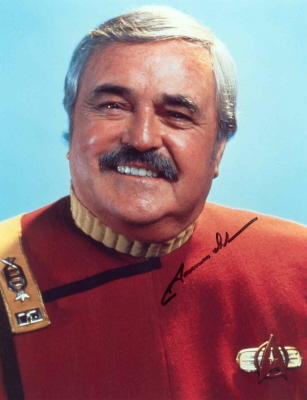
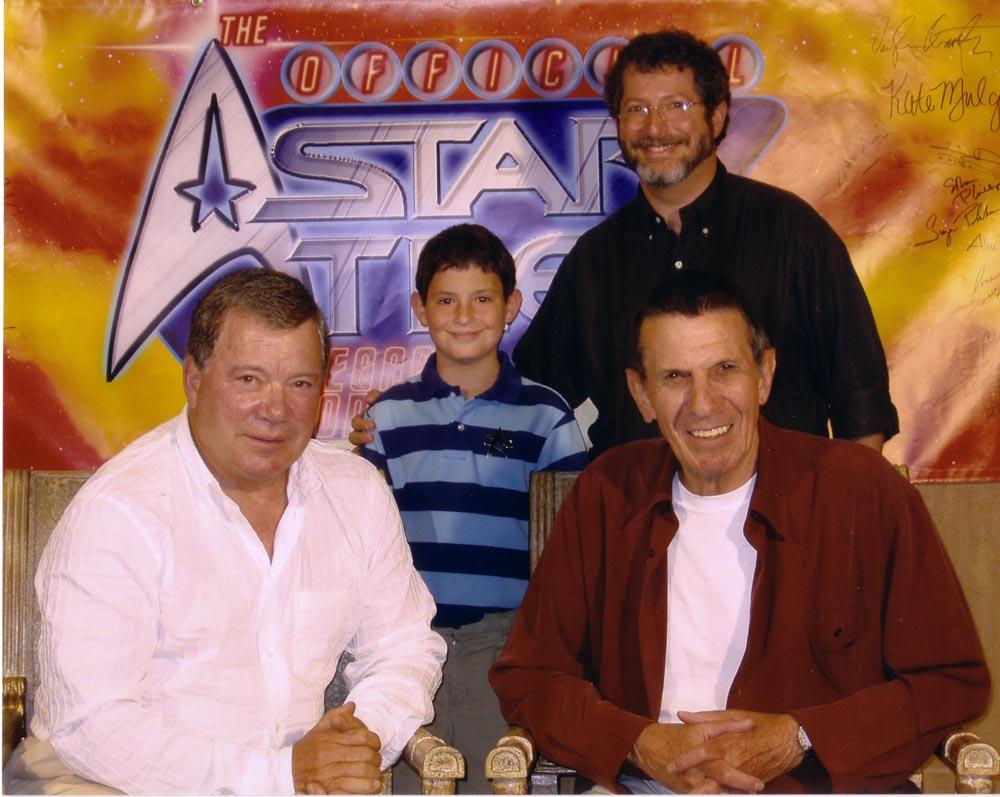
Today, we Star Trek fans say goodbye to James Doohan, who will be forever known as Scotty, the Chief Engineer of the Starship Enterprise. He died of complications from pneumonia and Alzheimer's disease at age 85. His ashes will be rocketed into orbit later this year. (That's not a joke, by the way; he will join Star Trek creator Gene Roddenberry, whose ashes were intered into space several years ago.) I guess we tend to forget that the characters of Star Trek are getting on up there in years. DeForest Kelly, who played Dr. McCoy, died in 1999 at age 79. Even Kirk (William Shatner) and Spock (Leonard Nimoy) are in their early seventies now. I had the chance to spend 10 seconds in their presence last summer at the Star Trek convention (yes, I admit I went), while posing with my son for this photo. I call it three old Jewish guys and a kid.
Many say Jimmy Doohan was the most beloved of all the Star Trek actors. I think we can rest assured that he was beamed up and not down to his Final Frontier.

One Brief and Shining Moment....


My apologies to the late Richard Harris....

I am really amazed at the traffic generated by the AuntMinnie.com article. Comments have been generally positive, usually something like, "I didn't know PACS could be funny!" I seem to have the attention of a significant number of those in the PACS community, and I would like to put that to good use while it lasts.

It seems clear that there is a disconnect between the designers and (Radiologist) users of PACS interfaces. I'm not sure why this is the case, as it seems logical to consult your end users before creating a huge software product. I don't want to indict any one particular company, but some do a better job than others of giving us the clear interface and powerful tools we need to slog through the day's work.

For the moment, lots of users, and not a few vendors are dropping by to see what foolish thing I have posted this time. Now I'm sure you all realize that is is possible for you to post comments here, and I really, really, REALLY encourage you to do so. It's simple; just click the word "COMMENTS" at the end of each posting. Perhaps this blog might be considered a "safer" place to post complaints or suggestions for the vendors, and for them to post answers. This happens on the AuntMinnie.com boards to some extent, but I think some are hesitant to post there. So, come here and let it all hang out. Don't hold back, say what you really think. I certainly haven't even begun to describe everything that would go into a perfect system, but if I can get input from as many of you as possible, maybe we can get closer to that ideal product.

Now, if you will excuse me, the boys want me to get back to the Roundtable, I mean my PACS station, and generate some revenue.

Monday, July 18, 2005

Northwest, One Last Time

Ms. Michelle Mohr
Northwest Airlines Complaint Department
Dear Ms. Mohr:

Unfortunately, Northwest was unable to live up to the earlier performance on our trip home. In brief, we were delayed leaving Minneapolis/St. Paul on our flight yesterday due to "weather over Detroit", and we idled on the tarmac for almost an hour before taking off, burning a significant amount of expensive jet fuel. After a very late arrival at DTW, we did manage to make our connecting flight home, but all five of our bags did not. We had to sprint to the departing gate, B19, from A70, the longest possible distance at DTW, but made it with a few moments to spare. The fate agents were courteous, and even apologetic but told us we could not take even a minute to walk across the hall and buy a snack, since the gate was about to close. They asked US if WE knew of anyone else trying to make the flight. As it turns out, there were indeed two stragglers who boarded about 10 minutes after we did, and I would be surprised if your computer did not report that these people had arrived at DTW and were en route to the flight. (One of them had a leg injury and was walking with the aid of crutches.) It was very clear that having the aircraft push back from the gate on time was much more important than letting my family grab a quick snack to take onboard (we had not eaten for 8 hours, anticipating an adequate amount of time to do so at DTW, and this flight didn't even have your now-famous $1.00 trail mix available.) This was the last flight of the day to our destination, and the aircraft had nowhere else to go that evening. Your schedule was likely already in shreds due to the "weather problem"; one more minor delay would not have mattered. As it was, the flight arrived home 10 minutes ahead of schedule. To complete the series of unfortunate events, all five of our checked bags did not make the transfer, forcing us to go through the claims process. The only person available at 12:30 AM was George S., one of the baggage handlers, who clearly was trying very hard to do a good job, but just as obviously had never been trained to use the computer system to file a missing baggage claim. Another baggage-handler finally was able to come to his aid, as did Venus R., whom I believe was a Continental agent. Hopefully, our luggage will be delivered sometime today.

Ms. Mohr, I am sad to report this experience, as I had much greater expectations after my last flight with Northwest. It seems that your people can shine if everything in the system is functioning perfectly, but a glitch, such as bad weather or mechanical failure sends everything into a tail-spin. Staffing has obviously been cut to the bone, and the goal of the airline seems to be to meet the on-time deadline of door-closure and pull-back at the expense of the comfort of the passengers. This will be my last flight on Northwest for the foreseeable future.

Thanks for your time. I know there are many good people working for Northwest; it is unfortunate that they are not allowed to perform to their potential.


Addendum: I do have to add praise where praise is due. Rick, the baggage manager for Northwest in my hometown, personally delivered our 5 bags when the local service couldn't get around to it. I wish Northwest would allow the rest of their employees to go the extra mile as Rick did for us.

Wednesday, July 13, 2005

PACS preferences: How to push a radiologist's buttons

I've finally made the big-time! This was published on AuntMinnie.com today! For radiology, PACS has been nothing short of a complete and total revolution; PACS now quite literally defines how I perform my job. As a nuclear radiologist, I spend at least 85% to 90% of my day with the microphone in my left hand and the mouse in my right hand. If I'm not talking into the former whilst manipulating the latter, I'm not generating revenue for my group.

My goal in life is to do my work and go home; my PACS system should facilitate this and not get in my way. So what are the elements of a usable, unobtrusive PACS according to this humble rad?

Let's start with some general observations on PACS GUIs and their functions. First and foremost, every part of the darn thing has to work every single time, and that includes all those little buttons that you might use once a year.

The vendors will quote you "uptime" rates of 99.999%, but for some distributed systems, if just one workstation is up, well, that counts as uptime. Given that great uptime, please spare me hourly (or more) lockups and reboots. Been there, done that: we used an early form of a small PACS network that would fail literally on every other study. One of my partners (who still likes the product) determined that pressing thus-and-so button, and right-clicking just there, while holding your left hand in the air and howling at the moon would keep the program from crashing. That may be, but most of us just don't have time for a crash-o-matic solution. The system needs to be bulletproof, and the least-technical member of your group should not be able to bring it down, even if he presses all the keys at the same time (I've seen it happen).

The interface must be clear, without distractions. The whole point of the process is to see the images, right? So why do some programs devote tremendous amounts of screen real estate to everything but the image? If I want the old report, or the demographic page, or the Nasdaq stock ticker, let me bring it up somewhere else, not where it invades the current image.
Some PACS systems out there seem to imitate the bridge of the Starship Enterprise up to and including the "gleeps" and "whirrs" from the controls. As a closet Trekker (we prefer that term to Trekkie, by the way), I love that idea, but not while I'm trying to work, please! Cute, but not what I really need.
Graphics on the various buttons can be a little underdone, too; that same crash-o-matic system I mentioned uses some very primitive low-resolution unintuitive icons on its various buttons, and at least one of those symbols seems to have been lifted from another famous non-PACS, but still copyrighted, source.

Make the interface clear and readable, with obvious designations. The same goes for menus. Some of the most sophisticated programs out there suffer from "right-click-orrhea" in which a right-click brings up a huge list of stuff. Now I don't mind if the right-clicker results in a well-organized and helpful submenu, but there are those who pile everything including the kitchen sink into this otherwise hidden area. No thanks. Some systems make that right-click deluge (and about 1,000 additional settings) customizable, and all that for each modality, no less. Most of us would give up and use the default settings that came with the program. Keep it clean, clear, and simple. That's all I ask.

Oh, and by the way, how about having all the buttons work in a consistent manner? It is a real pain if, say, the magnifier works by left-click activation, then actual manipulation with the mouse wheel, while the window/level control is toggled on and off with a left-click and manipulated with moving the mouse immediately thereafter without clicking anything else, etc., etc. See what I mean?

These expensive toys come with a vast number of tools and gadgets, all intended to help us interpret our examinations. Do they really accomplish this goal? Well, let's see. In no particular order, here are some of my favorites (or not as the case may be):

RIS/PACS integration: The new Holy Grail. I don't think this is quite there yet. Yes, it's nice to get your reports brought up within the PACS window, and all systems do that with the appropriate connection. But does the PACS really need to feel the RIS and be the RIS, or could they just go out for dinner and a movie?
Worklist: The unsung hero of PACS. You need to see what you need to read, yes? Well, there's much more to it than that. Tell me what needs reading, what is STAT, what can be put off until after lunch, is someone else reading something so I don't have to, are there prior examinations, and maybe tell me something about the patient like age and what idiot (oops, I mean honored referring clinician) ordered this test.
Hanging protocols: I like to think I'm flexible, but in reality I am set in my ways. I like my studies to come up in the same manner every single time. Hanging protocols are supposed to accomplish this. Properly done, you should simply set up windows and other settings the way you want them for a particular type of exam, click the button, and presto, the next exam comes up in the same way. There are systems out there that require deep, dark, secret programming methods to set up, and somehow, no one ever quite knows how to do it. Hanging protocols can be totally confounded, however, if your techs are inconsistent in labeling the examinations. The PACS is stupid, after all, and can't just look at the image, decide whether it's the patient's head, tail, or something in between, and place it appropriately. Wine and dine your techs and make them swear to label the same image the same way every time. Tell them your happiness is their reward.
3D: Gotta have it for CT and some MRI exams. Period. Some companies have built-in multiplanar reconstruction (MPR), volume rendering, and such, and some let you connect to 3D software (or actual added-on computers). The absolute minimum acceptable to me would be MPR with the ability to do oblique reconstruction, and the ability to MIP (create maximum intensity projections) from there. Volume rendering is really nice to have. It is very helpful to be able to push those renderings back to your PACS, which is often not available without the add-on programs. And by the way, make the included stuff intuitive, if you please. If I point to a lesion on one plane, I want the other planes to show me the same lesion. It's called triangulation, and some of the vendors out there must have slept through that class in high school.
3D cursor: Most MRI studies are done in multiple planes, and the DICOM headers tell you lots of spatial information if you actually look there. A 3D cursor uses this information to triangulate (see above), snapping the images in all sequences to the spot you select. Believe me, this is incredibly helpful.
Spine labeling: Done the easy way using that 3D information there for the taking in multiplanar studies (CT, MRI), I can label the individual vertebral bodies and disk spaces in five seconds. Done the hard way (by another company), it would take me 10 minutes if I were willing to slog through things that way, which I'm not.
Magnification: You thought there wasn't anything new here, right? Surprise! Several companies have figured out that image magnification should not go from the center of the image matrix itself, but should be centered where you select. It doesn't sound like much of a philosophical difference, but it saves the panning step after you've magnified the abnormality off of your screen and have to drag it back.
Linking: If you read a CT or MR that by some miracle has a prior study available, you want to link them together slice by slice. Just about every system will do this based on table position, so if one CT was performed with thicker slices than the other, the images will match up better. A few companies still haven't grasped this simple concept, however. If your potential vendor can't do this, run, don't walk, to the next one. It can be done with one click, especially if you want to display multiple views of the same sequence with different window and level settings, for example. The more clicks, menus, and buttons it takes to make this (or anything else, for that matter) happen, the less likely you are to actually use it. Some systems get bogged down if you link too many windows. That's too bad, because I like to link multiple windows.
Measurement/markup: I have to keep reminding some of my partners not to write on the screens with the red crayons -- that's what the markup tools are for, guys. I like the latest versions that let you place the actual measurement somewhere other than over the thing you're measuring. And if I want to make a hundred measurements on a single slice, I'm going to do just that; one system will only allow two measurements to appear on the screen at once, and that will never do.
Web client: Being rather set in my ways, I really prefer having the same interface at home as I do at work. The Web-based systems allow this; the older model "big-iron" approach is to add on another whole system that taps into the main PACS database (and was usually acquired from some other company anyway).

In my own humble opinion, a PACS needs to let me do my work, and not get in my way. At the same time, it needs to give me a Swiss Army knife (dare I say McGyver-esque?) set of tools to get the job done. These are not mutually exclusive criteria; rather, a properly deployed interface will make my work of interpretation much easier, and make my day much more enjoyable. Well, except for the BEs....