Saturday, November 11, 2006

I'm Not The Only Critic
...of Impax 6.0

We crusaders (read that as whiners) are often met with the following response: "Everyone else is happy/satisfied/pleased with X, so we don't know what you are complaining about." Thus, it's always nice to get some support from unexpected quarters.

This morning, I received the following comment on my "Good, Bad, And Ugly" post:


I just want you to know that your problems are not isolated. I have been watching an Impax 6.0 rollout since last summer at another institution and have not exactly like what I have seen. To me (an IT/business person) Impax 6.0 is a shiny new wrapper on the old Agfa PACS. Yes there is a new front end and yes there is the ability to tie into the system using webservices, but I am not sure any of that matters. Many of the radiologists do not like and want the old version back. To me AGFA really needed to hit a homerun with this version. Anything short would not be enough. I just don't think that they did.

Wow. This is what I have been saying for a while now. Agfa ported the viewer pretty much in toto from Impax 5.2. Some of my partners are showing some nostalgia for 5.2, but in the end, I don't think Agfa changed a lot overall. Sadly, they brought forward most of the bad as well as the good.

My whining may have had some effect, although our hospital's chief PACS administrator really wielded the heavy club for us, and I am forever grateful for her efforts since she finally realized just how much trouble we are having. I don't know all that was said to Agfa, but I can guess, and as a result we will be visited by some of my good friends from Waterloo this coming week. (If nothing else, they will enjoy the weather down here.) I'm very glad they are coming, and what I hear of the composition of the group, they will actually have the power to do something about some of our problems. Personally, I hope they have the ability to do a near-complete rewrite of the system, because that may well be necessary. Sitting here, on call on an otherwise lovely Saturday morning, pounding away at Impax 6.0, it is pitifully obvious that Agfa did NOT test this program in any sort of high-production environment with rads that were familiar with other products. Agfa has told me differenly, but I just can't believe it based on what came out the other end. (And that is a deliberate allusion.) Here is a partial "doo doo" list (hey, this is a family blog!) that I hope to see addressed:


  1. Crashes, crashes, crashes. We have found one or two things that will trigger a crash, but for the most part they happen randomly. I thought CRL and .NET were so very much more stable than JAVA.....
  2. As often as not, the wrong study among a series of new and old studies will be selected for on-stage status. More often than not, the wrong comparison will be selected. I spent 10 minutes with a clinician poring over a mass that had apparently grown rapidly, only to find that Impax 6.0 had brought up a much older comparison. Egg on my face, and on Agfa.
  3. Series bar...a very poor implementation indeed. The series bar holds thumbnails for a study that has several different series, such as an MRI. The bar has inconsistent behaviour, usually pops up over what you want to see, gives unintuitive control over distributing the series, etc. This needs a big revamp.
  4. Things like rulers and elipses may not stay active long enough to actually use them. There is nothing so frustrating as placing the measurement cursor over a nodule, clicking, and having the whole ruler revert back to the window/level tool or something before the measurement is placed.
  5. TOGGLING....Please tell me who approved of the "toggle" concept, and I'll make them listen to my poetry until they beg for mercy. This, of all the Agfa approaches, is the one that makes me tear my hair out. It leads to lots of other problems, probably including number 4 above, as well as constant re-deployment of Voxar 3D in an otherwise excellent integration. By toggling, I mean that if you click a button, it is still active until you unclick it. This leads to a ton of problems, trust me, and Agfa is, to my knowledge, the only company doing this. It needs to be ditched, and brought back to the way everyone else does things, that being only one tool at a time. If I click window/level, my tool should stay that way until I click something else. Actually, the window/level tool may have been the impetus for the design in the first place: Click the tool, then click in the image, then manipulate the window without another click until you like what you have. But why not just do the click-and-hold thing that EVERYBODY else does? Yes, getting rid of this is a major rewrite, but you guys really should have thought of that before inflicting it on us.
  6. Window Toggling is another major problem. The color or outboard monitor shows a state-dependant display, geared to which exam is selected in the viewer. Even after several months, it is still disorienting, and it can lead to problems like those in number 2 above.
  7. If two studies or exams are displayed, tools will only work on the one in the leftmost monitor. Applying a tool such as window/level to a study or series may cause it to shift to another monitor.
  8. The screen is rather slow to refresh or repaint when moving to a new study or series. If reading from a worklist, and for some reason, you didn't read the first study, that first study flashes briefly on the screen before the next study in line loads.
  9. The "Search" function is a complete disaster. Either a simple search (which I have never seen) or an "Advanced Search" is available, but NOT both. Really shortsighted move, boys and girls. What do I search for about 95% of the time? A patient's name, and to get to that on the advanced search, I have to scroll half-way down a list of two dozen possibilities, then set up a search. This was probably the brainchild of a brilliant engineer, who had absolutely no idea of how we actually do things. It is incredibly powerful, but incredibly frustrating the vast majority of the time. Please just give us the simple search in addition to the advanced extravaganza, not instead of.
  10. There is no easy way to get back to a study you have bombed out of, say due to a crash, unless you happen to remember the patient's name. Even 5.2 had the old bookmark that held the name of the last viewed patient.
  11. The concept of clone windows as opposed to being able to drag any series to any viewport is a pain. How about doing what the other folks do?
  12. Hanging protocols are still unusable by the average doc. There has been an improvement in their set up, in that one no longer needs to understand machine language, but the new and improved drop-down interface is still going to be the domain of programmers. Sorry, we need something we can actually operate at the user level.
  13. Table position linking works fairly well, although I much prefer the Amicas method wherein you press one button and that's it. Sadly, Impax 6.0 has a very nasty tendancy to, ahem, toggle back and forth between one-on-one and multiple windows at just the wrong time, such as when I'm trying to link two windows. There seems to be some sort of a mouse click timer issue here. Please fix it! I've almost smashed my mouse five times in disgust over this one just this morning.
  14. Hot-key programming seems to be retained only intermittently. I'm wondering if there is a problem transferring the settings between our THREE application servers.
  15. "Sticky" window settings, column resizing, and the like, is not always, well, "sticky". Perhaps this relates to 14 above. Possibly related is the fact that sometimes window/level changes will apply to the whole series, and sometimes not, requiring the reactivation of the series-wide control. Why doesn't it just stay put!
  16. As noted in previous posts, we have been thrown for a loop by the fact that things that were supposed to be individualized are not in the production model. Having items such as window/level presets, precanned comments, etc. set up as global for a user-class, i.e., radiologists, has led our own PACS people to take the control away from us, leading to more problems. In particular, the button to add precans still exists, but because we can't use it, it bombs the program. Give me back my individuality!
  17. The measurement tool works differently than any other in the business, mainly because it places the measurement right in the middle of the line you have just drawn. Now there is a little handle to grab to move the number out of the way, but if you are measuring a small item, that handle is impossible to access, and the number is left to obscure the lesion. How about throwing that number off to the side? Even ScImage does that!
  18. And lest I forget, there is no workable spine-labelling tool.

This is only a partial list...my partners are helping me put together a much longer and more extensive tome. I have high hopes for the impending Agfa/Mitra visit. I just wish they had come by to see how an average group operates BEFORE they wrote Impax 6.0. But they didn't. So, we are in a jam. We have a system that is no better, and in many ways worse than the old one it replaces. The only real improvement is web-access, and that is indeed a step up from good old Web1000. Still, we are left with few choices. We can suffer through these problems, waiting for Agfa to fix them at their leisure, we can demand to revert back to Impax 5.2, or we can insist on a forklift replacement and go with another PACS. At this point, none of those are really acceptable. I can only hope that the Agfa/Mitra team is committed and empowered to fix this thing, although I'm not too optimistic given the fact that it took over three years of development to get it to this point! Still, if things are not going to be fixed in a very timely manner, option three starts to look better and better.

In the meantime, patience on the part of prospective buyers is still advised.

ADDENDUM:

My friend quoted above sent the following comment about the above post:

Hi Dalai,I will take issue with your first point about .net/CLR stability. So Agfa picked a good infrastructure to use. But just because they did does not excuse them from writing good code, which in my estimation the code quality is probably poor. There are many rock solid .net applications out there. Impax just isn't one of them.You mention testing and I really agree. But it isn't just an Agfa problem. The development practices of PACS software run a gamut from good to bad, but most lean towards bad. I have observed issues that should have been caught in testing. If there is an extensive test plan in place and these issues are still being had then something needs to change internally.Let us know what happens.

Rather a harsh indictment of the programmers, but.... I certainly agree about the testing aspect. Note to vendors: Get a wide range of users to beta-test your latest and greatest. You might learn a great deal. Note to buyers: Do whatever you can to test your intended PACS product in a production environment. The more you live with it, the more you will come to know its good and bad points. Simple advice that no one follows until it's too late.

Monday, November 06, 2006

Saturday, November 04, 2006

A Dalai Halloween

The oncology clinic we cover makes a really big deal of Halloween, with the various departments competing over decorations and such. Since I was assigned over there on Halloween, I had to join in the fun. Notice the ears, Star Fleet insignia, and phaser. Add the scrubs, and you get Dr. Spock, right? No parenting advice, please!

Thursday, October 26, 2006

Doctor Dalai's Advice on Impax 6.0:
Wait...

We are now several weeks into our Impax 6.0 upgrade. It has gone fairly well, but the glitches keep coming. At this point, I would recommend that anyone considering upgrading to Impax 6.0, or even a new purchase thereof, wait until some of these issues are corrected.

I want to differentiate between a glitch and a design problem. When my workstation crashes periodically due to an "application server error", that's a glitch. When Voxar 3D keeps launching and relaunching because the "Volume" button is pressed, that's a design error. More on those later.

The workstation crashes are intermittent today, although another (or maybe the same?) application server error brought the whole enterprise down for two hours a few nights ago. BIG glitch. I don't know if this is meant to fix that problem, but a hardware upgrade is planned for the weekend which will add "more processors" to the servers. Keep in mind, our enterprise required three complete application servers. Beyond the crashes, there is often a very perceptable (in other words, long) delay between clicking something like the "mark dictated" button, and the action occuring. Is this a network problem? A .NET problem? A Doctor Dalai problem? I don't know, but it is annoying, and can lead to multiple clicks which then can cause other problems, like prematurely marking a study as read.

Some problems lie somewhere between design errors and glitches. Bringing up a study that has a prior, or alternatively looking at a patient who has multiple studies can be an exercise in frustration. The Text pane on the left monitor shows the information for only one study at a time, and this is where one types in comments to the ER or whatever. You have to be very, very careful to ensure that the study that is selected in the Text is the one you wish to alter, because Impax does not seem to decide this in any logical fashion. The fetching of priors has, at least, improved considerably, but sometimes the study will open with an old exam presented on the primary monitor instead of the new one.

One major problem we are having is with the Series bar, which contains thumbnails of the sequences available, say for a multisequence MRI. Perhaps this problem would be solved with hanging protocols (which have not been made for us as yet), but we often find ourselves struggling to be certain that all sequences have been read. Amicas has a similar, but permanent bar (Agfa's can be closed), but somehow, it works better. Perhaps it is because Agfa's has all sorts of arrows and such, but just doesn't let you see all the thumbnails at once, even if you make them fairly tiny. This needs work. I'm still not too happy with the toggling, and the toggle-on/toggle-off nature of the Impax controls. This leads to the Voxar 3D problem. The integration of Voxar to Impax is almost perfect, and I have to say works much better than the integration of full Voxar to Amicas (which really isn't integrated at all.) The problem is that once the "volume" switch is toggled "on", every time you click over the image, Voxar is restarted. Who ever signed off on the doggone toggling mentality anyway?

I am hoping that all of the glitches and at least some of the design errors outlined in this and other posts will be addressed by RSNA. Until then....patience, young padawans, patience. In other words, wait a bit before you jump.

Tuesday, October 17, 2006

The Latest Dynamic Imaging Ad
...A DoctorDalai.com World Premier!!


I have lots of friends throughout the PACS world (and a few enemies here and there, too). Because of one friendship established several vendors ago (for my friend, that is) I have the rare honor of introducing a new ad campaign for Dynamic Imaging. Rather catchy..."Don't Just Read, Read Well".... That is what we are supposed to be doing, right? (Forgive me, but being on a constant diet makes me substitute the word "eat" for "read", but that only enhances the attractiveness of the catch-phrase.) The ad goes on to ask what your patients might think if they could look inside your PACS. For some of the systems we GEt to use, that could be a real joke.

I've tried to get Amicas to create a campaign around my slogan, "It doesn't get in your way", but so far I haven't seen any ad copy, nor have I received any checks in the mail. Perhaps I forgot to send in my address.....

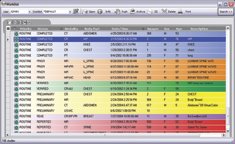
If you click on the ad above, you will see an enlarged version. The PACS station on display is NOT running DI's Integrad Web software, but there is a sort of "generic PACS" using color bars on its worklist. Hmmmmmm. Does that remind you of anything? To my knowledge, there is only one system out there that uses color bars for its worklist, and we all know who that is. I did ask about this, and I was told that there are indeed others out there that do so, like RamSoft, so this was indeed meant to be "generic":

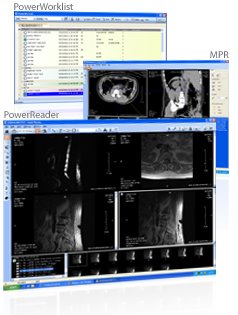
The above is from Medical Imaging Magazine from February, 2006. But, if you visit the RamSoft site today, you see this version of their PowerWorklist:


Look, Ma, no colors! I can't come up with anyone else doing color worklists at the moment.

Upon very close perusal, the ad shows the PACS station to be shot full of holes. The gist of the ad is that if your patients were well-enough versed in the PACS field, and could see your system, they would realize as you should realize that your system is full of holes, and should be replaced by DI's Integrad Web. This is a little darker version of the 1989 introductory Infinity ads where you could see babbling brooks and streams, but not the doggone car! Personally, I'd like to see the Integrad Web in action.

Sigh. PACS is a dog-eat-dog world.


Wednesday, October 11, 2006

Hello, Agfa!

I see that the Agfa folks worldwide (Wilmington, Waterloo, and Mortsel) are enjoying my recent Impax 6.0 posts. A lot, it seems. I hope I'm providing some useful feedback, as well as simple entertainment.

I think I'm going to name my next dog Impax, or maybe Mitra, and create a website just for the dog. How about www.HereImpax.com?

Saturday, October 07, 2006

Impax 6.0 Upgrade
...The Good, The Bad, and the Ugly

Well, after much anticipation, trepidation, anxiety, and delay, our Impax 5.2 PACS was upgraded to Impax 6.0. I am told that ours is the largest enterprise to date that has undergone this transition, and it was not without some trouble. Fortunately, we seem to be past most of the pain, and now we have clear sailing into the Six-y future.

Let's start with the Bad, some problems with functionality, then move on to the Good, and close with the Ugly, the problems with the actual upgrade.

The Bad isn't much worse than I have already reported, but there were a few unsuspected little problems. First and foremost is the fact that worklists and window/level settings are class-wide, and not individual. By that I mean that all users of any class, say, radiologists, have to share worklists and window presets, and probably some other stuff I haven't discovered yet. The worklists are indeed highly customizable, but now, I have to depend on our PACS people to create them, instead of just doing so myself. And if I don't like one of the window/level presets, that's too bad. Minor problems, true, but still annoyances for a tinkerer like yours truly. In fact, there is a troubling lack of individualization at several points. The Configuration screen, pictured below, gives its user access to EVERY machine in the enterprise. You can see the list of machines on the left. Because of this wide open access, our IT/PACS people won't let lil' ol' me into this area anymore.

Why do I need to be in there? Two reasons. First, Impax 6.0 is a RAM-hog, or it will be if you don't change its default settings. It will sequester the majority of RAM available on your computer. That's OK if you aren't doing anything but running Impax 6.0, but at home, I need to run Amicas as well, for the other hospital system, and I need to have some memory, or I'll have to just shut off one program when I activate the other. There is a control within the Configuration screen that lets one adjust how much RAM is available for other (obviously unimportant) programs. Monitor configuration is a little problematic, too, and it is also controled from the Configuration screen. To make a long story short, 6.0 just doesn't work right with a four-Barco monitor setup. We tried it, and it sucks. Impax 6.0 is very, very dependent upon the text/list screen. However, monitor setup requires that you tell the program which screen gets the text, where the images are to start, and whether you want the images on one, two, or four monitors. Note that three wasn't included. Attempting to use all four Barco's for images resulted in tons of toggling between text and images for the first monitor, and also yielded some very strange glitches such as duplication of the study on monitor 1 over to monitor 3, and blanking of monitor 2. It just doesn't work. So, Dr. Dalai, in a rare blast of intuition, suggested making these four-bangers act like three-bangers, in other words, use the first monitor for text, the middle two for images, and shut off the fourth. I had to beg our IT folks to do this, but they did with the express understanding that it was my idea, and my fault, and that I made them do it. Well, it worked quite well, and my partners prefer it for the time being. We eagerly anticipate the arrival of a fifth monitor and bracket thereof for the four-bangers, which will again allow images on all four Barcos. (For some reason, it took over a month to decide what bracket to use, and they still haven't been ordered...seems we need to go through all the proper channels to cut a P.O.)

Other problems include the lack of migration of older reports to the system (it's now brokerless, so I guess the reports have to go to the Mitra context server?), lack of retrieval of the proper prior (e.g., old hand radiograph is displayed to match new chest radiograph), and a rather annoying but transient flash of the "Available Series" bar into the middle of the screen when changing studies. Also, the "cine viewer" control keeps popping up inappropriately. Unlike the Amicas RealTime Worklist, which updates instantly, the Impax 6.0 worklists update only periodically. Ours is set to go every 5 minutes, but I'm convinced it doesn't cycle anywhere near that often.

Now, some good news. Without citing numerous specifics, I have to tell you that Impax 6.0 really does work, and once some of the glitches are fixed, it will work better than Impax 5.2. The toggling of windows is still disorienting, but I'll get used to it.

And now, the ugly. A major upgrade such as this is never trouble-free, and ours was definately no exception. The procedure was done over a weekend to lessen the, um, impact, although our weekends are about as busy as weekdays. The weekend crew operated from a temporary server which could not be user-customized, and only had 2 weeks of priors. Still, the weekend went OK without major problems. Now, Monday was a different story. I was off for a religious holiday, so I didn't have to participate in the fun, but I sure heard about it. To make a long story short, the whole thing slowed to a crawl, and there were well over 100 exams that couldn't be read. This included at least one positive scan that could not be viewed for over six hours. The culprit was, of all things, a virus scanner on a server. This was removed around midnight, and two additional processors were placed in the Oracle server, and things improved. But on Tuesday, we had more problems that shut everything down. It seems that there was a problem on the database side where a database cleaner didn't activate, but Agfa fixed this and says it won't happen again. Then we had a problem with the IIS (Internet Information Service) on one of our three servers (yes, it took three application servers to make Impax 6.0 run on our fairly large enterprise.) The service sometimes didn't work at first, but would do better if bounced. Agfa thinks they have this one fixed, but they are watching it anyway.

OK, we got through all this, and everything is running well at this point. But, to have 100 studies stuck in ethernet purgatory is to us a disaster. The positive study that languished for six hours is quite literally a disaster. We failed in our mission to provide patient care, and we could have caused harm to the patient. And there may have been more cases like this. This is where sometimes IT just doesn't grasp the mission-criticality of what we do. When I used the word "disaster" to describe Monday's events, I got this response from the IT heirarchy (italics are mine):

Actually, the performance issues have been taken care of and I feel"disaster" is a pretty strong statement. I would call it more of an unexpected set back. Impax 6.0 is functioning extremely well and we are moving forward with the upgrade as planned. If you are receiving feedback today that is not as we have experienced it, please do let us know. Any system upgrade of this magnitude is expected to have some issues,we are just working our way through them. We appreciate all the support and cooperation from the Radiologists staff as we have been working hard to make this a reality for them and (the enterprise).

This came in on Tuesday, just before the other problems became apparent. Now, I do want to congratulate and thank our PACS people, and the Agfa folks, too. They all worked very, very hard to get this upgrade accomplished, and they didn't stop until it was complete. Agfa folks are still around to make sure we are comfortable, as some of my illustrious partners never bothered to go for training, and then they expected to be brought instantly up to speed. But the whole "unexpected setback" thing troubles me greatly. As I have said many times, once a department goes filmless (and paperless, for that matter), the PACS is the department. It dictates what you do, how you do it, and when you do it. If PACS croaks, the entire radiology department is dead, and the hospital has lost critical functionality. Sorry, when we lose PACS as we did Monday night, that's a disaster. Plain and simple.

I posted a poll a while back to see who owns PACS at various places. The results were:

IT------------(7)
Radiology---(15)
Both---------(19)
Other--------(2)

Total votes:--43

I have to think that the majority position is the ideal in this venue. Radiology obviously understands its own workflow, and brings incredibly valuable knowledge to the table. IT, of course, brings tremendous expertise to the picture, because PACS at its essence is a network of computers. IT folks get to play with the shiny new computers with the blinkey lights, and you would think they would be anxious to move ahead as rapidly as possible. But somehow, IT often gets really bogged down in bureaucracy. This may have its rewards, as a disproportionate number of CIO's seem to make it to CEO level. I get the distinct feeling that the IT folks want to protect their computers and networks from us, the Great Unwashed. And, as above, there can be a significant disconnect when it comes to our mission-criticality. A computer is just a computer after all, and if it croaks, you simply replace it. Would that we could do that with patients. (Maybe some could be replaced before they croak? Just kidding!) The bottom line here is that a partnership between Radiology and IT is ideal if not critical for PACS to function properly. Yes, PACS is just a mess of computers and wires and such, but my patients' health (and my livelihood) is at stake if things don't work right (or at all). Everyone needs to be on board.

Sigh. Now that I'm in the PACS business myself, I can see how easy it is NOT to be all things to all people. But as the boss, I get to make sure things work the way I want them to work, and that's a good start. Impax 6.0 won't ever work exactly as I would have specified, but it will do the job. Stay tuned for more reports as we progress with the great experiment.

Friday, October 06, 2006

The Star Trek Auction
...Beam Me Up Some Cash, Scotty!


Images courtesy of www.christies.com


Sale Title: 40 Years of Star Trek: The Collection
Location: New York, Rockefeller Plaza
Sale Date: Oct 05, 2006 - Oct 07, 2006
Lot Number: 493
Sale Number: 1778
Lot Title: DEEP SPACE NINE MODEL
Estimate: 8,000 - 12,000 U.S. dollars
Lot Description: A principal visual effects model of space station Deep Space Nine, the highly-detailed fiber-reinforced cast resin construction on a steel armature with internal fiber optic illumination [untested], with ceiling mount bracket -- 72in. diameter -- featured in every episode of Star Trek: Deep Space Nine
Lot Notes: The "hero" Deep Space Nine station model was designed by Rick Sternbach under the supervision of Herman Zimmerman. The design reflects a strongly alien architectural style, while maintaing a simple, yet distinctive overall form. This model was built by master model-maker Tony Meininger and was seen in every episode of the series.


To celebrate the 40th anniversary of Star Trek, CBS and Paramount have emptied out their warehouses of anything and everything that ever had anything to do with Star Trek. Being a loyal Trekkie, I registered with Christies.com, which required producing all sorts of information including my bank account number and a contact at said bank (no kidding!) I actually did put down a few bids on some small items, and I was blown away in the first 3 seconds of bidding.
I guess it's a good thing overall. Those of us nerdy little guys (and girls) who grew up with Star Trek have apparently become rather successful in our adult lives. Picard's Captain's chair from the Enterprise E went for $68,000, and the six-foot long model of Deep Space 9 went for an incredible $110,000! As of this writing, they haven't even gotten around to selling the model Enterprise itself...I wouldn't be surprised if it hits $250,000 or even $300,000.

I won't editorialize about the wisdom of spending these amounts of money on dusty old movie and TV props. I certainly can't do it (even if I had that kind of cash laying around, Mrs. Dalai would have my hide if I thought of spending it in that manner), but I guess I envy those who can. Perhaps the bidding frenzy represents a desire to be a part of something bigger and better than what we have now, and what could fit that definition better than a piece of the Star Trek universe? Of course, if I had hundreds of thousands of dollars to spend of this sort of thing, my universe would be a lot better, too!

I guess the only thing left to say is: Live Long and Prosper! (CBS certainly will!)


ADDENDUM:

Here are some of the final results:

Partially destroyed Enterprise from Star Trek III: $40,000

Enterprise C: $40,000

Regula 1 Starbase from Star Trek II: $42,000

Space Dock from various movies: $65,000

Enterprise E: $110,000

Enterprise B/Lakota: $132,000

McCoy's Space Suit from "The Tholian Web": $144,000

Enterprise A: $284,000

Klingon Bird of Prey from Star Trek III: $307,000

Enterprise D: $576,000


Image courtesy of www.christies.com

Total take for CBS/Paramount: $7,107,040, including commission, far more than double what had been expected.

What else can I say? I canna' take it anymore, Capn'!

Friday, September 22, 2006

Agfa Impax 6.x…The Saga Continues

I’m not the only one who has noticed some gaps or glitches in Impax 5.2 and even 6.0. One Agfa user mentions these problems (rewritten for clarity) on APUG (the Agfa user’s group) with reading MRI under 5.2:

1. Triangulation - the localization tool in Impax 5.2 doesn’t work as well as some of the more simply designed tools in eFilm or Amicas. With the latter two, you just click on a point, and all other windows lock on to the same level. With Impax, the corresponding tool does work, but not on images that are linked by position to other windows. Good, but not quite there. As with lots of other tools, you have to click it again (actually twice) to turn it off. The soon-to-be-famous Agfa toggle.

2. Speaking of linked sequences, it is possible to link a bunch of sequences together. We even have a wizard button that will sync all the planes of an MRI together. Unfortunately they all scroll at the same time, and you can’t just click one button and link everything together. Amicas links the planes individually and intuitively, as do others, and with one button.

3. There is no easy way to display location of a slice on every other orthogonal plane, and have it update as you scroll through slices, without a "scout" window, nor is there a way to show the first and last image on other planes. The scout scroll tool in Impax is by contrast extremely cumbersome and finicky. Amicas and others do this with a single button.

4. Measurement tools - dragging across an object, clicking to get a measurement, then moving the number aside to measure the perpendicular dimension (to avoid the numbers overlapping right in the middle of the lesion being measured) is simply too many steps for what should be a much simpler process.

5. Too many functions in 5.2 require several mouse clicks, which is frustrating for many rads who are used to the functionality of tools which require a single mouse click.

6.What passes for a spine-labeling tool and hanging protocols are essentially impossible to use in 5.2.

The list ended with this: “One wonders how much end user (i.e. radiologist) input was sought at the time of development.” Someone else comments, “Perhaps enough voices will together prompt the necessary improvements in functionality. It is apparent that no working radiologists were involved in the development of the initial product.” Now, I was told that there were 12 radiologists on the Agfa advisory panel that approved Impax 6.0, and yes, they had experience with other systems. Still, given that Impax 6.0 does things in very similar fashion to Impax 5.2, I have to wonder a little bit about that. The majority of these difficulties persist into 6.0, which has a viewing component that is very similar under the hood to what we have with 5.2. Keep in mind for CT triangulation and whatnot that the "simple MPR" tool has been removed, but it may be replaced at your option with Voxar 3D.

The good news is that at least some of these things are to be fixed by RSNA 2006, or so we hear. That would be nice.

A friend of mine on the other coast has been having a world of trouble with his 6.x installation and migration from another vendor. “The doctors’ workstations crash all the time, AGFA applies a patch and says this will fix it and in a couple of days the stations are crashing again. The rads say AGFA sucks! Even so, they do all agree that we are in a better place than we were with the old vendor.”

Obviously, Agfa needs to work on a few things.

I am probably a bigger fan of Agfa's than they are of mine. I do believe I got several of their execs rather upset with some of my blog posts on Impax 6.0, but I'll stand by most of what I posted, and I corrected the areas that were inaccurate.

Agfa's big push with Impax 6.0 was the migration to the .NET architecture, a laudable goal. The "front end" to the interface was completely revamped from Impax 4.x-5.x. The new interface is very different overall, for those of you who have not sampled it. There is a great deal of "toggling" between screens of information. I liken it to a control panel on the Enterprise (the starship, that is) where a wave of the hand would load in a different set of options. Having used Impax 6.0 as a web-appendage for call purposes over the last several months, I still find this quite disorienting. I like having a worklist constantly visible on the third (or fourth or fifth) monitor. (As an aside, we are having to add a fifth monitor to our four high-res monitor stations to accommodate the eventual migration to Impax 6.0 from 5.2.)

While the main interface was revamped, the Impax 6.0 viewing component is really a re-skinned port of the viewer from Impax 5.2 with all its good and bad points. The main deficiency I find (beyond the lack of usable tools as others have outlined) is the persistence of the clone-window concept. With other systems (and Amicas I think does this quite well), one can drag any sequence to any viewport or window. I like to view my CT's with multiple window settings, for example. Now this can be done, and I even have a wizard to do it, but it requires spawning a clone window to do so. I want to be able to do this within the main viewer itself. I could go on, but you get the idea.

As I mentioned above, Agfa told us last RSNA that "12 radiologists" were on their panel for approval of Impax 6.0, and they ultimately agreed on the final release. I suggested at the time that these radiologists must have been exclusive Agfa users, because of the stasis of the viewer; I was told that was not the case. Having sat on advisory boards of other vendors, I can attest to the difficulty in getting more than two radiologists to agree on anything, so I can see how things might have gone in the Agfa meetings. Still, now is the time to fix and revamp Impax 6.0, before it gets entrenched as it stands. We can only hope that Agfa can fix some of these problems by RSNA, or I’m going to be “toggled” to death.

Tuesday, September 19, 2006

Visitor Twenty Thousand!!!!

It's really unbelievable. My humble little blog has been hit 20,000 times! And the vast majority were not from me! Visitor number 20,000 is actually comes by frequently; he (or she) is from Montevideo, Uruguay! I would love to know more details about your PACS and your hospital. Drop me a comment below. Does your facility need a visit from Dr. Dalai? Send me a ticket and I'll be there!

I'm sure there are those out there that view me as somewhat of a terror, if I've even reached their threshold of attention. Well, maybe I'm more of a terrier than a terror...I sink my teeth into an issue and then I just won't let go. As I love my Jack Russell Terrier dearly, that's a compliment. Much more to come!

Thursday, September 14, 2006

Voice, I mean Speech Recognition, Buggy Whips, and OODA Loops

I love new technology. I live for it. I spend inordinate amounts of money on it, much to my son's delight, my daughter's bemusement, and my wife's chagrin. If there is an electronicomechanical way of doing something that I could have done manually, well then, I'm on it. However, when it comes to Voice Recognition, I do an about-face from my progressive side and become a pure Luddite. But follow my reasoning, and you might agree.

First off, the Wikipedia informs us that "Voice Recognition" is the task of recognizing people from their voices, and this might be done electronically for identification purposes, among other tasks. What we are really interested in is Speech Recognition which the Wiki says "is the process of converting a speech signal to a set of words, by means of an algorithm implemented as a computer program." Now, this has been one of several Holy Grails for computer science since the dawn of time.

SR should be great for radiology, given that our main product is the typed report that is based on our talking into a microphone all day long. The old timey approach was to have a human listen to all that blather and type a report into a typewriter (remember those?), or into some computer or another. Now, if I can get said computer to actually understand what I'm saying, we eliminate the middleman, or woman, i.e., the transcriptionist. But is the technology there yet? In 1968, the movie 2001: A Space Odyssey told us that we should have had conversant, artificially-intelligent HAL 9000's, as well as commercial space flight, a Hilton hotel on a space station, a moon base, and exploration of Jupiter as of 5 years ago. Oh well. We don't even have Pan Am anymore. But, we do have VR, I mean SR, right? Here's a citation from a Journal of Digital Imaging article out of Mass General by Mehta and Dreyer, et. al.:


Voice recognition--an emerging necessity within radiology: experiences of the Massachusetts General Hospital.

Mehta A, Dreyer KJ, Schweitzer A, Couris J, Rosenthal D.

Department of Radiology, Massachusetts General Hospital, Harvard Medical School, Boston, USA.

Voice recognition represents a technology that is finally ready for prime time use. As radiology services continue to acquire a larger percentage of the shrinking health-care dollar, decreasing operating costs and improved services will become a necessity. The benefits of voice recognition implementation are significant, as are the challenges. This report will discuss the technology, experiences of major health-care institution with implementation, and potential benefits for the radiology practice.

Great article, and it was written in 1998! The italics are mine, by the way. So here we are, eight years later; why isn't everyone using VR/SR?

The problem seems to be that the technology really isn't there yet. Matrad6781 posted this on an AuntMinnie.com forum, and it tells the story in a painfully accurate manner:

My problem with our voice recognition system is that commands that used to be triggered by the thumb on a microphone are now voice commands. Often the software doesn't recognize my voice and I end up having to repeat myself several times. That never happened in the "buggy whip" days. Throughout my department you can hear radiologists saying: "Defer report...defer report...DEFER REPORT, dammit!" or "delete that sentence, DELETE that sentence, delete that SENTENCE!" Also, when I say "parentheses" or "quote" or "paragraph", my transcriptionists know what I mean. This system actually types out the words "parentheses', "quote", "unquote", etcetera. How clever is this? Is this what is meant by artificial intelligence? I have alot of "canned" reports, both normals and intro paragraphs for MRI protocols, interventional procedures, etc. At last count, I had 150 such "normals." Before voice recognition, all I had to dictate was, "Normal MRI of the left knee" and the transcriptionists called it up from their macros and sent it for my electronic signature. Now I have to remember the name I gave the normal report (ProVox calls them "Macros") and enunciate it properly (so I don't get a "Normal chest" appearing when I said "Macro Normal CT Chest Enhanced". But it happens, all too frequently. And I have to always keep an eye on the voice dictation window, the way you would a toddler to make sure it's doing what it's supposed to and not getting into trouble. By the way, that window, even when minimized takes up valuable real estate from my PACS work station (and I have four monitors!) I'm always moving the window around because it's obscuring images or the worklist. Very inconvenient. The worst is when the system thinks that I (or someone in the background) uttered a voice command that is one of the "nuclear option" commands, like "finalize report", "delete that paragraph", "cancel report." Then, poof, five minutes of dictation are gone, just like that, and I have to start from scratch. Are you guys telling me no one else has experienced any of these problems? Is it just our manufacturer? Lastly, the voice recognition is so bad, that everything ends up getting deferred by all the radiologists to the transcriptionists, so that they can correct the errors before sending to the task list for finalization. So we have as many transcriptionists as before. Last point: We have some great transcriptionists who catch errors that a voice recognition system would never recognize. I used to get electronic notes like "You said LEFT in body but RIGHT in impression." Or: " You gave a measurement of 3.5 mm in the body, are you sure you meant "mm" and not not "cm"?" These folks have saved my butt many times. I'm kind of glad that the voice recognition dictations still go through them as a fail safe mechanism. Also, one of our transcriptionists makes really good carrot cake! Let's see a VR system do that!


The bottom line is that these very expensive systems (think hundreds of thousands of dollars) do not have human intelligence behind them. No, I'm not saying bad things about the programmers! It's simply that there is a very rich background to our communications, and no machine has risen to the level of understanding, or perhaps I should say intuiting, what we put into it. The left/right and cm/mm problems are good examples. I suppose you could program the machine to count how many times you say "left" and how many times you say "right", but then what? Should there be an equal number? Not necessarily. So what is a poor machine to do? The human transcriptionist can easily find the discrepancies of this sort, but a machine just can't do that yet.

What are the advantages of SR that make it worth the kind of trouble Matrad describes? I can think of only two: time and money. If all works well, the SR system can have a report available online the instant you sign off. That's a good thing. Which can be equalled or even surpassed by having an adequate pool of human transcriptionists on-line and ready to do their thing. But speed doesn't seem to be the main impetus in many places. Sadly, what SR allows is the shifting of work onto the radiologist. The transcriptionist's job is really two-fold: she (or he) commits to the screen what the rad has dictated, and then she edits out the errors that may have occured. SR can do a passable job of typing (if one trains it to one's voice for a very long time), but it just can't do the editing. Since the radiologist is ultimately responsible for the report, some administrative types have decided that the rad should do the editing as well! Wonderful idea, if you are trying to rid yourself of transcriptionists. Unfortunately, this adds a lot of editing time to the rad's day that he or she should be spending reading studies. Another poster, Jack (Dr. Death) Kervorkian puts it in these terms:
(S)orry guys, in my book - time is money. If I have to spend 20% of my time correcting reports and looking for content, syntax, grammatical and/or spelling errors, that is 20% which I am not productive. Furthermore, it now makes me not a radiologist, but an editor of reports. Just think, in an 8-10 hour day that amounts to an extra 1-2 hours of agonizing editing. I'd rather have a second set of eyes and ears - which know my dictation style to look over me. Can't tell you how many times a transcriptionist has saved my ass from looking stupid, with the usual 'right/left" errors, or at the 12th hours calling a CT scan an MRI scan.. Although voice recognition will catch spelling errors, it won't catch content, grammatical or syntax errors, as mentioned above.


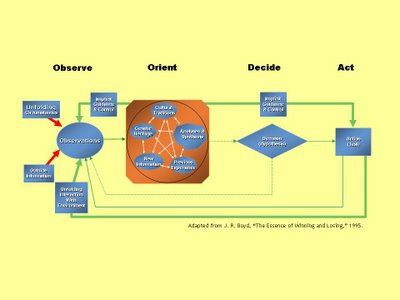
So everyone loses in this scenario, except for the bean-counters who justify the expense and the pain to the rads with the savings in personnel. Just great. Those who support SR call those of us with doubts "Luddites" and "buggy whip makers". AuntMinnie member Frank Hartwick suggests that we stick to the principles of the "OODA Loop" for decision making such as this to keep from being left behind. OK, what's an OODA loop, you ask...is it like a Fruit Loop? Not quite, and it really is germaine to this discussion. Click on the diagram below to blow it up...


OODA Loop

The OODA loop (Observation, Orientation, Decision, Action) is simply a way to describe a decision-making cycle, designed by a retired fighter pilot, Col. John Boyd. Basically, it describes a dynamic process that one should go through to evaluate evidence and make choices, and how those choices are dependent on your background (even your "genetic heritage") and the information you get. The decision impacts your observations, changes your orientation toward the problem, and you remake your decision.

Got all that? So, I think Frank H's OODA loop tells him that SR gives good service and should be implemented. But MY OODA loop observation is that there are a lot of complaints about SR, and with my genetic heritage of worrying, and previous experiences of getting burned on buying some of the latest and greatest, lead me to the decision that SR isn't ready for me as yet, and thus the action of, well, inaction. I'm digging in my heels on this idea. I have told our administration that I and my group will not accept SR unless they promise us total human backup. In other words, if they want to spend $300,000 or so on a fancy microphone for me, that's just fine. As long as they realize that we rads refuse to become editors, they can go ahead and spend the cash. But don't wave the expenditure in my face when it comes time to replace some of the worn-out scanners that really need to go.

Am I really being a "Luddite" on this? I think not. My job is to interpret my studies, not edit the reports. No one has yet convinced me that SR technology has reached the point of really being ready for prime-time. And I don't make buggy whips...to really stretch the analogy, one could say we use buggy whips in our trade. SR could then be likened to an electric cattle prod, I suppose. But to carry this to its logical end, SR will eliminate the horse, and I'll be forced to use the cattle prod on myself! No thanks, guys. I'd rather walk.

ADDENDUM....

I just had to add this from a post from William Fife on the AuntMinnie.com thread...

For those of you who love VR here is something one of our physicians did one day on call. I will note that this physician had been using VR exclusively for MONTHS (a few words have been deleted (deleted) to protect the guilty). This is not a joke, this is an actual VR transcription of that the physician was saying (in bold).

Indicating this using (deleted). (I am dictating this using (deleted).)

Mr. date of 01/02 help recent films time.(Yesterday I went to help read a few films on my own time.)

A family cells. In some (deleted). there for over and out or.( I found myself stuck in some (deleted) error for over an hour.)

The year cannot: 5 hours report was (The ER kept calling to find out where the report was.)

This did not seem to encourage may help my colleagues and the films. (This did nothing to encourage me to help out my colleagues and read films.)


Today came in early to try again had.(Today I came in early to try and get ahead.)

Instead I am now line. Out of on the nodule was noted least 15 times. (Instead I am now behind. I had to run the audiowizard 15 times.)

I had to call the past / (deleted) to support. (I had to call the PAC/(deleted) support staff)

12 joules was helpful and white, there was nothing ET tube from home. He has new trials were to things year defects at myself. (While Joe was helpful and polite, there was nothing he could do from home. He asked me to try all sorts of things here to fix it myself.)

Spent there are might time to ingest fat rather than reading films. The CT scanner post I am not expected fixed fat.Lysis any different. (I spent an hour of my time doing just that instead of reading films. When the CT scanner goes down I am not expected to try and fix it myself. Why is theis any different?)

The patient or best served 1 international unit films not tried fixed (deleted) problems were transcribed unknown reports for distended noxious females. (Patients are best served when I read films, not try to fix (deleted) problems or transcribe my own reports or send obnoxious e-mails.)

Kilohertz it is line, we need better on slight support. (When it works, it is fine. When it doesn't work, we need better on-site support.)


ADDENDUM #2:

This was just posted to AuntMinnie.com by "breastguy", hopefully a mammographer, and I think it really seals the deal against SR:
I heard of one rad at a children's hospital in PA who was trying to get a lawsuit together against Dictaphone for their false claims about the product. Every so often our chief circulates examples of gibberish that was sent out and cautions us to look at what we are siging - but it still happens -- one major problem is there is no "undo" button or delay- once you hit sign report it is gone and as it disappears you see "clitoral history" fly by and there is no delay to catch it. The quality of the reports clearly suffers. And you cant say "known Carcinoma" it comes out "No carcinoma" -- I curse the Powerscribe apps people that spent days with us yet never called attention to possible pitfalls like this - they never pointed out the weaknesses- we had to stumble over them ourselves. Sure you can save the reports and review them later, or send every one to the editor (be sure to keep some transcriptionsits to edit) but I can tell you, in our large group , with editors, crap still gets sent out and ref docs gleefully call you up to say "Did you mean Clinical History instead of Clitoral History?" Certainly makes us look foolish. As far as it not understanding the instructions to call up a macro- it was driing me crazy! I solved that - instead of my saying "Mammo Heterogenous Normal Compared" I renamed it "Hubert Nancy Carol" Dense mammo is " Denise Nancy Carol" etc and so on for the many screening mammo macros I created- here it does save time.

I really think that's enough. Frankly, after looking into this, I'm inclined to say "NO SR" altogether. The machines seem to compound the possible errors, making the transcriptionist/editor's job that much harder. This is a really, really, REALLY bad idea.

Sunday, September 03, 2006

Thursday, August 31, 2006

Logmein al Carbonite


Periodically, a product comes to market that improves my life considerably. Today, I'll mention two such wonders.

LogMeIn, found at http://www.logmein.com, lets me and Mark the PACS Guru take care of a lot of computers in a lot of places. There are various services offered including LogMeIn IT Reach, which is the one we use the most. This advanced program gives me remote control access to the target machine, the ability to perform management functions (turn services on and off, for example, remote reboot, and even direct file transfer). There is a free version that just gives one remote control, pretty nice for the price. This system is secure with 256-bit encoding, and the best part is that it will automatically negotiate firewalls, with no need to fool around with port-forwarding and the like. LogMeIn also offers a "Rescue" product that doesn't require any software installation on the receiving end. There is even a new service called Hamachi which is "a zero-configuration virtual private networking (VPN) application. In other words Hamachi is a program that allows you to arrange multiple computers into their own secure network just as if they were connected by a physical network cable." LogMeIn just might put the networking guys out of business! Well, not yet. My little illustration is prompted by the Chinese-dish sound of the non-caps version, logmein...like chow mein, get it?

Carbonite (http://www.carbonite.com), like its namesake, is a protective shell of sorts. I had been looking for a way to back-up my computer onto some nebulous place on the internet, and Carbonite provides this. It works like a charm. Basically, one just installs the small app and it backs up whatever portion of your disk you specify, up to and including the whole thing if you wish. The price is pretty reasonable, depending on how long you contract for the service. Check it out!

Tuesday, August 29, 2006

Dalai PACS

I don't like to repeat gossip, but there is a rumor floating around that I am going to start my own PACS company.

It's true.

Film at 11.

Sunday, August 20, 2006

How Many Monitors?


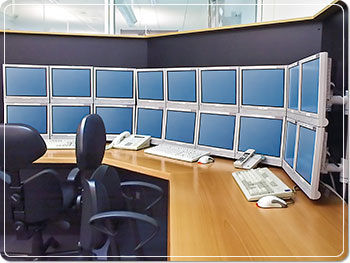
How many monitors is enough? How many are too many? Is there a "just right" number, Goldilocks?

Probably, the answer differs for every radiologist, and every group. The 21 members of my group would give you a several answers. At home, most use just one commercial-grade Dell monitor for on-call prelims. (I, being different, have two, and a couple of my partners have just ordered out some used Barcos so they can do full interpretations at home.) At the hospitals, the majority of our stations have the 2+1 configuration: two high-res monitors and one 17" or 19" color monitor for worklist or 3D display. We still have several stations that consist of four high-res Barco monitors only. Now here is where opinions differ. Personally, I am satisfied with the 2+1 setup. I figure I can only concentrate on a small area of one monitor at any one time, so why have so much screen-real-estate that I can't look at immediately? Those who prefer the four-bangers (a legacy title I bring to this post from the old days of four-function calculators) counter that it is much easier to compare complex multisequence MRI's if you have more space to put the images. I guess that makes sense. The second reason, and the one that I find more compelling, is that when comparing CR's, it is helpful to view more prior exams at once, to better see trends in the patient's condition. That one makes more sense to me. This can still be done with a two-banger, but you have to cycle the priors on the second monitor.

I mentioned in a prior post that Agfa Impax 6.0 probably doesn't play well with an all high-res monitor set-up, so we will probably be adding a fifth, color monitor, to the four-bangers. We may need bigger desks, or maybe some sort of bracket suspension aparatus. Remember back when PACS was new, and some companies were showing the huge banks of 8 CRT's? Those were the days....


Image courtesy of http://www.ergodesk.de.

Another interesting discussion involves what should go where. Where should the new study go? Where should the priors go? On the far left monitor, on the far right monitor? This can and should be strictly up to the individual user, and with hanging protocols and presentation states, that should not be hard to, well, arrange. I've been hearing some talk about moving one particular series around, and that one has me concerned. Let's say you are looking at a complex multisequence MRI, and you wish to compare the current axial T1-weighted post-contrast sequence with its counterpart from last month's examination. The theory is that you should be able to move just that one prior sequence into a viewport or window that otherwise holds nothing but the current study. Personally, I have a feeling that could be dangerous. What if I get distracted, and somehow, in my reverie, forget that this sequence in the middle of the screen is actually from the old (here, the wrong) study? Disaster awaits. I know those planning to do this sort of thing are intending to put some fancy border around the foreign sequence, but will it be enough to penetrate my thick skull? Perhaps if the border had a flashing marquee that said "Danger Will Robinson, Danger, Danger!!" Personally, I want the ability to disable this function, although I guess I might come to like it someday.

You can sometimes teach an old doc some new tricks....

Wednesday, August 09, 2006

Anti-Semitic Radiology Residents???

I take the pulse of the world of Radiology via AuntMinnie.com. The Residents' Digital Forum is always lively, with discussions of topics ranging from politics to how to go about switching residency programs.

The political threads can get rather intense, with conservative posters (often called Neocons, Right-Wingers, Bushies) going head-to-head with liberal posters (Leftists, Socialists, Bush-haters, Commies). You get the idea!

Israel, Islam, Iraq, and the Mideast situation in general creates a flash-point for discussion. The usual polarization is present within these threads, but I have noticed a very ominous trend: there are now several blatantly anti-Semitic posts. Here is a thread about the current war between Israel and the Hezbollah in Lebanon. I won't even try to discuss the issues of the war itself here; that's beside the point I am trying to make. The AuntMinnie thread contains a considerable majority of anti-Israel sentiment: Israel is bloodthirsty, Israelis are the real terrorists, America is stupid for supporting Israel. Fine. But then come the racist rants: The media and Congress are Jew-run, Jew this, Jew that. It makes my blood freeze. You see, this forum is on a RADIOLOGY web-site, and is geared toward residents (although old farts like me drop in periodically.) These comments are ostensibly from intelligent young physicians! What has happened? I wish I knew. But I can only speculate. There is a lot of frustration out there, and a tremendous amount of anger, mainly on the part of the liberal posters anyway, about our involvement in Iraq, and about President Bush. I don't know if this is manifesting into anti-Semitic sentiments de novo, or just unmasking such feelings that were already there. Either way, the fact that supposedly smart people are rehashing material from the Protocols of the Elders of Zion (an anti-Semitic tome from years ago) makes me worry. A lot. What will happen to this country, and to Israel, for that matter, when this angry young generation comes of age and acquires real political power?

Those who hate destroy themselves just as much as the objects of their hatred. You might not be able to prove that scientifically, but it is so nonetheless. I hope these kids learn that before too much longer.

Wednesday, August 02, 2006

Edge Detection Rule(r)s!!


I haven’t posted much in the way of pure PACS lately, in my quest to be a politician and policy maker (or breaker as the case may be). My good ideas seem to be coming less and less frequently; must be old age, or stress, or some combination thereof.

Finally, my rusty steel trap of a mind has come up with something new. Well, it really isn't new, but it is a simplified and useful twist on an old concept.

Edge-detection is a well-known mathematical procedure, useful in the detection of abnormalities on mammograms, and nodules on CT's. There are a number of Artificial Intelligence (AI) programs out there that sniff out badness on these exams and do all sorts of measurements allowing for followup.

My idea is much simpler, and applicable to the everyday PACS world. In fact, it occured to me whilst measuring innumerable lung nodules on a cancer patient. It is a true pain to draw in short and long axes, especially when the nodule is in the subcentimeter range (and even more so when your non-averaGE PACS won't let you show more than one pair of measurements on the screen.) So, let's create an edge-detection-based ruler! As in the rather primitive mock-up above, the user draws a circle or ellipse around the nodule in question, and tightens up its radius to a reasonable level. The computer then takes over, detecting the edge of the nodule, finding long and short axes, and even giving average density, total area, etc. Yes, this could be expanded into 3D, seeking the nodule in the slices above and below, but that adds so much complexity, it probably isn't worth it. All I want is my measurements done for me without tedious submillimeter movements of the mouse. The Dalai Edge Detection Ruler would do the trick.

OK, which PACS company is going to make this happen? I'll take 50% royalties, thank you. Uh, how about 30%? 20%? Oh well, just put this in action and I'll be happy!

Sunday, July 23, 2006

The Idiot’s Guide to Writing a Letter Home…

Image courtesy of http://www.koretz.com


My son is still at camp, enjoying the 6th of 8 weeks away from Mom and Dad. Well, make that 7 weeks away, because I was up there in the North Woods myself a few weeks ago playing doctor.

My son is a bright fellow, but when it comes to writing home, well, we never get to see that brilliance in action. My daughter, who behaved exactly the same way when she went to camp, decided to do something about this behaviour, and she wrote the following:

We noticed you were struggling with the art of writing to your family, and so we thought we would include a sample of how the typical, loving, caring son, tackles this difficult task. First we will name the unacceptable forms of letter writing:

1. Empty Envelopes: Save yourself a stamp, an empty envelope says I’m thinking about you like (a friend of ours) says I have sympathy (In the dictionary, sympathy sits between sh*t and syphylis!)

2. Sending Food: Unlike at camp, this is not a hard to find commodity when at home. We have our own potato chips, thank you very much, but we do appreciate the offer!

3. Stick Figures: We are out of the Stone Age thank goodness! That means no loin cloths, no grunting, and NO picture writing!

Now that we have looked at the less than desirable forms, let us now examine the correct way to write a letter:

Step 1: The Greeting...Typically, a kind phrase or welcome is used here. This may include, but is not limited to the following examples: Dear Mom and Dad,Hey Family!What up, home dawgs?!Hiya Bubba, Bubba Senior, and Bubbette!

Step 2: The Summary...Usually following the greeting is an inquiry into the state of the family, followed by a description of one’s current state. Next, a list of activities, complete with details and opinions concerning the events, is given:
How are you? Camp is AWESOME! Today, I had a blast at canoeing- I portaged for 3.4 miles, using only one hand and blindfolded. Then, Bobby Joe and I went hiking on a nature hike, and caught a bear! We’re having a great time teaching it to dance and do tricks! I’m leaving to go on Isle Royal tomorrow- my pack weighs 150 pounds, so I think I might take my mattress and the toilet out of my pack so I can actually carry it!! I can’t wait to go on the trip though!


Step 3: The Wrap Up
Finally, after the letter is complete with information, you may gradually bring it to an end. The kind writer informs his reader he will soon be ending the letter, and uses a hope or promise (see example) to conclude:
Well, that’s all going on here! I hope that everything in boring South Carolina is going well! I promise to write again after Isle Royal with tons of stories about my trip!

Step 4: The Sign Off
This difficult skill is left out by sons at camps across America, however, it is one of the most important parts of the letter! Your family’s assurance of your well being lies in this lone signature. Typically, campers will precede this valuable information with an expression of emotion:

Love,
Jonathan

Luvya,
Jonny-Boy

Haven’t showered in a week- I smell,
Stinky

Sincerely,
Mr. Jonathan B.


Hope this helps your writer’s cramp! Can’t wait to hear from you soon!

Love,
Your Family

Wednesday, July 12, 2006

Virtual PET/CT: Dalai's Idea Validated!


I am often asked to lecture about PET and PET/CT to local groups, having ushered our state into the positron era. Of course, our state was the last to get a PET scanner, but I'm the one that brought it here! Anyway, my PET/CT lecture ends with the image above, a simulated combination PET/Virtual CT. Wouldn't it be nice if the bad stuff lit up like this?

I won't take credit for the idea, as I probably saw it somewhere. Still, I was thrilled to see a real demonstration of the concept in this month's Journal of Nuclear Medicine. In the article "Flying Through" and "Flying Around" a PET/CT Scan: Pilot Study and Development of 3D Integrated 18F-FDG PET/CT for Virtual Bronchoscopy and Colonoscopy by Andrew Quon, Sandy Napel, Christopher F. Beaulieu and Sanjiv S. Gambhir, from Stanford use a GE AW 3D workstation (oh well) to fuse a volume-rendered virtual colonoscopy (and bronchoscopy) to a volume-rendered PET. Here's the result:

Now, the paper and pdf versions of the article don't show the virtual fly-through, but I'll bet it's pretty spectacular. Great idea, huh?

Tuesday, July 11, 2006

You Don't Need PACS For This...


While playing pediatrician at camp, I encountered a couple of tick bites, several dozen sore throats and runny noses, and other joys of having 200 boys gathered into one place. At 10PM on my last night in camp, I got the call that a young man had hurt his toe playing basketball. When he was carried into our little infirmary by his pals, the abnormality was rather obvious. I chose not to reduce this lovely little dislocation without better drugs than I had on hand, so I sent him on to the neighboring city. Better for him to hate the ER doc than me! Ah, primary care.

Monday, July 10, 2006

America the Porcine

Image courtesy of http://animals.timduru.org
I just finished my stint as camp doctor yesterday, and we flew home last night. On the last one-hour hop from the hub city to our average town in the South, I encountered some behaviour that troubles me greatly. Delta Airlines' web-site would only allow me to book seats 10A and 11A, window seats, for my wife and myself on this regional jet flight. You know the planes, the ubiquitous CRJ 50 passenger jobs. I actually prefer them for shorter flights, and find them comfortable enough with 2 x 2 seating. I have never noticed any particular difference in the aisle seats, or the window seats. (You get a little more legroom in an emergency exit row.) I figured we might be able to trade seats once we got on the plane. Really, who would refuse to let a married couple sit together? As it turns out, the occupants of seats 10B and 11B did just that. These were well dressed and well-spoken people, who were travelling alone. When we very politely asked if one of them would be willing to trade, they rather coldly refused. It seems they MUST have the aisle seats on that particular plane, and, no, neither would consider sitting in the window seat. Both very smugly noted that they had selected their aisle seats online, and that was the end of that. My wife and I looked at each other and shrugged. The week before, when we flew to visit our relative with cancer, another passenger was making a fuss about wanting to sit by a window on the same hop. My wife and I agreed to sit separately on that occasion to accomidate this stranger. Apparently, what goes around doesn't always come around after all.
Have you tried to make reservations for much of anything lately? You will find that everything is snatched up as soon as it becomes available. We have become a nation of hoarders, more bluntly, a nation of pigs (which is an insult to pigs). We will shove anyone else out of the way to get our hands on anything we think we want or deserve. Our lives have become a big race to get to the goodies before the next guy, and make sure we get our share, and his too if we can manage it. This behaviour is not borne of need, simply of gluttony, greed, and entitlement. It is the same basic instinct that drives people to want their CT's when they want them, be it 3AM or 3PM, and the same motivation that keeps self-referrers self-referring. I guess it isn't unique to Americans, but we seem to be very, very good at it.
I have no answer for the implied question of what to do about our porcine behaviour. Perhaps if we keep in mind where bacon comes from......

Tuesday, June 27, 2006

Alternative Murder

Here's one from the heart, folks. Hold on to your hats.

I'm going to lose two of my relatives to cancer. That is sad, of course, but what is really unfortunate is that they could have been cured at early stages of their disease. What happened? They became enmeshed in the folly of "alternative medicine", and they are going to die because of that.

I won't name names or give any identifying information. One relative had cancer of the tongue that could have been excised and eliminated when it was quite small. He refused conventional therapy proposed by one of the leading cancer centers of the world, and instead used diet and supplements to treat himself, on the advice of a "practitioner" with barely a high-school education. Three years later, the disease advanced to the point that he had to seek conventional therapy, and he underwent a glossectomy. That's a nice word for having your tongue cut out of your mouth. He "eats" through a tube in his stomach these days.

The other relative has breast cancer. She and her husband, very smart and well-educated people, decided that nutrition and other alternative methods were the only treatment for her. A year later, this formerly healthy woman is an orange, jaundiced skeleton. She just had a biliary stent placed, and she can't even consider chemotherapy until she builds up her strength. Which she can't because she had starved herself trying to follow various cancer diets. My wife and I made an emergency trip to see this relative over the weekend, and she still doesn't realize what has happened to her. She fears most that the cancer has spread to her brain, because the local practitioner of ElectroDermal Screening told her it had done so.

People, I don't know whether to cry, scream, or what. How did this happen?

In the short space of one post, I can't properly cover the entire topic of alternative medicine. I strongly refer you to http://www.quackwatch.org. Dr. Stephen Barrett has spent the last 30 years examining the phenomena, and his articles are mandatory reading on this sad subject.

There is no single reason for people to suspend reason and go for the alternative therapies. Victims include rich, poor, educated, illiterate, black, white, Jewish, Christian, Muslim. No one is immune. The only common thread is that most people will be vulnerable at some point in their lives to the ministrations of charlatains, and those with a chronic or recently diagnosed illness are right at the top of the list. Why go through painful and debilitating chemotherapy when nutrition and electrotherapy can cure you of your cancer?

The "practitioners" usually have no scientific background, and learned their trade by weekend seminar, or perhaps right here on the Internet. Their idols, the inventors of the wonderous therapies, assure them with false testimonials and bogus science that their therapy works. Why are these miracles not accepted by the mainstream medical community? My relative with the tongue cancer was quite convinced that there is a conspiracy amongst all physicians, insurance companies, and pharmaceutical manufacturers to keep these "cures" away from the public, so we, the conspirators, can keep raking in the cash. Just take a look at this "infomercial" from Kevin Trudeau, who is revered among the alternative believers. He has since been banned from making such blatantly false statements. He was interviewed on TV recently, along with someone from mainstream medicine, and someone else from the alternative community. The mainstream doc lambasted him, and the alternative "doc" praised him. My relatives believed the latter.

In some cases, the victims of this deceit really do distrust the traditional medical community, and many are prone to believe conspiracy theories anyway. There is a very simple counter argument: Doctors and their families get cancer as often as any other group, and they live and die in the same percentages as everyone else. If there were some "secret" cancer cure, don't you think somebody would "break ranks" and reveal it to the public after all this time? Perhaps the greatest irony is that we are accused hiding and suppressing this stuff so we can make money. The quacks, however, are very quick to charge as much as much as they possibly can for unproven, untested, ineffective, and often harmful products.

Human beings are well known for believing what they want to believe, even when faced with heaps of evidence to the contrary. Throughout history, quacks, charlatains, witch-doctors, and all of their ilk have misled those who get caught up in their lies. It is no different in the 21st century, I am sorry to report.

Not being bound by the conventions of political correctness, I am going to call this what it is: MURDER. These criminals convince the naive to shirk medical treatments in favor of their patent medicine and snake oil. Many of the victims will die needlessly, and often horribly. That constitutes murder in my book.

Don't think for a moment that I am cannonizing the medical community. As you have noted in the pieces on self-referral, I think we need to fix a few things ourselves. M.D.'s are not above trying to make an extra buck, and I don't excuse them for it. But the methods we use for diagnosis and treatment have evolved via the scientific method. We do not think we possess the Absolute Truth, and we are constantly testing and retesting our diagnostic and therapeutic approaches. I am not ashamed to charge for what we do; we know we are offering the best we have, not something mired in secrecy and obscurity, and "proven" by handwaving and innuendo.

Again, I keep creeping toward more governmental intervention. The government MUST step in and stop this madness. People that make bogus claims need to be prosecuted. Those that have led their victims to their deaths should be up for murder. Because that's what their lies and deceit accomplished, the death of innocents whose only crime was believing the sales pitch. Perhaps there is a greater punishment awaiting these false practitioners, but for the moment, I'd rather trust the government to take care of these murderers. That's what they are.

Fifteen Thousand And Counting!

Image courtesy of http://aes.iupui.edu/
I thought it might be better to note visitation milestones a bit less frequently, and so we're now on the Q5000 scale.
Visitor 15K comes from London, Ontario, Canada, via Huron Telecommunication Cooperative, Limited. I will tell you that he (or she) was perusing an AuntMinnie.com thread, but I won't tell you which one. Believe me, we leave really huge tracks behind us on the web.
Thanks to all my visitors! You've made me what I am today...whatever that is!

Sunday, June 18, 2006

The Da Vinci Code
...or Opus Dei and the Knights (Templar)


I finally got around to taking my son to see The Da Vinci Code. At 12, he is a voracious (dare I say precocious?) reader, and after reading the book, he was quite anxious to see the movie.

Now, I don't want to spoil it for anyone, so both of you out there who haven't seen the movie or read the book STOP READING NOW!

OK. To summarize, the story involves several threads revolving around the premise that Jesus was married to Mary Magdaline, and she bore Him a daughter after the crucifixion. This certainly interferes with the concept of Jesus' divinity, and so the Vatican has tried mightily over the years to suppress this, whilst the Priory of Sion and the Knights Templar attempted to protect Jesus' descendants. Got all that? I'm really simplifying things here. The movie goes on to implicate a strict Catholic order, the Opus Dei, in several murders designed to quash the Priory once and for all.

There are probably a thousand web sites out there that dissect the arguments, and the "facts" of the movie in tremendous detail, and I won't even try it here. Suffice it to say that the movie is enjoyable in a plodding, mystery-story fashion, and it was fairly true to Dan Brown's book. I would recommend you read the book first to be able to follow the plot-twists.

The book and movie have caused great consternation, or at least a lot of discussion in the Christian community, and I can understand that. Coming from the Jewish viewpoint, I don't find the concepts particularly offensive. Judaism does not accept the divinity of Jesus in the first place; rather most of us consider Him to have been a great rabbi, perhaps the first Reform rabbi, and possibly a Prophet in His own right. You will notice very few bachelors among the Jewish characters of the Old Testament; it was tradition for the best and brightest to marry and have lots of children (be fruitful and multiply, as they say), and so it would not be surprising for a rabbi or great teacher to have done so. Think of this as the world's first eugenics program: you want to breed your best stock. I can only speculate as to why the Catholic Church took the exact opposite approach with their clergy.

I guess I can't comment with any great passion on how the "truth" as concocted in the Da Vinci Code would affect Christianity. Much evil has been done in the name of Christianity (the Inquisition, the Crusades, for example), but I would be so bold as to say that overall the good deeds over history outweigh the bad. Nobody is keeping score as far as I know. I realize that the divinity of Jesus is a fundamental tennant of modern Christianity, but even if it were not the case, His teachings would probably still be relevant. Basically, they were a softening of the fairly harsh version of Orthodox Judaism practiced in His day, and one could almost say that we Reform Jews are closer in spirit to what Jesus taught than anyone else. How about that?

I have tried and tried to tie this whole thing into PACS, and I'm coming up short. Maybe we could use the Cryptex to enter our passwords?

Sunday, June 11, 2006

Lessons from the Vasa, and Other Baltic Musings

The Vasa, courtesy of the Vasa Museum, http://www.vasamuseet.se
I'm back from Europe, and jet-lag is setting in to a significant extent. Before I drop, I wanted to post about some of the places we saw on our Baltic cruise.

Oslo seems clean, and modern in a timeless, Frank Lloyd Wright fashion, although the focal point of the city is the Akershaus Fortress, built in the 1300's. For some reason, I find the place very intriguing. Copenhagen had the feel of a much older city, with a feeling of age that we simply don't have in the much younger United States. Stockholm is somewhere between the two, and I found it my favorite of all the places we visited. Helsinki was rather stark, though it still has much of beauty, including a Lutheran church blasted from a stone hillock. Our time in St. Petersburg was rather surreal; a visit to Russia is still uncomfortable, even though the Russian Republic is now a democracy. Our guide spoke almost whistfully of the old Soviet era: it was hard, but the State took care of its people. I fear the old generation will have to pass on before freedom is totally accepted. The Russians are well on their way, however; there were many more Lexuses on their roads than I see here at home! Talinn, Estonia, was a surprise; there is a beautiful medieval city adjacent to a very modern metropolis. The Estonians recovered their freedom and statehood only 15 years ago, and they are fiercely proud of their new/old democracy. If only their weather was better! We ended our trip with a few days in London. We saw the major sites (Buckingham Palace, the Tower of London, Madamme Tussaud's, Harrod's), although we certainly didn't even begin to scratch the surface. London is horrendously expensive...at first glance, the prices are similar to ours here in the US, but those numbers are Pounds Sterling, not Dollars, and therefore everything is roughly double in price.

Oh, yes, before I forget...gasoline everywhere we went was going for about $7-8 per gallon. It was only about $2 or so in Russia, but our guide told us that salaries were commensurately low as well.

Our ship and the cruise line delivered us safely, and very well fed, but there were a few (but significant) glitches that I'll discuss in a later post directed at Royal Caribbean. Get out your bashing clubs, folks!

Delta flew on time, and they didn't lose any of our luggage.

Now, the story of the Vasa. The ship was built in 1628 on the order of King Gustavus Adolphus. On it's maiden voyage, it sailed into Stockholm harbor, listed over to one side, drew water in through open gunports, and promptly sank. The good news is that it was encased in clay at the bottom of the bay, and was nicely preserved for 333 years until it was rediscovered and raised from the depths. It is on display today in a huge museum built around it, a ghost ship returned from the dead. What happened? Here an analysis from the Vasa Museum's website:

In the 17th century there were no scientific methods of calculating a ship's stability. It was not uncommon that warships heeled over and sank. Their cargo - the guns - were placed relatively high up in theship, whereas merchant-vessels stored their cargo in the hold, ie inthe bottom of the ship. Instead of using calculations, the 17th century shipbuilders used so called reckonings, which recorded certain ship-measurements. However, the reckonings used in building the Vasa were intended for smaller ships with only one gundeck. The Vasa was built differently. She had two gundecks with heavy artillery (when the norm was to place lighter guns on the upper gundeck). The standard rules obviously did not apply here. Deep down in the Vasa several tons of stone were stored as ballast. They were meant to give the ship stability. However, the main reason for the Vasa capsizing was that the ballast was not enough as counterweight to the guns, the upper hull, masts and sails of the ship. In the inquiries after the Vasa disaster it was revealed that a stability test had been performed prior to the maiden voyage. Thirty men had run back and forth across the Vasa's deck when she was moored at the quay. The men had to stop after three runs, well before the test could be completed - otherwise, the ship would have capsized. Present was Admiral Klas Fleming, one of the most influential men in the Navy. His only comment to the failed stability test was "If only His Majesty were at home!" After that he let the Vasa make her maiden voyage.Who, then, were to blame for the disaster?

Admiral Fleming. Partly. He could have stopped the ship after the stability test. On the other hand, the ship was already complete and the king was waiting impatiently in Polish Prussia.

King Gustavus Adolphus. Partly. He was anxious to acquire a ship with as many heavy guns as possible. He had also approved the Vasa's dimensions and was keen to have her completed rapidly.

The shipbuilder Henrik Hybertsson. Partly. Although he built the hulltoo narrow, he was a skilled shipbuilder who had previously built manygood ships. His unexpected death the previous year just complicated matters.

The captain Söfring Hansson. According to a new theory the capsizing of the Vasa may be blamed on the captain. He sailed a brand new ship with open gunports. The Vasa sank when water gushed in through the lower gunports! It would have been wiser to test the new ship on her maiden voyage with closed gunports.However, the inquiries showed that no one could really be blamed for the disaster. The main reason being the insufficient theoretical knowhow of the period. The Vasa was something new - a military experiment. After the Vasa, many successful ships were built with two,three and even four gundecks. The shipbuilders learned from their mistakes with the Vasa and improved later designs.

Facinating stuff. In some ways, we can today be very thankful that the Vasa met its doom in this manner, because it otherwise would not have been preserved for us today.
So, what lessons do we learn, and how in the world does this apply to PACS? Well, the Vasa website was a little more conciliatory toward the king than our guide; apparently it is commonly felt in Sweden that the whole mess was the King's fault. Gustavus declared that the Vasa was to be built with too many gun-decks, which made it very top-heavy and unstable, and the Admirals and Captains, and everybody else had to go along. The King is the King, after all. So, this is what happens when someone bulldozes ahead, convinced that his (or her) way is the right way, and the experts and critics be damned. I'll grant you that it is unlikely that lives will be lost if one picks the wrong PACS system, but the point is that the building of a ship, or the assembly of a PACS system, should not hinge on the whims of one group that "knows what's best" for everyone else. Rather, such decisions need to be made by acquiring as much knowledge and expertise as possible. The ship, or the PACS, needs to perform its duties, but it cannot be weighed down by bells, whistles, or guns that would jeopardize its functions, even if the King, or the radiologist, or the IT folks demand it. Compromise, folks. And listen. Or somebody might be digging up the remnants of your PACS in 300 years.

Dr. Dalai Promises.....


A few months ago, I signed up to be a beta-tester for Intelerad's new IntelePacs InteleViewer, hoping they would consider me InteleGent enough to help them out. I guess I've been doing a little too much muckraking lately, as I received this letter from Rick Rubin, Intelerad's Executive VP for R&D:
I see you’ve signed up for our Beta program. I think that’s great, with one proviso (can you guess?). I wouldn’t be comfortable giving you an advanced copy of the InteleViewer if you’re going to write about all its flaws on your blog. Our goal for the Beta release is to get exposure and experience with different PACS systems and users out there but with limited exposure so that we can find out and resolve any major issues before releasing the product. So, it kind of defeats the point if you publicize those problems.

Once we’re in general release, you’re obviously free to do whatever you want, and hopefully we can live up to your scrutiny. But for the Beta program, do you agree not to publish information on the viewer?

OK, Rick, here it is in print (well, if you hit Ctrl-P, you'll have it in print): I promise to behave, and I will not reveal any details of your beta product. I have little more than my crediblity, since my rogueish good looks have long since left me, and no one has ever accused me of being the best radiologist in the world. So, yes, you can trust me.

Blogging is a little like being a real author, but I don't have to answer to anyone. Therefore, I have to be my own editor and publisher, but I get to say whatever I want to say. The major joy of this exercise is knowing that someone is actually reading my illustrious prose, but even so, my goal is to be more like the Today Show than the Jerry Springer Show. I would like to entertain and inform, but I'm not out to ruin anybody or any company. However, I am not going to sugar-coat a bad product. When I bash a product, it is out of frustration borne of using something that wasn't ready for primetime (or was poorly designed in the firstplace) but was released as a full production model anyway.

Don't worry, Rick, I realize that a beta test is a beta test, and I am gratified that YOU understand it as well. There are those who use paying customers to work the kinks out of their software (actually, Microsoft comes to mind on that one), and I don't have time for that when I'm trying to do my work. I cannot think of any other major PACS vendor that has taken this bold step of allowing a large number of interested users to help test and shape a new product, although Rick mentioned something to me about eFilm back in the good old days doing something like this.

I'm expecting great things out of Intelerad. I'll report on this product when Rick gives the OK.