At this very moment, I am on a ship traveling up the east coast of Sweden en route to Stockholm. This trip required my son to miss his championship baseball game, but one of the other dads was kind enough to email us the results. (My son’s team lost, unfortunately.) The communications link went something like this: My friend emailed the play-by-play from the field via his Blackberry. The messages went to the Internet, which I picked up in my cabin, where my laptop is also connected to the Internet via satellite. Now my connection is running at dial-up speeds, which gets really frustrating, but, on the other hand, I’m really tickled that I can be on a ship (at that time headed toward Oslo) and get email from someone at a baseball field in South Carolina. Oh, Brave New World.
The Internet probably has done more to unite humanity than any other single factor in history, as illustrated by my little vignette. A more practical and useful example would perhaps be the Wikipedia. This is a collaborative effort, basically involving anyone who wants to participate, to catalogue the world’s knowledge. Anyone can write an article, and anyone can edit the Wikipedia. You do have to be prepared to back up your contribution with facts, and you must credit any photos you submit. I have made my mark on the Wiki by altering the paragraph on PACS architecture to include to concept of Web-based PACS. No doubt it will be edited further, but I feel I have had my 15 minutes of fame.
So far, we have been to Oslo and to Copenhagen. Both are spectacular cities. Oslo is a little more stark in some ways, but I found it to be more compelling. It seems to be overall a more peaceful place, but it’s hard to get much more than just a subjective feeling in a few hours.
Norway has a great deal of oil money from the North Sea fields, and it taxes its citizens quite heavily. Still, the Norwegians enjoy numerous benefits, including socialized medicine. They do have a co-pay for doctor visits, but there is then a major-medical plan that takes over if necessary. There is apparently a growing wait for some non-emergency services, but no one in Norway goes without health care. Period.
I have been a very loud opponent of socialized medicine for most of my career, but I am at the very early stages of thinking it inevitable. I look at the American system, and I see how it is being gutted and deformed and derailed by greed and fear, by self-referral on the part of some doctors, and by gluttony for unneeded services on the part of some patients. We cannot go on forever like this. When I hear about how well a system like that in Norway is working, I have to wonder if theirs is the right way after all.
Forgive my melancholy. It’s a beautiful night on calm seas. I’m going to enjoy it. Thanks for listening. Oh, and by the way, thanks for your ever-increasing readership of this blog. May isn’t even over, and it has topped all previous months for numbers of visitors and page-hits. Maybe I’m at least keeping you guys amused, huh? I’m very grateful for your interest, and I hope you feel your time here is well-spent.
Tuesday, May 30, 2006


Monday, May 22, 2006
Showdown at the PACS Corral
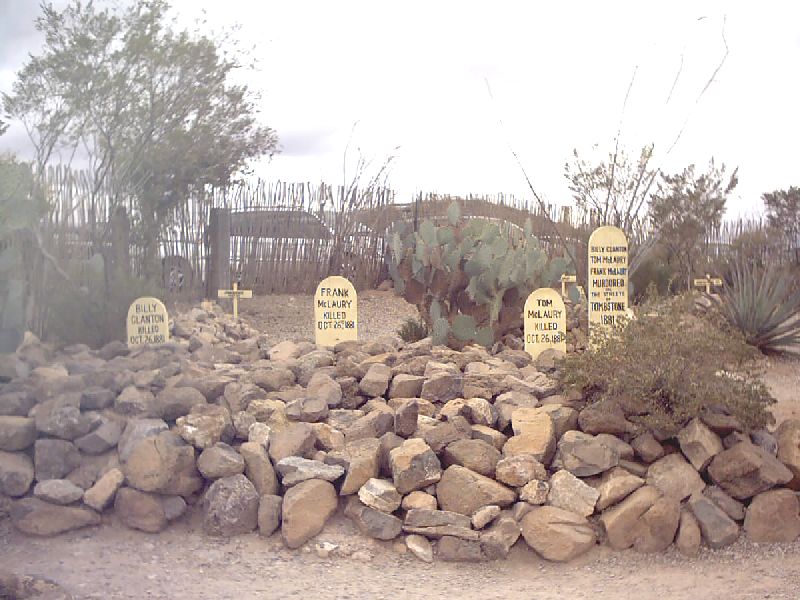 The second-place winners of the shoot-out at the OK Corral
Courtesy of http://maclir.dyndns.org/
A rather unusual event took place at the SCBT/MR (the Society of Computed Body Tomography and Magnetic Resonance if you didn't know) meeting last month. Six PACS vendors, Agfa, Amicas, Fuji, GE, McKesson, and Philips were pitted against each other in the first-ever PACS showdown. This is really a mighty feat in and of itself; getting six PACS stations and associated servers to all work at the same time is quite a miracle. I wonder who paid the electric bill.
Several vendors had engineering/apps types running their demonstrations, which consisted of performing a set of typical PACS tasks whilst under the gun. Amicas sent a physician who was very well acquainted with their product, and probably the best choice to show the world how their system works for its intended end users.
According the the Diagnostic Imaging article, there was no clear winner to this little exercise. Sadly, while some vendors (Amicas rep Barry Gutwillig was quoted in particular) wanted the results released, ". . . The vendors with more sensitive concerns. . .won this debate. To ensure a healthy participation at the next showdown, the SCBT/MR will not publish how the audience ranked each vendor." (Italics and implied disgust are mine.)
DI interviewed some of the attendees, and received various responses. Here's one from Dr. Dennis Foley, chief of Digital Imaging at MCW: "Dr. Foley. . . said that Philips, McKesson, and Fuji performed reasonably well in handling large data sets and doing relatively routine daily work. None of these companies, however, had well-integrated 3D solutions in their packages, he said. His nod went to GE for its hanging protocols, exam comparison, access to prior reports, and recovery from interruption." Ahem. It's clear that Dr. Foley hasn't used Centricity in the real world.
I am very disturbed about the "coverup" of the results of the showdown. Let's run an Olympic race and only report the results if the US wins. Obviously, one of the biG vEndors had a problem with how things turned out. Perhaps the small fry were more confident, or at least felt they had nothing to lose. Barry said it best:
“The society asked us if we wanted the results released, and we said yes,” said Barry Gutwillig, executive director of marketing and business development for Amicas. “We wouldn’t be here if we didn’t feel we could rank. I think it’s a testament to the vendors who are here and maybe more so to the ones who are not.”
With all this in mind, here is my advice for prospective PACS buyers: Do your OWN showdown. Either get a bunch of vendors to set up demos at your place all at once (or fairly close in time to each other so the details remain fresh), or get access to a web-based demo that will let you pound on their system at your leisure. I really favor the latter, as you can get a much better idea of how things work in your own hands. Vendors? Can you make this happen?
PACS interface preference is a very subjective thing. I like this approach, you like that approach. In this game, the second-place winner is in no immediate danger of extinction. Perhaps future showdowns can work from some additional metrics, such as: Does the damn thing work? Does it get in my way? Is the interface clean and usable? On second thought, those metrics are pretty hard to, um, meter, aren't they?
ADDENDUM
I received this comment, which is worthy of being moved into the post itself:
As one of the "big vendors" who was present at the show, we were also actually extremely irritated that the results were not disclosed, wherever we placed. This change in policy occured after we went on site. We may not participate again if that is going to be the way the showdown is run as it seems kind of pointless.We also thought the demonstration script was watered down from the original proposal and would have liked to have seen some of the original more challenging scenarios tackled.BTW: You have a minor inaccuracy in your article. You wrote that "Several vendors had engineering/apps types running their demonstrations". Actually, all of the vendors had a customer radiologist running their workstation. Some just seemed geekier than others.
I'm thinking this is from HBO/McKesson, by the way...
Now I wonder which vendor limited the tasks and then Got Excited about the results and as near as I can tell had them quashed? GEe, who could it have been?
OK, enough innuendo. If the folks at Centricity Central want to comment, I will publish their words here verbatim, just as I have for the Anonymous other Big Vendor. Well?
Sunday, May 21, 2006
Cool is for Losers!
My daughter just graduated from high school this weekend, and she will head to college in the fall, departing my sphere of influence. My son is finishing sixth grade, and will hang on to the Dad payroll for quite a while longer. It is his contemporaries that are starting to really worry me, the little 11 and 12 year-olds that shouldn't have a care in the world. Sadly, there are young kids in my son's class, boys as well as girls, that are incredibly concerned with what others think and say about them. It is very important to be "cool". These days, being "cool" involves not eating, not studying, not listening, showing no respect, and generally not doing anything they should be doing. The consequences of all this for these children's health are the most frightening aspect of the whole mess. When I hear a 12-year-old boy say that he can't drink a glass of milk because it might make him fat, I throw up my hands in horror. Enough is enough, people!
I propose a new campaign to fight this horrible trend, "Cool is for Losers!" When you get right down to it, being "cool" just means that you are doing stuff that makes you popular, but might not necessarily be smart or good for you. Starving yourself, smoking whatever, drinking, doing drugs, piercing various body parts, dressing like a prostitute, dressing like a convict (the droopy drawers look originated with prisoners who wanted to, ummmm, advertise their backside wares to fellow inmates), and so on and so on and so on. A real classy way to act, huh?
Why is it so important to be cool anyway? We've all been teenagers recently (ha!) and we all know the insecurities involved in that age group. To be accepted is more important than being healthy, or looking like a human being. But those whose entire goal in life is to be "cool" are more likely than not those who are petrified that they won't fit in with the "in" crowd. While they might make themselves popular with one tiny subset of society, they ruin their reputation with everyone else, and may cause irreparable physical or psychological harm to themselves. To put it quite bluntly, it is the "losers" that try so terribly hard to be cool, and conversely, the attempt to be "cool" can make these kids losers.
I'm no psychiatrist, and I can't begin to find the solution for all of this. However, sometimes just a catchy phrase will get things started. So, spread the word among the young folks in your lives: "Cool is for Losers!" It might actually make them think about the weird things they're doing, which is at least a step in the right direction.
I propose a new campaign to fight this horrible trend, "Cool is for Losers!" When you get right down to it, being "cool" just means that you are doing stuff that makes you popular, but might not necessarily be smart or good for you. Starving yourself, smoking whatever, drinking, doing drugs, piercing various body parts, dressing like a prostitute, dressing like a convict (the droopy drawers look originated with prisoners who wanted to, ummmm, advertise their backside wares to fellow inmates), and so on and so on and so on. A real classy way to act, huh?
Why is it so important to be cool anyway? We've all been teenagers recently (ha!) and we all know the insecurities involved in that age group. To be accepted is more important than being healthy, or looking like a human being. But those whose entire goal in life is to be "cool" are more likely than not those who are petrified that they won't fit in with the "in" crowd. While they might make themselves popular with one tiny subset of society, they ruin their reputation with everyone else, and may cause irreparable physical or psychological harm to themselves. To put it quite bluntly, it is the "losers" that try so terribly hard to be cool, and conversely, the attempt to be "cool" can make these kids losers.
I'm no psychiatrist, and I can't begin to find the solution for all of this. However, sometimes just a catchy phrase will get things started. So, spread the word among the young folks in your lives: "Cool is for Losers!" It might actually make them think about the weird things they're doing, which is at least a step in the right direction.
Wednesday, May 17, 2006
Dalai Busts a Junk Faxer!
Well, Almost....

My fax line at home rang at 3AM the other day, naturally the night before I had to take call. It was a message from my friendly Junk Faxer, and I had received the very same fax about 10 times already. But when someone wakes me at 3AM unnecessarily, watch out!
Some rather brief research on the Junk Faxer's fax-back number disclosed that he is using Global Crossing, and that the long distance provider is a little Seattle company called Threshold Communications. I called Threshold, and was able to speak to Karen, one of their VP's. She was very kind and helpful, and promised to get my number removed from the Junk Faxer's list. But, no, she could not disclose the name of the faxer. And she had been receiving numerous calls from disgruntled members of the public such as myself.
Junk Faxing is illegal, as it turns out, mainly because unlike email spam, it costs money to receive a fax. Paper, toner, ribbon, they all add uup, you know. But some of these guys just ignore the law and keep on faxing. We, the victims have very little recourse. There are some services, such as FaxRecoverySystems, that will handle the prosecution for you. Send them a dozen or so junk faxes, they will do the research, file the claims for the illegal activity, and send you a check for $100 or so. It's probably a good deal, as the footwork gets complicated, but keep in mind that the fine for each illegal fax is about $1500. FaxRecovery is recovering more than faxes! As an aside, they had a message posted asking for information about the rather ubiquitous fax, and I supplied them with Threshold's number. Hopefully, I'll get some sort of reward, although not having the phone ring at 3AM is reward in and of itself.
I am no lawyer, thank Heavens, but I have to wonder if the other companies involved in Junk Faxing have some legal liability. The people at Threshold obviously know that they are providing services to a company that is doing something illegal, as well as distasteful. Why don't they refuse to do so? Karen gave me the clue: the junk faxer has about 300 numbers through their service, "but we only get complaints about 3 of them." Money talks, eh?
It would be unethical for me to suggest that anyone contact Threshold and tell them the error of their ways, or to put the fax number of the Junk Faxer on speed-dial and help tie up his lines, so forget that I said anything about that. But if there are any Threshold customers out there reading this, perhaps they could mention the situation the next time they pay their bill? Just a thought.
Saturday, May 06, 2006
Walk the Line (Placement)
 Courtesy of ClinicalCases
Of the many and varied annoyances we endure on call, the CXR for line-placement at odd hours is becoming more common. When a surgeon or internist places a catheter in a large vein, there are some potential complications that should be excluded with a radiograph of the area. These problems include a pneumothorax, hematoma, and aberrant course of the line. All well and good. However, some of our clinicians have gotten into the habit of placing the line, and then telling the nurse to get Radiology to "OK the line" as they walk out the door.
Now, I can exclude the complications outlined above, although if I'm working from home at 3AM, I don't have high-res monitors at my disposal, and I can't really confirm that there isn't a tiny pneumo. But even a Sony Jumbotron would not tell me if the line is "OK", in other words usable. That is a clinical determination. If there was good return of blood through the line at the time it was placed, then it should be usable from a hemodynamic (plumbing) standpoint. For this reason, I am now placing the following sentence in the impression of each and every study I read for line placement:
Function of the line cannot be evaluated radiographically. This must be determined by the presence or absence of blood flow at the time of insertion.
Now, the question becomes: is the clinician who placed the line responsible for looking at the post-procedure radiograph? I posted this question on AuntMinnie, and while there was some debate, the majority felt that yes, the clinician IS responsible. He/she placed the line, and will collect the fees for doing so. Line placement has known possible complications, and the clinicians are perfectly able to see these on the radiograph. Are we selling our birthright if we ask them to look themselves? I don't think so. Dr. "Sofa King" posted this on the AuntMinnie thread:
Part of the procedure for line placement in confirmation of positioning and excluding the presence of a pneumothorax. If you have not done this the procedure is not over. If you cannot do this you should not be performing the procedure. If you cant see the cathether traversing up the neck, you shouldn't be performing the procedure.
The ONLY purpose of these rediculous follow-up xrays for placement of anything in a patient is to spread or turn over liability. Don't kid yourself that it is for anything else.
That said, we are not asking them to interpret an xray. Like a stethescope and ultrasound (both of which most of these guys have in their offices) the xray is just another tool of the procedure. Don't think that the idea that you won't let these guys read things in the hospital will stop them from taking anything from you when they want. They have xrays in their office and they can easily take a one week course in anything and get credentialled.
Couldn't have said it better myself. We'll see how much trouble my little canned statement causes. For me, that is.
Teens’ Speech Patterns Often Fail to, Like, Demonstrate Intelligence

The "LIKE" phenomenon is taking over the nation. Kids today, mine included, cannot utter a sentence that doesn't include the word "LIKE". Fortunately, my kids respond to yelling, screaming, threats, and ultimately beatings, and their abuse of this four-letter word has abated somewhat. Sadly, "LIKE" spews forth as every other word from some of their friends, and that is NOT an exaggeration. I am at the point of not being able to understand these poor kids.
Somehow, I thought this was a new problem, but it seems that is not the case. Here is an article from the Columbus Dispatch dated 4/1/1998, written by William L. Bainbridge, who is Distinguished Research Professor at the University of Dayton and is President & Chief Executive Officer of SchoolMatch®, a Columbus based educational auditing, research, data firm:
One of our country's many talk show celebrities is CNN monarch Larry King. King has used his outstanding listening, questioning and communication skills to catapault himself into an exciting career as a premier television and radio interviewer.
In his spare time, the King of primetime question-and-answer shows has published several books focused on his communication secrets. In How to Talk to Anyone, Anytime, Anywhere, King advises his disciples not to rely on "nothing filler words." Words and phrases such as "you know," "as I said," "basically," "actually," "hopefully," and "whatever" are condemned by King as only slightly worse than "uh" and "um" in spoiling interpersonal communication.
Despite the best efforts of teachers and parents, the nothing filler word of the 1990's has been, and continues to be, the dreaded word LIKE. It must have started somewhere in a cheerleading camp and spread with rapid-fire speed through our schools with the help of the media beginning with the early 1980's song and movie, Valley Girl. The movie Clueless and its television adaptation currently being run ad nauseum on cable channels everywhere, unfortunately, presents an accurate picture of the misuse and overuse of this word.
Recently, our organization was conducting an "effectiveness audit" in an affluent suburban school district. The school system recorded incredibly high achievement in virtually all areas of the curriculum. During our team's site visit, we met with a group of community leaders including elected student leaders. The president of the senior class is an outstanding young lady with impeccable scholastic credentials. She has high scholarship examination scores and terrific grades. Her achievements and activities are most impressive.
After the session, several adults clustered in a private corner discussing this young person's "communication flaw," or what Larry King would call a "speaking tic." She seemed unable to speak more than five words without one of them being LIKE.
The session was videotaped. We reviewed the tape and, to no surprise, found sixty-four instances by actual count of this bright person cluttering her sentence with the word LIKE in less than four minutes: "You know LIKE I feel LIKE students LIKE have trouble LIKE selecting LIKE career awareness LIKE experiences." This student was given an opportunity to demonstrate her verbal skills before leaders of the community. In the minds of those in a position to help promote her aspirations, she undermined the serious concepts she was putting forward with a nothing word sentence splice. Moreover, her speech pattern seriously interfered with her attempts to discuss the issues and persuade the audience. What was she trying to accomplish? Had this tic been developed in the process of trying to be trendy with her peers? Some teenagers can turn this brainless language on and off at will. Others apparently have difficulty adjusting to the audience. Most are completely unaware of the extent to which listeners are irritated by this drivel.
Teens need to be encouraged to express themselves. But sentence fillers and splices, however, taken to an extreme, are not well-received in public presentations and interviews for employment, scholarships or college admissions.
If there is a parent or teacher of a teenager reading this who hasn't heard the LIKE phenomenon, consider yourself fortunate. For the rest of us, let's throw it out with the oral crutch "uh", "you know" and "like I said" of an older generation and try to promote better language skills and communication.
So, can we like stop this horrible like bad habit before we like kill somebody? Like DoctorDalai? Let's all like declare our homes like-free zones, so we can have some intelligent conversation, like we used to. You know?
Friday, May 05, 2006
California Legislature To Tom Cruise:
NO MORE ULTRASOUND!
AuntMinnie.com reports today on a bill in the California Assembly designed to thwart private individuals from buying their own ultrasound scanners for home use:
Personally, I'm not sure how many private folks out there are going to cough up $100,000-$300,000 for their own private sonography suite. I also have to wonder whether the California legislature has anything better to do.
Now, we all know that Tom is really into Scientology, which spurns much of conventional medicine. I am glad to see him embrace some of our technology. You may know that Scientology uses a device called an Electropsychometer, or E-meter for short, to perform Auditing. Here is an image of the L. Ron Hubbard Mark-VII Super Electropsychometer:
The bill (A.B. 2360) was introduced by Lieu in March. An amended version of the bill, dated May 1, states that violation of the proposed law would carry a criminal misdemeanor charge. The bill was slated for its third reading on the Assembly floor on Thursday.
"If someone sees Tom Cruise buy one, they think this is the thing to do. This is a public safety measure. There's really no medical reason for an untrained person to use this machine," according to Lieu (E!Online, May 4, 2006).
Personally, I'm not sure how many private folks out there are going to cough up $100,000-$300,000 for their own private sonography suite. I also have to wonder whether the California legislature has anything better to do.
Now, we all know that Tom is really into Scientology, which spurns much of conventional medicine. I am glad to see him embrace some of our technology. You may know that Scientology uses a device called an Electropsychometer, or E-meter for short, to perform Auditing. Here is an image of the L. Ron Hubbard Mark-VII Super Electropsychometer:
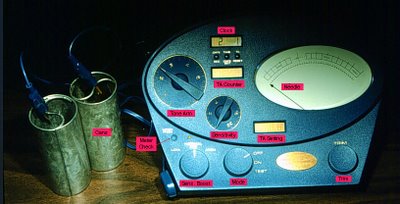
Very impressive. From the Scientology website, we learn that:
When the person holding the E-Meter electrodes thinks a thought, looks at a picture, reexperiences an incident or shifts some part of the reactive mind, he is moving and changing actual mental mass and energy. These changes in the mind influence the tiny flow of electrical energy generated by the E-Meter, causing the needle on its dial to move. The needle reactions on the E-Meter tell the auditor where the charge lies, and that it should be addressed through auditing.
Couldn't Tom and Katie have just looked in on little Suri with one of these instead?
A Blast From The Past...
Vital Images Comes A-Callin'

Mark, our PACS guru, phoned me this morning with some interesting news: Carrie from Vital Images was on the line, and wanted to ask about updating our software licenses. Mark was rather confused, a very rare state for him, because he didn't know we even had any of Vital's products. I clasped my hands together in a sinister manner and slobbered with glee....
You see, we do own three Vitreas, dating from the mid 1990's. All are Silicon Graphics computers, two running IRIX (SG's flavor of UNIX), and one running Windows NT. These represent an investment of something like $150,000 to $200,000 or so. I wasn't involved with their purchase. Actually, if memory serves, the NT was a trade-in or something. But I digress.
About three or four years ago, one of the computers blew a hard-drive. I tried to nurse it back to health, but to no avail. So I called Vital Images. TEN TIMES! And I emailed them ten more times. Nothing. I posted nasty things about them on AuntMinnie.com. Nothing. We chalked up our losses, and went on to bigger and better things, like GE AW's and Siemens Leonardos, and various installs of Voxar 3D, all of which have done the job nicely.
I returned Carrie's call, and as nicely as I could for someone out $200,000 on non-working equipment, explained the situation. She had only just joined the service force, and was not happy to hear of our plight. I suggested she elevate the complaint to the president of the company, although that would be mainly for their benefit. Given this incredible service faux pas, I would not even accept a freebie at this point. If Vital wishes to donate a Vitrea to a third-world country in my name to assuage their collective conscience, that would be fine. But do tell them not to expect stellar service if it breaks.
Carrie promised to figure out what had happened, and to keep such a thing from happening again. I wish she had been with Vital a few years ago....
Addendum: The Vital rep for our area did indeed contact me, and we had a very good conversation. I do wish this new generation had been around when our problems started. Anyone want to buy a first or second generation Vitrea?
Sunday, April 30, 2006
The Case of the Missing Hole...
A Doctor Dalai Mystery
I'm on call tonight, and I've read about 200 studies since 8AM. Does wonders for the attitude. Imagine my joy (or lack thereof), when I received the following call from one of our hospitals:
"Uh, Dr. Dalai? This is Joe Tech from NorthSouth Hospital. I have another CT PA gram for you, and also a renal stone CT. Oh, and Dr. Feckless in the ER wants to know if we should scan a chest without or with contrast. Why does he want it? Well, he sees a hole in the lung on a chest X-ray, and he wants to scan it......"
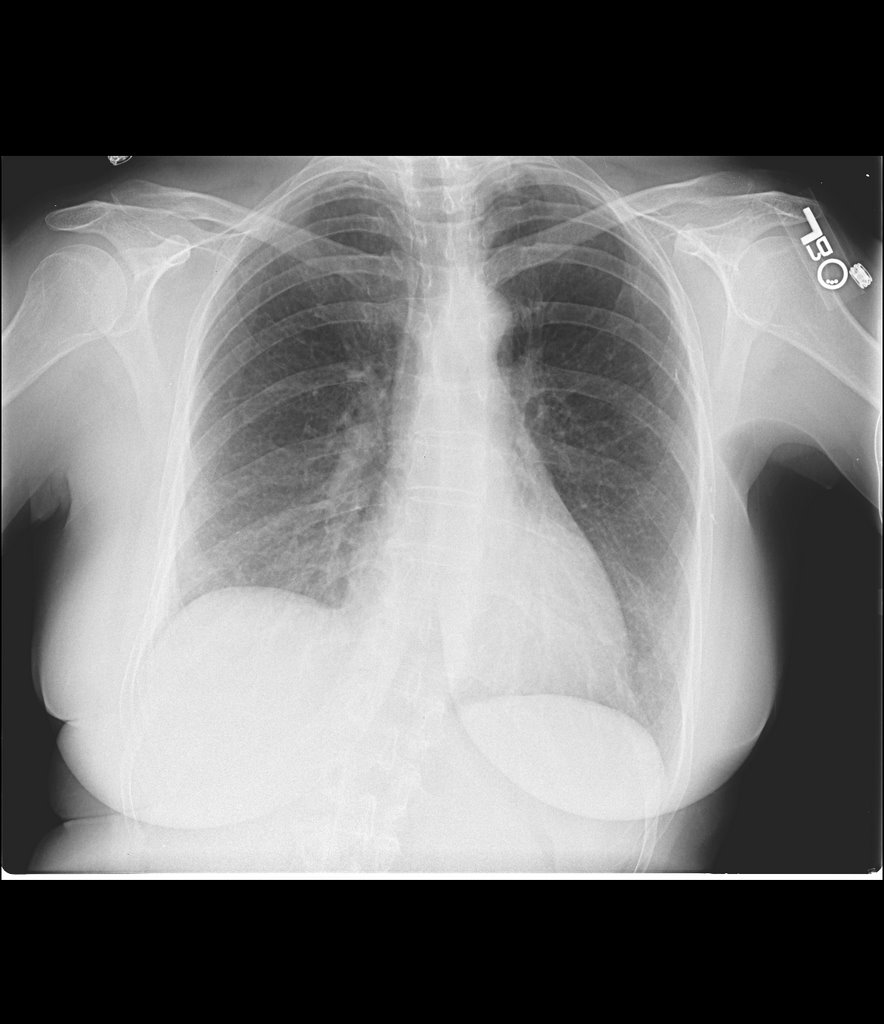
Only the names have been changed to protect the innocent (ME!!!). The chest X-ray in question is anonymously reproduced below:

My response to Joe Tech was at first angry and then practical..."Is Dr. Feckless going to call in the surgeons based on the CT finding? No, don't repeat that....repeat the chest X-ray with the arms out of the way, and if the, ummm, hole is still there, THEN we'll do a CT." The repeat is found below. Voila! No hole!
This practice has got to stop, just as much as self-referral must be curbed. I keep backing into the conclusion that socialized medicine is going to do that for us, whether we like it or not. Hope I'm wrong. In the meantime, let me read the next 10 negative CT's.
Thursday, April 27, 2006
SCAR Capitulates to Estonian Pressure!


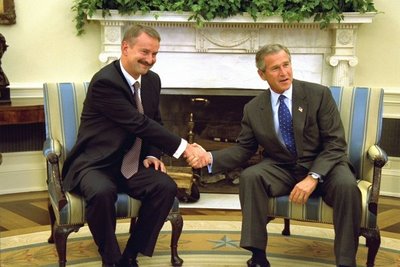
Big news in the PACS world, folks! SCAR, the Society for Computer Applications in Medicine has changed its name to Siim. Now, in theory, this stands for the Society for Imaging Informatics in Medicine. However, Dalai, your intrepid reporter, did a little digging and discovered the following: The Prime Minister of Estonia is, you guessed it, Siim Kallas! Coincidence? I think not. Notice in the photo below how Mr. Kallas (the one on your left) is looking quite pleased with himself, having just convinced Mr. Bush to move SCAR, I mean SiiM, headquarters to Estonia. I will actually be in Estonia later this year (really!) and I will check this out personally.
In the meantime, if you go to http://www.siim.com, you will reach the site of a plastics manufacturer with these featured products: 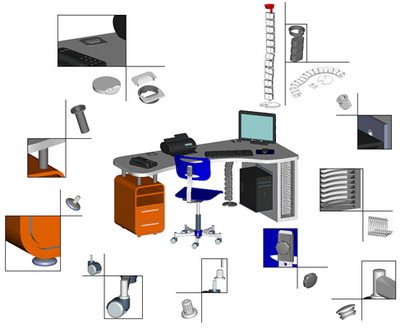
Looks like they are in the PACS business, too! Do you sense any takeover plans? Hmmmmm?
United 93

Dalai's Note: David Beamer is the father of Todd Beamer, one of the heros of United Flight 93. His words are so eloquent and poignant, I have copied his statement from today's Wall Street Journal for the benefit of my readers. America needs to hear this, and we need to see this movie.
By DAVID BEAMER Wall Street Journal,April 27, 2006; Page A18
The calendar says it's April 25, 2006. At noon, my wife, Peggy, and I are walking around Battery Park -- near the Tribeca area -- in New York. It is our first time. The flowers are blooming; kids are fishing; people boarding the ferry to Ellis Island and the Statue of Liberty. Kids are laughing and noisy. The sun is shining. The vendors are hawking T-shirts, pretzels and some "designer" wares. And just up the street there is a hole in the skyline and in the ground.
In the park, there is a memorial with walls standing tall. Walls filled with so many names of those who gave their all in the Atlantic in World War II. How fitting that the names are here to honor those who gave their lives to enable this fun, this laughter -- on this sunny day. The sights and sounds of freedom continue.
Fast forward -- it is 10:30 p.m., April 25. We have just seen a movie premiere at the fifth annual Tribeca Film Festival. A film festival that has done so much to energize and revitalize the city, its people and especially the area that has that hole in the skyline and in the ground. This year the movie that had its worldwide premiere at the festival is titled "United 93." It is about the day when the hole in the skyline of New York was made -- the day when a hole was made in the side of the Pentagon near Washington, D.C. -- the day when a hole was made in a quiet mountain meadow in Pennsylvania. The day that our nation was attacked; the day when the war came home -- Sept. 11, 2001. The day our son Todd boarded United 93.
Paul Greengrass and Universal set out to tell the story of United Flight 93 on that terrible day in our nation's history. They set about the task of telling this story with a genuine intent to get it right -- the actions of those on board and honor their memory. Their extensive research included reaching out to all the families who had lost loved ones on United Flight 93 as the first casualties of this war. And Paul and his team got it right.
There are those who question the timing of this project and the painful memories it evokes. Clearly, the film portrays the reality of the attack on our homeland and its terrible consequences. Often we attend movies to escape reality and fantasize a bit. In this case and at this time, it is appropriate to get a dose of reality about this war and the real enemy we face. It is not too soon for this story to be told, seen and heard. But it is too soon for us to become complacent. It is too soon for us to think of this war in only national terms. We need to be mindful that this enemy, who made those holes in our landscape and caused the deaths of some 3,000 of our fellow free people, has a vision to personally kill or convert each and every one of us. This film reminds us that this war is personal. This enemy is on a fanatical mission to take away our lives and liberty -- the liberty that has been secured for us by those whose names are on those walls in Battery Park and so many other walls and stones throughout this nation. This enemy seeks to take away the free will that our Creator has endowed in us. Patrick Henry got it right some 231 years ago. Living without liberty is not living at all.
The passengers and crew of United 93 had the blessed opportunity to understand the nature of the attack and to launch a counterattack against the enemy. This was our first successful counterattack in our homeland in this new global war -- World War III.
This film further reminds us of the nature of the enemy we face. An enemy who will stop at nothing to achieve world domination and force a life devoid of freedom upon all. Their methods are inhumane and their targets are the innocent and unsuspecting. We call this conflict the "War on Terror." This film is a wake-up call. And although we abhor terrorism as a tactic, we are at war with a real enemy and it is personal.
There are those who would hope to escape the pain of war. Can't we just live and let live and pretend every thing is OK? Let's discuss, negotiate, reason together. The film accurately shows an enemy who will stop at nothing in a quest for control. This enemy does not seek our resources, our land or our materials, but rather to alter our very way of life.
I encourage my fellow Americans and free people everywhere to see "United 93."
Be reminded of our very real enemy. Be inspired by a true story of heroic actions taken by ordinary people with victorious consequences. Be thankful for each precious day of life with a loved one and make the most of it. Resolve to take the right action in the situations of life, whatever they may be. Resolve to give thanks and support to those men, women, leaders and commanders who to this day (1,687 days since Sept. 11, 2001) continue the counterattacks on our enemy and in so doing keep us safe and our freedoms intact.
May the taste of freedom for people of the Middle East hasten victory. The enemy we face does not have the word "surrender" in their dictionary. We must not have the word "retreat" in ours. We surely want our troops home as soon as possible. That said, they cannot come home in retreat. They must come home victoriously. Pray for them.
Wednesday, April 19, 2006
Happy Birthday, Dr. K!
Nobody escapes the Spanish Inquisition, or Doctor Dalai when he has photos!
Dr. K celebrated his 40th birthday by trucking into the hospital at 4AM to do a lumbar puncture on a 350 pound lady who wouldn't hold still. The day did improve significantly, and we had a chance to celebrate a little. Dr. K is an avid biker, occasionally riding all the way to the hospital from home. We thought he needed something a little snazzier......
8G SCAM!
A Public Service Announcment from Doctor Dalai


From the "if it's too good to be true it probably isn't" department.....
I troll around eBay periodically, looking for bargains and whatnot. I stumbled across a listing for a "Sony Micro Vault 8GB USB Flash Drive," going for only about $40. I immediately bid on it. Fortunately, a kind soul informed me by email that Sony doesn't make any drives that large in that form-factor, and what I was bidding on was likely a fake. I was able to withdraw my bid in the nick of time. Yes, it would look like an 8GB drive to my computer, until I actually tried to write something to it and read it back. Then its real size of 64 MB would become apparent.
In the interests of Karma, I am passing this information on to my loyal readers. For more information, please see this notice on eBay.
This has been a public service announcement brought to you by Doctordalai.com. Thank you for your attention.
Sunday, April 16, 2006
Happy Easter from Doctor Dalai!
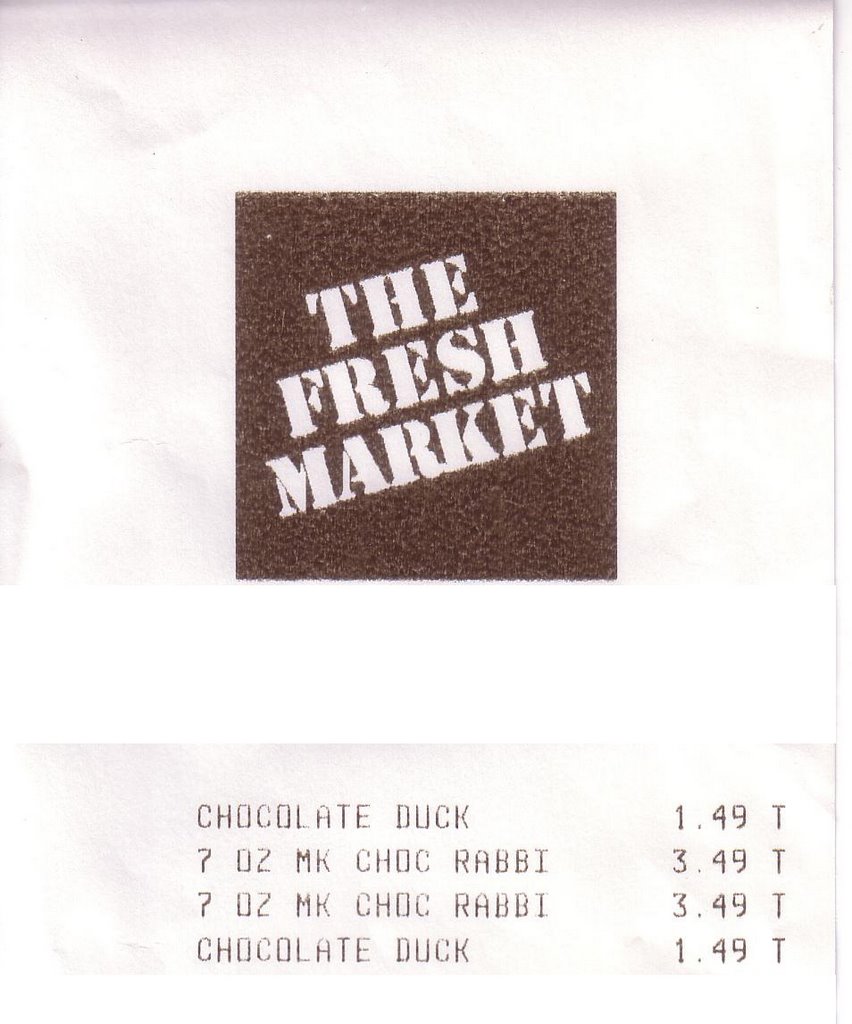

I swear this has not been retouched save to eliminate the name of the store manager. I have always been one to promote good relations between peoples of all faiths. We purchased some Easter Chocolate for some friends, but we didn't realize until we left the store just how ecumenical our selection really was. I wonder if my friends will go for the ears first......
Saturday, April 08, 2006
The X-Ray Man
It’s 2 AM on a Saturday
The regular crowd is all here
There’s an old man yelling out at me
With dementia he’s had for three years
He says, “Doc will you give me an enema?
You know where the barium goes
I got cramps and the trots
Which I didn’t have lots
When I had a younger man’s hose…”
Oh La La La De De Da
La La, De De Da Da Dum
Read us a film, You’re the X-Ray Man
Read us our film TONIGHT
‘Cause we’re all in the mood for a malady
And CT will make us alright
Now John down in Nukes is a friend of mine
He tries not to wake me ‘till 3
And he’s quick with his V/Q
And then he won’t seek you
Till the ER just won’t let him be
He says, “Doc, they just ordered another one”
“I tried not to do it till 10…
But the patient is dusky and comatose
And probably won’t live until then.
Oh La La La De De Da
La La, De De Da Da Dum
Read us a film, You’re the X-Ray Man
Read us our film TONIGHT
‘Cause we’re all in the mood for a malady
And CT will make us alright
Paul is our CT Technologist
Who scans like he’s been there for days
And he’s talking with Davy whose CR’s are wavy
But they all pass QC anyway.
And the ward-clerk is practicing medicine
As the waiting-room slowly gets mean
Yes, they’re sharing a drink they call Thunderbird
Which does wonders for liver and spleen
It’s a really slow night for a Saturday,
I’m 63 studies behind
It takes more than my best
To read neck, head, and chest
And abdomen, pelvis, and spine
And the PACS system smokes like a chimney
And the Dictaphone squawks in my ear
And I sit in my chair and stare off in the air
And say, “Man, what am I doin’ here?”
Oh La La La De De Da
La La, De De Da Da Dum
Read us a film, You’re the X-Ray Man
Read us our film TONIGHT
‘Cause we’re all in the mood for a malady
And CT will make us alright
Saturday, March 25, 2006
Radiology, PACS, Clinicians, and Rocket-Science
"semila" started an AuntMinnie thread with the following posts:
Gee, where do I begin.... First off, I'll take the IT comment more as a complement than anything else, although I am no doubt considered a "scary cat" by both IT and physician camps. I'm in progress on my next AuntMinnie article concerning this particular relationship, and it is guaranteed to touch some nerves. As it turns out, I have degree in Electrical Engineering, major in Bioengineering, minor in Computer Science, so I do have the ability to “talk the talk” of IT, and occasionally even to “walk the walk”.
I tend to agree with semila to some degree about the level of "rocket science" or lack thereof in PACS. It has indeed been commoditized and often just comes as an added bonus with a suite of scanners or other computer systems. Rather like a prize in a cereal box. As an engineer, I do keep in mind that PACS at its core is simply the movement of image data from place to place, and this is not “rocket science” in this day and age. Semila points out that HIPAA plays a major part in its function, but as I found in researching my last article, one can use HIPAA as a template, and not hide behind it to avoid doing your job as some IT folks are wont to do.
At this point, I am going to throw in something so obvious, yet so obnoxious, that it will certainly generate some nasty commentary. So be it….. PACS EXISTS for the radiologists. Ha! Try to disprove that. As Pacs_Guru says, we radiologists are now blind without IT, but IT has no reason to exist without us. PACS defines how I do my job, which is to interpret radiographic and related imaging studies. Without PACS, the patient would still get the study and get it read, but this process would utilize film or perhaps reading directly off of the scanner’s monitor. There is a lot of technical jargon involved in the processes of “receiv(ing) images from modality, compress, store, display, and distribute”, even if it is pretty mundane. Those of us who come here are interested in these “boring” things, and they need to be discussed.
No doubt there will be eventual incorporation of PACS into the wider information systems; we are seeing that already to a minor degree. But since PACS is a tool for radiologists, I will push the very biased view that its next evolution/revolution needs to be in radiology workflow. I have only a vague idea, personally, of where that needs to go. When I went into private practice, 16 years ago, the work model was not so very different than it is today. We would pile in at 8AM, grab 20 or 30 jackets off a stack of 100 or so, put the films on the viewer, interpret them by dictating into a tape-recorder, with demographic information, history, etc, from a paper requisition, take the film down, sack it, stack the jacket, and then do the same for the next patient. The workflow today is to some extent an electronic version of the film days. We sign on to the PACS, select the appropriate worklist, queue up the first study, dictate it into the tank (eventually to VR), using demographics gleaned from the HIS/RIS system, and push the button removing this exam from the list and queuing up the next. (The sweat-shop/factory analogy is apt much of the time.)
The real difference between film and PACS is that we can manipulate the images we view, and in the case of multislice CT, we can add a number of tools to the armamentarium, including cine-view and the various flavors of 3D such as MPR, Volume Rendering, Virtual Endoscopy, and so on. At some point, there will be some radically different paradigm for reading, although it would have to go hand-in-hand with advances in imaging technology as a whole. We are already seeing that to some extent with whole-body CT. Instead of an X-Ray here and there, our patients are being scanned from head (almost) to toe. There is a great push in this direction from the ER, which wants us to do all their diagnosis for them. Thus, our trauma center often orders “Man-Scans” including CT’s of the head, neck, chest, abdomen, pelvis, total spine, at least one extremity, CT PA gram, and CT Aortogram. One stop shopping, folks. Much as I resent doing the ER’s docs’ thinking for them, I realize that this is where we are in 2006, and somehow my workflow needs to incorporate this monster. Here is where a good, unobtrusive PACS system can help me. All of the imaging needs to be delivered to me in a way that I can read it as efficiently as possible. How about the exams that benefit from 3D (Aortogram, spine CT’s, etc.) being automatically displayed with the MPR’s or VR’s necessary for rapid interpretation? How about automatically displaying relevant priors, images, lab data, etc? That is just the tip of the iceberg, and there are many folks much smarter than I am out there working on all this.
Semila proposes that radiologist need not be the masters of imaging, that other specialties could do at least as well at it. I’m trying very hard not to take this as an attack on my profession, but that is quite difficult as you might imagine. I am assuming that semila is not from the US based on his/her diction, and perhaps things are different is his/her native land. I cannot put it better than did James P. Borgstede, M.D., head of the ACR, in his article “Chipping Away at Imaging” in this month’s Journal of the American College of Radiology:
The point is that radiologists are trained for many years to interpret the entire image. Remember, what we are looking at is ultimately the anatomy and pathology, not just an image of shadows and density distributions, or water mappings, or areas of glucose uptake. The total yield is definitely more than the sum of the parts here. It doesn’t matter if they are reading a film, a digital image, or holding the patient up to the light. That is why the “old” radiologists are just as good at the new modalities.
Could you train a cardiologist to spot a lung cancer on a coronary CTA? Could you train an orthopedic surgeon to see that same lung cancer on a thoracic spine series? Probably. These folks are very smart and dedicated to what they do best. I mean to take nothing away from them. But where does this mentality stop? Why shouldn’t the surgeon look at the cytopath slides from his biopsy? Maybe he should supervise anesthesia as well? I’m sure he could be trained to do so.
Rather like pathologists, radiologists are impartial arbitrators. We have nothing to gain by coming to one conclusion or another. Once the study is ordered, we have only the goal of finding the right answer. We cannot, by definition, self-refer, which is NOT the case with clinicians. I’m not going to rehash that issue on this thread, but it may well be the one single reason NOT to turn over the reins of imaging to the clinicians.
Definitely a fascinating discussion, semilla! Thanks for starting the thread.
OK, Semila, you did indeed get my attention! I posted a more limited answer on AuntMinnie due to restrictions on the size of individual responses, but here it is a bit more fleshed-out.Has anyone other than me concluded that the PACS market in general has become a big yawn? The conversations on these boards has deteriorated into techie minutia and nothing exceptional has come from any of the major PACS vendors in recent years. Price erosion continues to dampen the market and no new entries have come into the space in the past couple years. PACS has become a "cog in the wheel". Digital Imaging will in most cases now, be sold with larger information systems and will be a module that can be "turned on or off". PACS is not radiologies baby anymore, but one of the many niches that will make up the EMR/EPR. Aunt Minnie would be wise to diversify the content of its site to begin including more foward thinking discussion.
and
. . . PACS genrerally has one purpose: receive images from modality, compress, store, display and distribute. This isnt rocket science folks, and other industries do this all the time, they just dont have to answer to HIPPA! The foward thinking focus here should be how PACS fits into information systems. The small markets adoption of PACS is irrelevant.
Another note: I for one am a fan of image interperetation being taken away from radiologists and infused into the doctorate programs of the "real" docs, like cardiologists. Doctors that sit in dark rooms or in front of computers providing varying degrees of experience in diagnosis without ever actually seeing a patient is beyond me (teleradiogy - ugh). I am sure I touched a nerve with this one, but c'mon.........really. How bout this Dalai Lama cat.........this guy sounds more like an IT person than a doctor. Scary.
Gee, where do I begin.... First off, I'll take the IT comment more as a complement than anything else, although I am no doubt considered a "scary cat" by both IT and physician camps. I'm in progress on my next AuntMinnie article concerning this particular relationship, and it is guaranteed to touch some nerves. As it turns out, I have degree in Electrical Engineering, major in Bioengineering, minor in Computer Science, so I do have the ability to “talk the talk” of IT, and occasionally even to “walk the walk”.
I tend to agree with semila to some degree about the level of "rocket science" or lack thereof in PACS. It has indeed been commoditized and often just comes as an added bonus with a suite of scanners or other computer systems. Rather like a prize in a cereal box. As an engineer, I do keep in mind that PACS at its core is simply the movement of image data from place to place, and this is not “rocket science” in this day and age. Semila points out that HIPAA plays a major part in its function, but as I found in researching my last article, one can use HIPAA as a template, and not hide behind it to avoid doing your job as some IT folks are wont to do.
At this point, I am going to throw in something so obvious, yet so obnoxious, that it will certainly generate some nasty commentary. So be it….. PACS EXISTS for the radiologists. Ha! Try to disprove that. As Pacs_Guru says, we radiologists are now blind without IT, but IT has no reason to exist without us. PACS defines how I do my job, which is to interpret radiographic and related imaging studies. Without PACS, the patient would still get the study and get it read, but this process would utilize film or perhaps reading directly off of the scanner’s monitor. There is a lot of technical jargon involved in the processes of “receiv(ing) images from modality, compress, store, display, and distribute”, even if it is pretty mundane. Those of us who come here are interested in these “boring” things, and they need to be discussed.
No doubt there will be eventual incorporation of PACS into the wider information systems; we are seeing that already to a minor degree. But since PACS is a tool for radiologists, I will push the very biased view that its next evolution/revolution needs to be in radiology workflow. I have only a vague idea, personally, of where that needs to go. When I went into private practice, 16 years ago, the work model was not so very different than it is today. We would pile in at 8AM, grab 20 or 30 jackets off a stack of 100 or so, put the films on the viewer, interpret them by dictating into a tape-recorder, with demographic information, history, etc, from a paper requisition, take the film down, sack it, stack the jacket, and then do the same for the next patient. The workflow today is to some extent an electronic version of the film days. We sign on to the PACS, select the appropriate worklist, queue up the first study, dictate it into the tank (eventually to VR), using demographics gleaned from the HIS/RIS system, and push the button removing this exam from the list and queuing up the next. (The sweat-shop/factory analogy is apt much of the time.)
The real difference between film and PACS is that we can manipulate the images we view, and in the case of multislice CT, we can add a number of tools to the armamentarium, including cine-view and the various flavors of 3D such as MPR, Volume Rendering, Virtual Endoscopy, and so on. At some point, there will be some radically different paradigm for reading, although it would have to go hand-in-hand with advances in imaging technology as a whole. We are already seeing that to some extent with whole-body CT. Instead of an X-Ray here and there, our patients are being scanned from head (almost) to toe. There is a great push in this direction from the ER, which wants us to do all their diagnosis for them. Thus, our trauma center often orders “Man-Scans” including CT’s of the head, neck, chest, abdomen, pelvis, total spine, at least one extremity, CT PA gram, and CT Aortogram. One stop shopping, folks. Much as I resent doing the ER’s docs’ thinking for them, I realize that this is where we are in 2006, and somehow my workflow needs to incorporate this monster. Here is where a good, unobtrusive PACS system can help me. All of the imaging needs to be delivered to me in a way that I can read it as efficiently as possible. How about the exams that benefit from 3D (Aortogram, spine CT’s, etc.) being automatically displayed with the MPR’s or VR’s necessary for rapid interpretation? How about automatically displaying relevant priors, images, lab data, etc? That is just the tip of the iceberg, and there are many folks much smarter than I am out there working on all this.
Semila proposes that radiologist need not be the masters of imaging, that other specialties could do at least as well at it. I’m trying very hard not to take this as an attack on my profession, but that is quite difficult as you might imagine. I am assuming that semila is not from the US based on his/her diction, and perhaps things are different is his/her native land. I cannot put it better than did James P. Borgstede, M.D., head of the ACR, in his article “Chipping Away at Imaging” in this month’s Journal of the American College of Radiology:
One of the first canons radiology residents learn when they enter training is to look at the entire image. We are taught that this precept separates us from other physicians who view, but do not interpret, images. Image interpretation, as we all know, is difficult. Sometimes we’re given histories, and occasionally, we even have the opportunity to talk with referring physicians to assist us in our interpretations. Both written histories and dialogues usually focus on clinicians’ suspicions from their histories and physical examinations, assuming they have performed them. Clinicians direct our attention to parts of images or to certain organ systems. By adhering to the first tenet of radiology, we avoid missing unsuspected, but significant, findings included in studies. How many times is a computed tomographic scan requested for pulmonary embolus only to find that the patient has a rib fracture or subdiaphragmatic process that accounts for his or her symptoms? Radiologists, looking at the entire image, hopefully detect the significant abnormalities that are commonly missed by our clinical colleagues only looking at the portions of the studies piquing their clinical interest. These nonradiologist “viewers” of images mentally chip away at imaging examinations, excluding the areas they perceive as irrelevant. By viewing examinations with tunnel vision, they miss significant observations. It seems today that chipping away at images, and in fact our entire specialty, is an avocation of many individuals and groups inside and outside of medicine.Clinicians are keen on focusing on the parts of images within their specialties or subspecialties. Computed tomographic scanners have even been created to assist them in carving away unwanted portions of images. Cardiac imaging is one example; scanners have been created that remove everything from images except the heart. Therefore, physicians focused on the cardiac portions of scans do not have responsibility for the distractions created by bones, soft tissues, lungs, and other mediastinal structures. The companies marketing such scanners emphasize to nonradiologists the freedom from liability and responsibility such scanners create: “If you can’t see it, you don’t have any responsibility for it.” The companies in turn market the same products to radiologists under the pretext of protecting radiology for radiologists by excluding the ability of others to view portions of images that, in the companies’ opinion, are the purview of radiologists. What a help these companies are in chipping away at the images! Unfortunately, patients suffer in this scenario because they may require repeat scans to look at the structures excluded from the original examinations.
The point is that radiologists are trained for many years to interpret the entire image. Remember, what we are looking at is ultimately the anatomy and pathology, not just an image of shadows and density distributions, or water mappings, or areas of glucose uptake. The total yield is definitely more than the sum of the parts here. It doesn’t matter if they are reading a film, a digital image, or holding the patient up to the light. That is why the “old” radiologists are just as good at the new modalities.
Could you train a cardiologist to spot a lung cancer on a coronary CTA? Could you train an orthopedic surgeon to see that same lung cancer on a thoracic spine series? Probably. These folks are very smart and dedicated to what they do best. I mean to take nothing away from them. But where does this mentality stop? Why shouldn’t the surgeon look at the cytopath slides from his biopsy? Maybe he should supervise anesthesia as well? I’m sure he could be trained to do so.
Rather like pathologists, radiologists are impartial arbitrators. We have nothing to gain by coming to one conclusion or another. Once the study is ordered, we have only the goal of finding the right answer. We cannot, by definition, self-refer, which is NOT the case with clinicians. I’m not going to rehash that issue on this thread, but it may well be the one single reason NOT to turn over the reins of imaging to the clinicians.
Definitely a fascinating discussion, semilla! Thanks for starting the thread.
Thursday, March 23, 2006
TEN THOUSAND HITS for DoctorDalai.com!!!

Wow. Who'd have ever thunk it? From an inasupicious beginning to one of the four or five premier PACS blogs on the Internet! Of course, there are only about four or five PACS blogs on the Internet, so perhaps the competition isn't terribly fierce. Still, it's a monumental achievement as far as I'm concerned, and I thank all of you out there who have hit the reload button all those hundreds of times.
Anyway, I know visitor 10K quite well; he comes to us from mid-Florida via Road Runner, and he is one of the Mark's who define PACS for me. He knows who he is. Hey Mark, have you been sitting by the computer waiting for the opportunity? Did you think there might be a prize involved? Well, drop me an email, and you will qualify for an autographed photo, suitable for framing, target practice, or wrapping fish. Congratualations!
The Dalai PACS system is in progress...we have signed papers and promised money, and the equipment should start to arrive. The PACS adventure is just beginning!
Sunday, March 19, 2006
Impax 6.0: Glitch Report
I think Agfa may already know about this, but putting it on the blog guarantees that everyone who matters from Mortsel to Massachusetts will get to see it.
You will perhaps remember the monitor configuration screen:
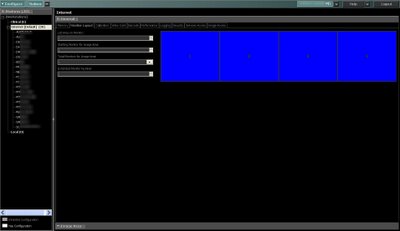
Well, Windows has its own monitor configuration screen, accessed through the "Display" control panel. One of our stations was set up such that monitor 3 was between 1 and 2...it's just the way the cables ran. Windows lets you move the icon representing the monitor to wherever you want it to be, thus matching the physical configuration. Unfortunately, this totally confused Impax 6.0, which tried to place the image panes between monitor 3 and 2. That didn't work very well. After an hour of reinstalling video adapter and monitor drivers (at one point, I rendered the whole station useless and had to LogMeIn into it to get it to work), I just swapped the cables to the offending monitors, and redid the Windows Display setup. Voila! All is well. Maybe Impax 6.5 will take its cues from Windows, rather than attempting to override it. Remember, folks, the market has chosen Windows as the platform of choice; things go more smoothly if we let it do what it wants to do.
You will perhaps remember the monitor configuration screen:
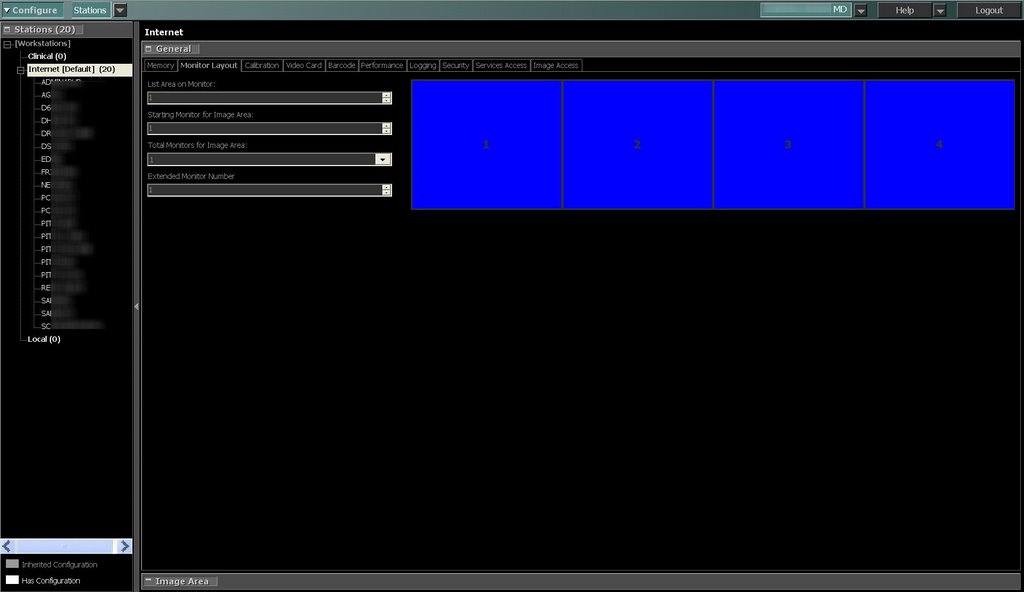
Well, Windows has its own monitor configuration screen, accessed through the "Display" control panel. One of our stations was set up such that monitor 3 was between 1 and 2...it's just the way the cables ran. Windows lets you move the icon representing the monitor to wherever you want it to be, thus matching the physical configuration. Unfortunately, this totally confused Impax 6.0, which tried to place the image panes between monitor 3 and 2. That didn't work very well. After an hour of reinstalling video adapter and monitor drivers (at one point, I rendered the whole station useless and had to LogMeIn into it to get it to work), I just swapped the cables to the offending monitors, and redid the Windows Display setup. Voila! All is well. Maybe Impax 6.5 will take its cues from Windows, rather than attempting to override it. Remember, folks, the market has chosen Windows as the platform of choice; things go more smoothly if we let it do what it wants to do.
Saturday, March 11, 2006
Feature Fatigue and Lego PACS

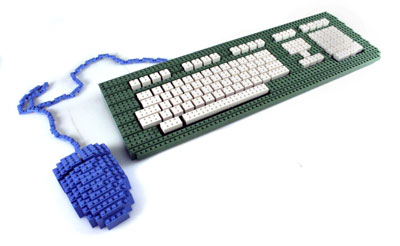



Even a blind pig occasionally finds an acorn, or even a truffle. So it is with yours truly. I was listening to NPR's "Weekend Edition" this morning (yes, conservative ol' Dalai listens to Radio Dark Side on occasion), and I caught an interview with Dr. Roland Rust from the University of Maryland. Dr. Rust holds the David Bruce Smith Chair in Marketing at the Robert H. Smith School of Business at the University of Maryland, where he is Chair of the Marketing Department and is Executive Director of the Center for Excellence in Service. Good credentials, right? Dr. Rust discussed the theory of "Feature Fatigue", and I was reminded instantly of Lego PACS. It seems I stumbled onto the same basic idea as Dr. Rust and his colleagues. The abstract of his recent paper tells the story:
As technology advances, it becomes more feasible to load products with a large number of features, each of which individually might be perceived as useful. However, too many features can make a product overwhelming for consumers and difficult to use. Three studies examine how consumers balance their desires for capability and usability when they evaluate products and how these desires shift over time. Because consumers give more weight to capability and less weight to usability before use than after use, they tend to choose overly complex products that do not maximize their satisfaction when they use them, resulting in “feature fatigue.” An analytical model based on these results provides additional insights into the feature fatigue effect. This model shows that choosing the number of features that maximizes initial choice results in the inclusion of too many features, potentially decreasing customer lifetime value. As the emphasis on future sales increases, the optimal number of features decreases. The results suggest that firms should consider having a larger number of more specialized products, each with a limited number of features, rather than loading all possible features into one product.
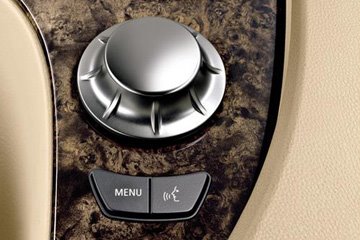
In the interview, Dr. Rust used the example of the latest BMW, which uses a technological innovation called "iDrive". This is sort of like a mouse for the car, and controls about 700 different functions. It looks good on paper, and in the showroom, but it seems that about 95% of those who buy the car actually use maybe 10 or 20 of those 700 options. To me, the way Lexus designs its dashboard is the antithesis to the BMW approach. It is simple and clear, there are far fewer buttons, but those that are there do what they are supposed to do superbly well. The car becomes almost transparent; it's just me and the road. But I digress. The bottom line is that people are attracted to products that have a lot of features, but usually, they end up not using most of the features that caught their eye in the first place. Hence, "feature fatigue", if not outright buyer's remorse.
I think this applies perfectly to my "Lego PACS" concept. Many systems out there are incredible technological tour de forces, or is that tours de force? I have written in my RSNA reviews about some of these. I will certainly give them great credit for innovation and the delivery of power to the end-user. However, do I really need the ability to change the wording of a 3rd-tier sub-menu? Does that help me get through my electronic stack of films any faster and easier? Personally, I think not. When I sit down at my station for a 6-hour uninterupted reading marathon, what I need (besides a bedside commode and a refrigerator) is the ability to interface with the study. I need the most streamlined, but still powerful, set of tools available to examine the image set, process it further if necessary, annotate it if necessary, and then send it away to be replaced by the next victim's, I mean patient's images. As I have put it many times before, the PACS should not get in my way.
I have yet to find an absolutely perfect system, but I still stubbornly insist that Amicas LightBeam comes close. I have the majority of what I need and very little of what I don't need. I do sit on the Amicas Advisory Committee, and I will do my best to keep them steered in that direction.
In the meantime, you'll have to excuse me. My cell-phone/PDA/MP3-Video player is ringing, and I seem to have misplaced my Bluetooth headset with caller ID, so I don't know who in the world is calling. Sometimes, I like feature fatigue....
Friday, March 10, 2006
Agfa Impax 6.0, Online!
Well, it's actually here and running. My friends from Agfa and Mitra have been very active on my blog today, with lots of hits on my older 6.0 postings. Now that I actually have it in my grubby little paws, so to speak, it's time for an update.
Our Impax 6.0 Interim Web Solution is a somewhat limited installation, as an appendage, if you will, to the Impax 5.2 system. One can query the database (but reports are not available), and "live" images must be pushed to the 6.0 server. Still, it is here and it works, and it is significantly better for home use than the venerable old Web1000.
Loading it was pretty straightforward, although on two of our machines, I ran into .NET problems. Impax 6.0 uses .NET 1.1, although Microsoft now offers version 2.0. One of the 1.1 hotfixes wouldn't install on my laptop, and I ended up reloading Windows. Likely the problem was with a virus scan or some such thing, and turning off the virus scan on the other problem machine let the hotfix load properly. Oh, well, my laptop needed housecleaning anyway. Once .NET was in place, the installer had to be restarted to load Impax 6.0, which then proceded nicely. One does need to know the address of the server during the install, a minor difficulty.
When everything is tidily loaded and rebooted, you click the icon to activate the program, and you are then greeted by this sign-on window:
Once you're "in", you get this screen full of worklists. As I noted in the last post, the worklists are extremely customizable, down to the day and even the hour if you so choose. Everything I posted about the "Relevance" and the "Refresh" buttons is accurate, so I won't repeat anything.
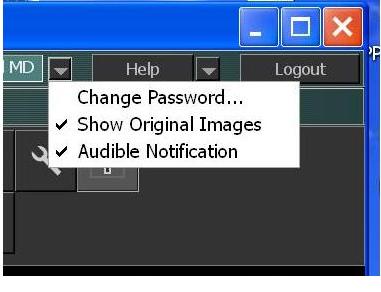
Now, here's a little peculiarity...to determine if you receive images compressed or uncompressed, you go to the upper right hand corner, click the triangle by your name, and check or uncheck "Show Original Images". This doesn't seem like a particularly logical place to put this, but then Saab puts the ignition switch on the center console. To each his own, just so long as I know where to look.
Forgive the necessarily brief overview, but what I am finding is that if you know Impax 4.5/5.2, you won't have much trouble with 6.0. That may be a good thing, but I do wish there had been a deeper overhaul. This product does get the Dalai stamp of usability, but mainly because I have spent a year with the older Impax's. But I do have to complement Agfa on what must have been a very difficult port over to .NET/CRL. This gave them the ability to deploy Impax 6.0 over the web, and that is a great achievement in and of itself.
I'll report more as the journey progresses.
Our Impax 6.0 Interim Web Solution is a somewhat limited installation, as an appendage, if you will, to the Impax 5.2 system. One can query the database (but reports are not available), and "live" images must be pushed to the 6.0 server. Still, it is here and it works, and it is significantly better for home use than the venerable old Web1000.
Loading it was pretty straightforward, although on two of our machines, I ran into .NET problems. Impax 6.0 uses .NET 1.1, although Microsoft now offers version 2.0. One of the 1.1 hotfixes wouldn't install on my laptop, and I ended up reloading Windows. Likely the problem was with a virus scan or some such thing, and turning off the virus scan on the other problem machine let the hotfix load properly. Oh, well, my laptop needed housecleaning anyway. Once .NET was in place, the installer had to be restarted to load Impax 6.0, which then proceded nicely. One does need to know the address of the server during the install, a minor difficulty.
When everything is tidily loaded and rebooted, you click the icon to activate the program, and you are then greeted by this sign-on window:

I like the graphics, personally. I guess someone in Waterloo plays "The Sims" a lot, because the image sure does look like a Sims-esqe radiology department. Hey, it's cute!
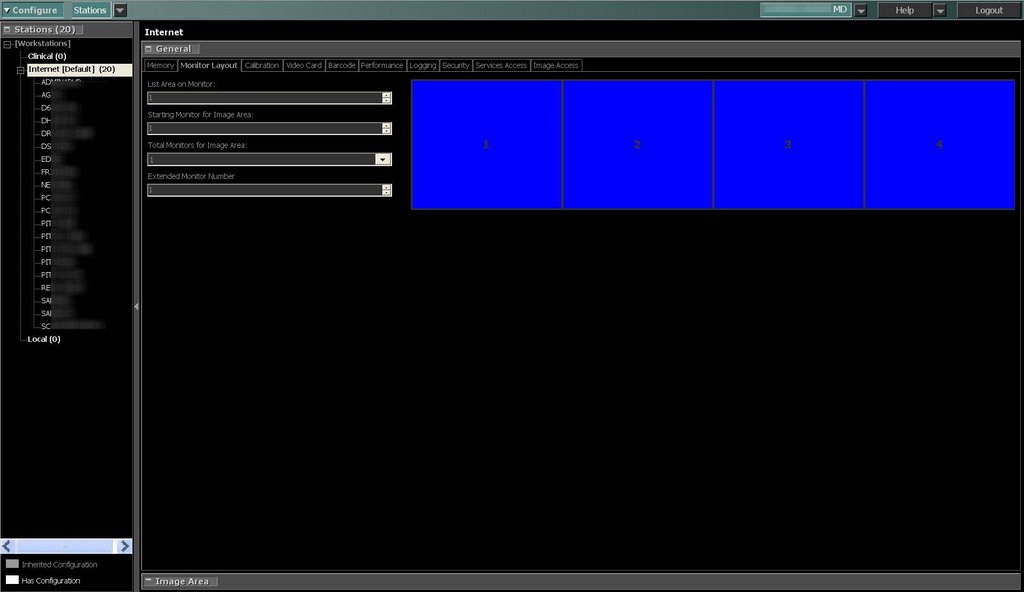
To digress a little before we get into actual usage, you can customize several factors by hitting the Configuration toggle on the front page. For most, the only item that will change is the screen layout. At home I have two monitors, but most of my partners have one, and you can set up the program to do it your way on each station where you have logged in. You get to choose where the worklist goes, how many and which screens actually get the image data, etc, and it will remember the next time you sign in. Also on this configuration screen can be found just about every other control that used to live in the IMPAX Configuration (or Conflaguration as one of our PACS admins puts it) control panel. The new Configuration screen looks uncannily like the old control panel. Anyway, about the only other control a lowly end-user like me will use will the the RAM allocation. This program wakes up hungry, and will reserve just about all available RAM for itself. Fortunately, you can tone this down, and on my 4 Gb machine at home (ain't the Dell Outlet site wonderful?), using only 2 Gb seems to work OK, and allows Amicas LightBeam to operate simultaneously as well.
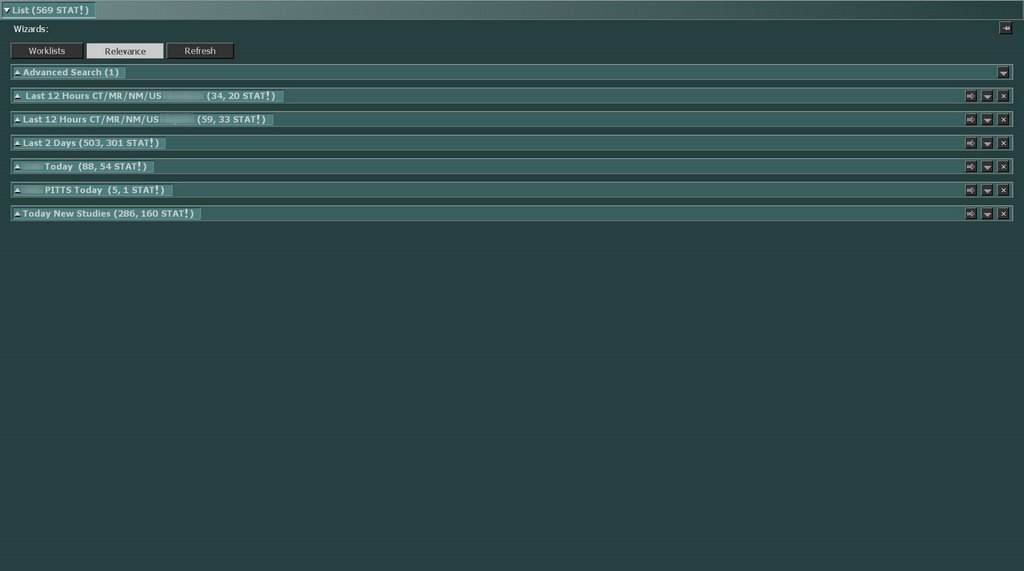
Once you're "in", you get this screen full of worklists. As I noted in the last post, the worklists are extremely customizable, down to the day and even the hour if you so choose. Everything I posted about the "Relevance" and the "Refresh" buttons is accurate, so I won't repeat anything.

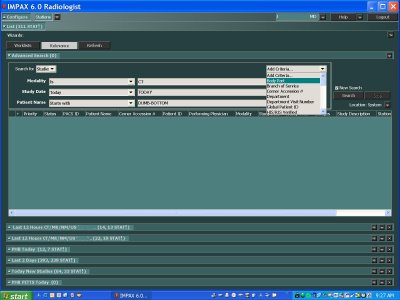
I had noted previously that you can do Boolean-style searches, and the criteria for such a search are nearly unlimited:
There is a way to make your own worklist and even deploy it on some days but not others:
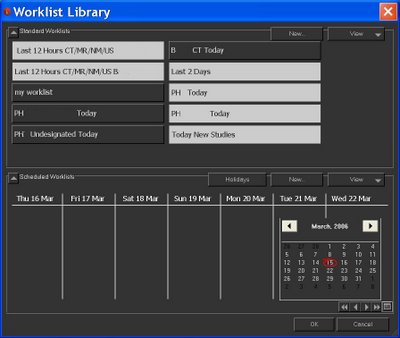

My ideal schedule would probably be no activity on any given day, but that doesn't pay the bills, does it? Anyway, opening a worklist gets you a list of patients and exams, and clicking one sends you to the actual viewer:
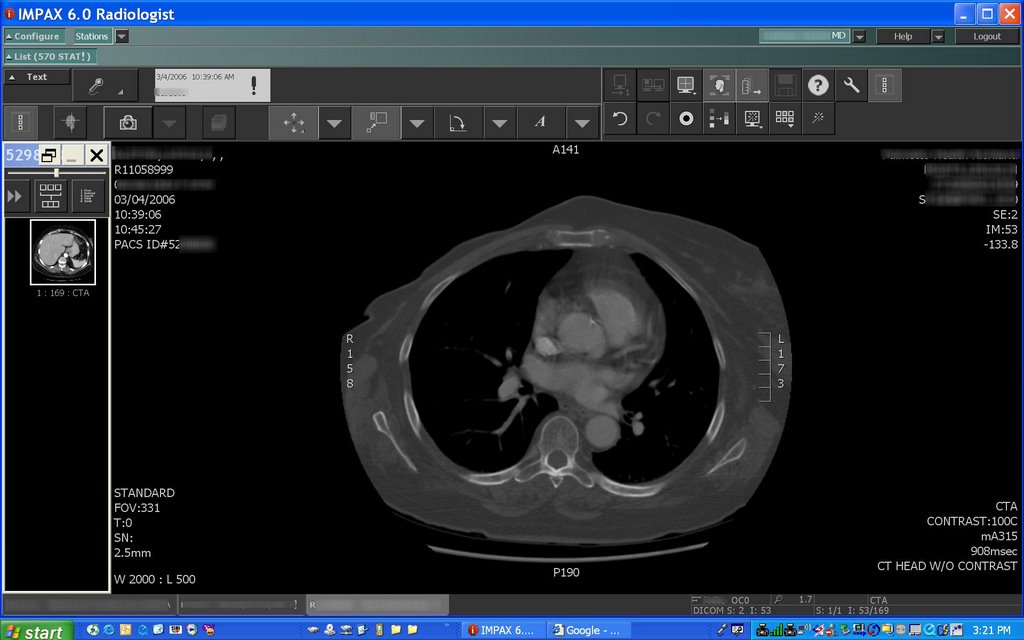
Ah, but wait! If you have only one screen, you toggle back and forth between the viewer and the data screen with the "Text" button. In fact, a lot of Impax 6.0 activity is based on toggling back and forth between screens in this manner. If you have more than one monitor, however, the images go off to the side, and you toggle between data and worklists, a more satisfactory experience. As I have posted earlier, the data or text screen has lots of very useful stuff like lists of priors, reports, and comment fields in which you can type your love notes to the ER. The panes can be easily resized and the program remembers what you did for next time.


Now, here's a little peculiarity...to determine if you receive images compressed or uncompressed, you go to the upper right hand corner, click the triangle by your name, and check or uncheck "Show Original Images". This doesn't seem like a particularly logical place to put this, but then Saab puts the ignition switch on the center console. To each his own, just so long as I know where to look.
Forgive the necessarily brief overview, but what I am finding is that if you know Impax 4.5/5.2, you won't have much trouble with 6.0. That may be a good thing, but I do wish there had been a deeper overhaul. This product does get the Dalai stamp of usability, but mainly because I have spent a year with the older Impax's. But I do have to complement Agfa on what must have been a very difficult port over to .NET/CRL. This gave them the ability to deploy Impax 6.0 over the web, and that is a great achievement in and of itself.
I'll report more as the journey progresses.
Subscribe to:
Posts
(
Atom
)