Sunday, May 06, 2012

Atlas Shrugged: Francisco d'Anconia's Money Speech

FYI, this is NOT a PACS entry, and it could be considered slightly to the right of center. Therefore, Left Wing NutJobs might want to skip today's post and return to the nurturing bosom of one of their favorite sites.

Anyway...After last year's "Christmas Carol" send-up, I was asked to consider next a parody of Ayn Rand's "Atlas Shrugged" with a radiological bent. Since I had not yet read the book, I figured that doing so might be wise before starting such a project. I'm about half-way through, and I'm not sure my meager talents are adequate for the job, but in the meantime, I've been absolutely overwhelmed by Rand's prescient writing.

"Atlas Shrugged" was published  in 1957, 55 years ago. Aside from some clearly dated references, this work could have been written today. The description of the criminalization and demonization of wealth and productivity could have come straight from the Left's playbook, tactics promoted by the Administration from Mr. Obama on down.

The character Francisco d'Anconia, an enigmatic playboy heir of a copper mining fortune, overhears someone at a party state that money is "the root of all evil."  His response follows.  Read it all; it's worth your time:
Rearden heard Bertram Scudder, outside the group, say to a girl who made some sound of indignation, "Don't let him disturb you. You know, money is the root of all evil – and he's the typical product of money."Rearden did not think that Francisco could have heard it, but he saw Francisco turning to them with a gravely courteous smile.

"So you think that money is the root of all evil?" said Francisco d'Anconia. "Have you ever asked what is the root of money? Money is a tool of exchange, which can't exist unless there are goods produced and men able to produce them. Money is the material shape of the principle that men who wish to deal with one another must deal by trade and give value for value. Money is not the tool of the moochers, who claim your product by tears, or of the looters, who take it from you by force. Money is made possible only by the men who produce. Is this what you consider evil?

"When you accept money in payment for your effort, you do so only on the conviction that you will exchange it for the product of the effort of others. It is not the moochers or the looters who give value to money. Not an ocean of tears nor all the guns in the world can transform those pieces of paper in your wallet into the bread you will need to survive tomorrow. Those pieces of paper, which should have been gold, are a token of honor – your claim upon the energy of the men who produce. Your wallet is your statement of hope that somewhere in the world around you there are men who will not default on that moral principle which is the root of money. Is this what you consider evil?

"Have you ever looked for the root of production? Take a look at an electric generator and dare tell yourself that it was created by the muscular effort of unthinking brutes. Try to grow a seed of wheat without the knowledge left to you by men who had to discover it for the first time. Try to obtain your food by means of nothing but physical motions – and you'll learn that man's mind is the root of all the goods produced and of all the wealth that has ever existed on earth.

"But you say that money is made by the strong at the expense of the weak? What strength do you mean? It is not the strength of guns or muscles. Wealth is the product of man's capacity to think. Then is money made by the man who invents a motor at the expense of those who did not invent it? Is money made by the intelligent at the expense of the fools? By the able at the expense of the incompetent? By the ambitious at the expense of the lazy? Money is made – before it can be looted or mooched – made by the effort of every honest man, each to the extent of his ability. An honest man is one who knows that he can't consume more than he has produced.

"To trade by means of money is the code of the men of good will. Money rests on the axiom that every man is the owner of his mind and his effort. Money allows no power to prescribe the value of your effort except by the voluntary choice of the man who is willing to trade you his effort in return. Money permits you to obtain for your goods and your labor that which they are worth to the men who buy them, but no more. Money permits no deals except those to mutual benefit by the unforced judgment of the traders. Money demands of you the recognition that men must work for their own benefit, not for their own injury, for their gain, not their loss – the recognition that they are not beasts of burden, born to carry the weight of your misery – that you must offer them values, not wounds – that the common bond among men is not the exchange of suffering, but the exchange of goods. Money demands that you sell, not your weakness to men's stupidity, but your talent to their reason; it demands that you buy, not the shoddiest they offer, but the best your money can find. And when men live by trade – with reason, not force, as their final arbiter – it is the best product that wins, the best performance, then man of best judgment and highest ability – and the degree of a man's productiveness is the degree of his reward. This is the code of existence whose tool and symbol is money. Is this what you consider evil?

"But money is only a tool. It will take you wherever you wish, but it will not replace you as the driver. It will give you the means for the satisfaction of your desires, but it will not provide you with desires. Money is the scourge of the men who attempt to reverse the law of causality – the men who seek to replace the mind by seizing the products of the mind.

"Money will not purchase happiness for the man who has no concept of what he wants; money will not give him a code of values, if he's evaded the knowledge of what to value, and it will not provide him with a purpose, if he's evaded the choice of what to seek. Money will not buy intelligence for the fool, or admiration for the coward, or respect for the incompetent. The man who attempts to purchase the brains of his superiors to serve him, with his money replacing his judgment, ends up by becoming the victim of his inferiors. The men of intelligence desert him, but the cheats and the frauds come flocking to him, drawn by a law which he has not discovered: that no man may be smaller than his money. Is this the reason why you call it evil?

"Only the man who does not need it, is fit to inherit wealth – the man who would make his own fortune no matter where he started. If an heir is equal to his money, it serves him; if not, it destroys him. But you look on and you cry that money corrupted him. Did it? Or did he corrupt his money? Do not envy a worthless heir; his wealth is not yours and you would have done no better with it. Do not think that it should have been distributed among you; loading the world with fifty parasites instead of one would not bring back the dead virtue which was the fortune. Money is a living power that dies without its root. Money will not serve that mind that cannot match it. Is this the reason why you call it evil?

"Money is your means of survival. The verdict which you pronounce upon the source of your livelihood is the verdict you pronounce upon your life. If the source is corrupt, you have damned your own existence. Did you get your money by fraud? By pandering to men's vices or men's stupidity? By catering to fools, in the hope of getting more than your ability deserves? By lowering your standards? By doing work you despise for purchasers you scorn? If so, then your money will not give you a moment's or a penny's worth of joy. Then all the things you buy will become, not a tribute to you, but a reproach; not an achievement, but a reminder of shame. Then you'll scream that money is evil. Evil, because it would not pinch-hit for your self-respect? Evil, because it would not let you enjoy your depravity? Is this the root of your hatred of money?

"Money will always remain an effect and refuse to replace you as the cause. Money is the product of virtue, but it will not give you virtue and it will not redeem your vices. Money will not give you the unearned, neither in matter nor in spirit. Is this the root of your hatred of money?

"Or did you say it's the love of money that's the root of all evil? To love a thing is to know and love its nature. To love money is to know and love the fact that money is the creation of the best power within you, and your passkey to trade your effort for the effort of the best among men. It's the person who would sell his soul for a nickel, who is the loudest in proclaiming his hatred of money – and he has good reason to hate it. The lovers of money are willing to work for it. They know they are able to deserve it.

"Let me give you a tip on a clue to men's characters: the man who damns money has obtained it dishonorably; the man who respects it has earned it.

"Run for your life from any man who tells you that money is evil. That sentence is the leper's bell of an approaching looter. So long as men live together on earth and need means to deal with one another – their only substitute, if they abandon money, is the muzzle of a gun.

"But money demands of you the highest virtues, if you wish to make it or to keep it. Men who have no courage, pride, or self-esteem, men who have no moral sense of their right to their money and are not willing to defend it as they defend their life, men who apologize for being rich – will not remain rich for long. They are the natural bait for the swarms of looters that stay under rocks for centuries, but come crawling out at the first smell of a man who begs to be forgiven for the guilt of owning wealth. They will hasten to relieve him of the guilt – and of his life, as he deserves.

"Then you will see the rise of the double standard – the men who live by force, yet count on those who live by trade to create the value of their looted money – the men who are the hitchhikers of virtue. In a moral society, these are the criminals, and the statutes are written to protect you against them. But when a society establishes criminals-by-right and looters-by-law – men who use force to seize the wealth of disarmed victims – then money becomes its creators' avenger. Such looters believe it safe to rob defenseless men, once they've passed a law to disarm them. But their loot becomes the magnet for other looters, who get it from them as they got it. Then the race goes, not to the ablest at production, but to those most ruthless at brutality. When force is the standard, the murderer wins over the pickpocket. And then that society vanishes, in a spread of ruins and slaughter.

"Do you wish to know whether that day is coming? Watch money. Money is the barometer of a society's virtue. When you see that trading is done, not by consent, but by compulsion – when you see that in order to produce, you need to obtain permission from men who produce nothing – when you see that money is flowing to those who deal, not in goods, but in favors – when you see that men get richer by graft and by pull than by work, and your laws don't protect you against them, but protect them against you – when you see corruption being rewarded and honesty becoming a self-sacrifice – you may know that your society is doomed. Money is so noble a medium that it does not compete with guns and it does not make terms with brutality. It will not permit a country to survive as half-property, half-loot.

"Whenever destroyers appear among men, they start by destroying money, for money is men's protection and the base of a moral existence. Destroyers seize gold and leave to its owners a counterfeit pile of paper. This kills all objective standards and delivers men into the arbitrary power of an arbitrary setter of values. Gold was an objective value, an equivalent of wealth produced. Paper is a mortgage on wealth that does not exist, backed by a gun aimed at those who are expected to produce it. Paper is a check drawn by legal looters upon an account which is not theirs: upon the virtue of the victims. Watch for the day when it becomes, marked: 'Account overdrawn.'

"When you have made evil the means of survival, do not expect men to remain good. Do not expect them to stay moral and lose their lives for the purpose of becoming the fodder of the immoral. Do not expect them to produce, when production is punished and looting rewarded. Do not ask, 'Who is destroying the world?' You are.

"You stand in the midst of the greatest achievements of the greatest productive civilization and you wonder why it's crumbling around you, while you're damning its life-blood – money. You look upon money as the savages did before you, and you wonder why the jungle is creeping back to the edge of your cities. Throughout men's history, money was always seized by looters of one brand or another, but whose method remained the same: to seize wealth by force and to keep the producers bound, demeaned, defamed, deprived of honor. That phrase about the evil of money, which you mouth with such righteous recklessness, comes from a time when wealth was produced by the labor of slaves – slaves who repeated the motions once discovered by somebody's mind and left unimproved for centuries. So long as production was ruled by force, and wealth was obtained by conquest, there was little to conquer. Yet through all the centuries of stagnation and starvation, men exalted the looters, as aristocrats of the sword, as aristocrats of birth, as aristocrats of the bureau, and despised the producers, as slaves, as traders, as shopkeepers – as industrialists.

"To the glory of mankind, there was, for the first and only time in history, a country of money – and I have no higher, more reverent tribute to pay to America, for this means: a country of reason, justice, freedom, production, achievement. For the first time, man's mind and money were set free, and there were no fortunes-by-conquest, but only fortunes-by-work, and instead of swordsmen and slaves, there appeared the real maker of wealth, the greatest worker, the highest type of human being – the self-made man – the American industrialist.

"If you ask me to name the proudest distinction of Americans, I would choose – because it contains all the others – the fact that they were the people who created the phrase 'to make money'. No other language or nation had ever used these words before; men had always thought of wealth as a static quantity – to be seized, begged, inherited, shared, looted, or obtained as a favor. Americans were the first to understand that wealth has to be created. The words 'to make money' hold the essence of human morality.

"Yet these were the words for which Americans were denounced by the rotted cultures of the looters' continents. Now the looters' credo has brought you to regard your proudest achievements as a hallmark of shame, your prosperity as guilt, your greatest men, the industrialists, as blackguards, and your magnificent factories as the product and property of muscular labor, the labor of whip-driven slaves, like the pyramids of Egypt. The rotter who simpers that he sees no difference between the power of the dollar and the power of the whip, ought to learn the difference on his own hide – as, I think, he will.

"Until and unless you discover that money is the root of all good, you ask for your own destruction. When money ceases to be the tool by which men deal with one another, then men become the tools of men. Blood, whips and guns – or dollars. Take your choice – there is no other – and your time is running out."
More to come.

Friday, April 20, 2012

What's Up With EMC?


I don't like SPAM, and I don't like cold-calls from vendors. Today, I received both from representatives of EMC. For about the 10th time. My storage needs for the present time have been met, thank you, and I'll be sure to call EMC if I should decide that I need their services.

In the meantime, as I told the young lady who called my cell wanting to speak to someone who made IT decisions in my organization, if I receive one more unsolicited contact from EMC, my next communication will be with their CEO. We'll see how HE likes cold calls...

Friday, April 13, 2012

Phear Of Photons


I never pass up an opportunity to throw in a Star Trek reference...

I had the usual joy of taking call last night, and the discussion about a particular case prompts me to put pen to paper, or fingers to keyboard as it were.

The call came through from the ER at 10 PM or so. The rather agitated ER doc related this scenario to me, desperate for advice: "I've got an elderly man with history of lung cancer, now presenting with dyspnea and wheezing after probably aspirating a beet. You know, the little red vegetables? Yeah, those. Anyway, he also had some EKG and lab abnormalities, and some chest pain. I just don't know what to order. I suppose he needs a CT pulmonary arteriogram, but I'm so afraid to give him any more radiation...."

Ummm, excuse me? The ER doc is afraid to give more radiation? The same ER department that just ordered about 30 CT's in the last four hours? The same ER that has no hesitation in ordering a CTPA-gram on teenagers? You're afraid to order a scan on someone whose already had a malignancy and is already on up there in years? You're AFRAID??

Clearly, we radiologists have shot ourselves in the foot on the issue of radiation. Because of a small number of scary articles (the latest now definitively states that we'll get meningiomata from dental radiographs), our ordering docs are now terrified of using radiation on those whom it will affect the least.

I've had the honor and privilege to participate in the most amazing technical miracle ever to happen to mankind. The diagnostic tools which we use daily, sometimes with some degree of nonchalance, are nothing short of magical wonders of the sort that could only be dreamt of not very long ago. Between CT, PET, MRI, SPECT, and the other members of our alphabet soup of toys, we can literally look inside the body without benefit of knives or getting our hands bloody. We can filet you open without filleting you open, and isolate abnormalities down to the molecular level (at least that's coming to a hospital near you soon). I could go on, but I might get emotional, and we can't have that. But when you think about it, what we do in Radiology is nothing short of amazing.

I've often said radiation is a lot like electricity. Use it carefully, and it's your friend. Stick your finger in the socket, and you'll get shocked. Proper use of our diagnostic tools saves lives. Improper use can cause trouble. Sadly, we've again got a disconnect between the truth and perception. Somehow, we've allowed the belief to flourish (or fester) that the next scan might cause a malignancy, even in the face of a more immediate threat. We need to do a better job of educating our clinicians. Somehow.

Set phasers to dumb....

By the way, the patient had a large piece of beet in the right lower lobe bronchus.

Wednesday, April 11, 2012

Attention Blog Spammers...


I've probably received about 100 comments posted to this blog over the years which are clearly Blog-Spam. They have little to no connection to the post they are supposedly commenting on, and usually advertise something else entirely. Many of them relate to medical software or websites that originate in India or elsewhere in the third world. There is a significant dump (as in defecation) from those wishing me to link to their less-than-illustrious blogs as well.

These blog-spammers are attempting to co-opt my readers and obtain free advertising. My personal opinion is that anyone who needs to resort to this sort of bottom-feeding activity knows full well that his/her product is an absolute piece of garbage, and won't sell to any but the least sophisticated out there. I'm assuming my audience would not appreciate being exposed to such filth.

My first instinct is to actually give these dirtballs what they want and publicize their sites, with the understanding that you, my intelligent readers, won't patronize them beyond perhaps sending a little note to their ISP's informing them of the behavior of their low-life clients. However, if only one of you actually does patronize the spammer's site, rather than electronically spit on them, they win, and we can't have that.

For the moment, these scum shall remain nameless, but if I should hear a great outcry, and promises from you that you will indeed ummm, inform the miscreants and their ISP's of the misdeeds, well, then, I might just be persuaded to publish a little list of the jerks in question.

As an aside, the VAST majority of SPAM e-mails I receive, something like 98%, comes from overseas, generally from Russia, Nigeria (I still get dozens of 419 scam emails per week), Ukraine, China, Korea, Romania (I started forwarding these to the Romanian Ministry of Communication, or the equivalent, and they stopped, or at least slowed), Poland, Portugal, Iran, Saudi Arabia, Israel, and many more. Clearly, the laws or at least the enforcement thereof outside the US is sadly deficient. I'm wondering if there is a way to completely block the receipt of any mail from foreign lands until the ISP's over there can get their act together. Frankly, I wonder if those ISP's are actually in cahoots with the spammers. As a matter of fact, the 419 scams are said to be the third-largest industry in Nigeria. I would think the world internet community would consider cutting that nation off of the 'net completely until they clean house. And newly-"capitalist" Russia seems to be the major source of this garbage these days. Remember, this isn't capitalism, it's unwanted refuse. I guess Mr. Putin has other things to do than monitor his nation's internet spew.

Anyway, I would advise human blog-spammers not to waste time on my blog. Those who use 'bots to troll other's blogs should consider reprogramming them to avoid this one. Or better yet, find a REAL job and stop trying to peddle crap. Or see if you can find Jack Kervorkian's instruction manual and follow it to the letter.

Thursday, April 05, 2012

April 5 2063: Happy First Contact Day!

First Contact...Image courtesy of Startrek.com
Rather than restate everything, here is the official description from StarTrek.com:
It was – or will be – in the evening of this day in 2063 that the Vulcan survey spacecraft T’Plana-Hath landed in Bozeman, Montana, after following the warp signature of the Phoenix, a ship that represented the human race’s first successful attempt at achieving warp drive. Soon after, a robed Vulcan, offering the Vulcan salute, met Dr. Zefram Cochrane, pilot of the Phoenix and the inventor of warp drive. First Contact was now etched in history, and it paved the way for the formation of the United Federation of Planets.

While it’s true, of course, that First Contact and First Contact Day are fictional creations, they have been well developed across the Star Trek franchise. Anyone interested in the finer details should be sure to check out some of the following:Glenn Corbett as CochraneThe TOS episode “Metamorphosis” features Glenn Corbett as Cochrane. 
The TNG film First Contact, with James Cromwell playing Cochrane as a man with a penchant for booze and rock and roll, and the nickname “Z.” Cromwell later reprised the role, in a blink-and-you-miss-it cameo, in “Broken Bow,” the pilot episode of Star Trek: Enterprise.
The books First Contact (a novelization of the film), First Frontier, Starfleet Academy,Imzadi and Federation, as well as the TOScomic book, A Warp in Space.NeelixThe Voyager episode “Homestead.” In it,Neelix and Naomi Wildman throw a party celebrating the 315th anniversary of First Contact Day. There’s a retro jukebox, lots of Cochrane’s favorite munchie (cheese pierogies), and the particularly amusing moment in which Tuvok very reluctantly raises his fingers in the Vulcan salute and intones the legendary phrase, “Live long and prosper.”
So, everybody, are you going to let your kids skip school? Will you stay home from work? After all, it is First Contact Day.

Wednesday, April 04, 2012

Displaying The Future: Project Glass


Google and Apple, two companies that didn't exist for much of my lifetime, are out to change the world and the way we interact with it. Today's post examines a new way of looking at our world, courtesy of Google, although I'm sure we'll hear about project iGlass from Apple one of these days...

Google's Project Glass follows the same philosophy I advocate for PACS:
We think technology should work for you—to be there when you need it and get out of your way when you don’t.

A group of us from Google[x] started Project Glass to build this kind of technology, one that helps you explore and share your world, putting you back in the moment. We’re sharing this information now because we want to start a conversation and learn from your valuable input. So we took a few design photos to show what this technology could look like and created a video to demonstrate what it might enable you to do.


The lead photo above shows what this mobile heads-up display might look like to those outside the Matrix.

The YouTube concept video is quite compelling...not only does Google envision the mating of the real to the virtual in this manner, they seem to think they can outdo Siri, and without the annoying metallic female voice to boot.  More power to them.

Naturally, the second thing I thought of was how this technology might be applied to PACS. The possibilities here are endless. How about displaying the pertinent anatomy to a surgeon who is knee-deep in someone's abdomen? Or maybe utilizing computer aided diagnosis (CAD) while reading studies. Or maybe reading studies without a monitor altogether. I wonder how many pixels this thing may ultimately manifest?

What's that? What was the first thing I thought of? Well...we all know what has driven most other technology over the years. Think Gutenberg and I Modi. Now you know why the young lady in the photo is so happy.


Hat tip to 23 Skidoo.

From the Gyn Oncologist:

Comment from the GynOnc whilst watching me make the PACS do something no one else understands: "You touch things I would never have even thought of..." Probably a complement from anyone in OB-Gyn.

Sunday, April 01, 2012

Thank God For Big Brother...

The tears welled up in my eyes. A passing waiter noticed that my glass was empty and came back with the gin bottle.

I took up my glass and sniffed at it. The stuff grew not less but more horrible with every mouthful I drank. But it had become the element I swam in. It was my life, my death, and my resurrection. It was gin that sank me into stupor every night, and gin that revived me every morning. When I woke, seldom before eleven, with gummed-up eyelids and fiery mouth and a back that seemed to be broken, it would have been impossible even to rise from the horizontal if it had not been for the bottle and teacup placed beside the bed overnight. Through the midday hours I sat with glazed face, the bottle handy, listening to the television. From 3 to closing-time I was a fixture in the bar. No one cared what I did any longer, no alarm woke me, no television admonished me. Occasionally, perhaps twice a week, I went to a dusty, forgotten-looking office in the hospital and did a little work, or what was called work. I had been appointed to a sub-committee of a sub-committee which had sprouted from one of the innumerable IT committees dealing with minor difficulties that arose in determining Meaningful Use within the Affordable Care Act. We were engaged in producing something called an Interim Report, but what it was that they were reporting on I had never definitely found out. It was something to do with the question of whether commas should be placed inside brackets, or outside. There were four others on the committee, all of them persons similar to myself. There were days when we assembled and then promptly dispersed again, frankly admitting to one another that there was not really anything to be done. But there were other days when we settled down to our work almost eagerly, making a tremendous show of entering up our minutes and drafting long memoranda which were never finished - when the argument as to what we were supposedly arguing about grew extraordinarily involved and abstruse, with subtle haggling over definitions, enormous digressions, quarrels - threats, even, to appeal to higher authority. And then suddenly the life would go out of us and we would sit round the table looking at one another with extinct eyes, like ghosts fading at cock-crow.

The television was silent for a moment. I raised my head again. The bulletin! But no, they were merely changing the music. I pictured vote tallies behind my eyelids. The trends were a diagram: a red arrow tearing vertically southward, and a blue arrow rising rapidly. As though for reassurance I looked up at the imperturbable face in the portrait. Was it conceivable that the red arrow did not even exist ?

My interest flagged again. I drank another mouthful of gin. A shrill trumpet-call had pierced the air. It was the bulletin! Victory! It always meant victory when a trumpet-call preceded the news. A sort of electric drill ran through the bar. Even the waiters had started and pricked up their ears.

The trumpet-call had let loose an enormous volume of noise. Already an excited voice was gabbling from the television, but even as it started it was almost drowned by a roar of cheering from outside. The news had run round the streets like magic. I could hear just enough of what was issuing from the television to realize that it had all happened, as I had foreseen; a vast electoral surge, the blue arrow tearing across the tail of the red. Fragments of triumphant phrases pushed themselves through the din: "Vast strategic manoeuvre - perfect co-ordination - utter rout - half a million counties reporting - complete demoralization - control of the whole of the Electoral College - greatest victory in human history - victory, victory, victory!"

Under the table my feet made convulsive movements, and I felt a thrill going up my leg. I had not stirred from my seat, but in my mind I was running, swiftly running, I was with the crowds outside, cheering myself deaf. I looked up again at the portrait of Big Brother. The colossus that bestrode the world! The rock against which the hordes of Republicans dashed themselves in vain! I thought how ten minutes ago - yes, only ten minutes - there had still been equivocation in my heart as I wondered whether the news would be of victory or defeat. Ah, it was more than a right-wing party that had perished! Much had changed in me since those first days of the Administration, but the final, indispensable, healing change had never happened, until this moment.

The voice from the television was still pouring forth its tale of electoral booty and slaughter, but the shouting outside had died down a little. The waiters were turning back to their work. One of them approached with the gin bottle. I, sitting in my blissful dream, paid no attention as my glass was filled up. I was not running or cheering any longer. I was back in the hospital, with everything forgiven, my soul white as snow. I was walking down the white-tiled corridor, with the feeling of walking in sunlight, and an armed guard at my back. The long hoped-for bullet was entering my brain.

I gazed up at the enormous face. Four years it had taken me to learn the smirk of a smile. O cruel, needless misunderstanding ! O stubborn, self-willed exile from the loving breast ! Two gin-scented tears trickled down the sides of my nose. But it was all right, everything was all right, the struggle was finished. I had won the victory over myself. I loved Big Brother. Thank God for Big Brother.

But only for today...

Friday, March 30, 2012

Big Scanner In The Big Apple


Following our recent visit to Ann Arbor, we went to New York to see a Philips Precedence SPECT/CT in action. We had a long look at the scanner and the computer, and spent an incredible time with Dr. S., whose Nuclear Medicine knowledge I could only hope to faintly imitate. I'm thinking of submitting the time as CME; that's how much I learned.  

The Precedence itself is HUGE, although it would probably fit the room where it needs to be placed. The SPECT part of the machine consists of two heads on articulating arms, as you can see above, basically a stationary version of the SKYLight, of which we already have two. The CT is a nice 16 slice unit. The computer system is the Extended Brilliance Workspace (EBW), which is unified across the Philips line, more or less, anyway, and it is fairly powerful. We will probably mostly use our Segami Oasis and TeraRecon (if it ever arrives) for most of the processing, though.

Now, if all decisions were made by how much fun one has on the site visit, well, it's hard to top The Big Apple. (Elscint once took me and a former partner to Israel and Germany, after the company was bought by GE, and the stuff we went to see was never put into production.) 

Having a few hours to kill before our flight back to the boonies, we went down to Ground Zero to see the new Freedom Tower:


Then it was off to Times Square, where we encountered the Naked Cowboy:


He was not really naked, as he was wearing a pair of Fruit of the Loom's, but a guitar hides a multitude. I texted the photo to Mrs. Dalai, who, miffed that I was having fun in NYC, responded, "Looks like you're working hard." I responded, "So is ...." ummm...never mind.

Here is Kathi, our Department Director, and Gerald, the Philips rep, enjoying the sites of Times Square. Notice that the camera is pointed up, and not at Naked Cowboy. 


Kathi was quite traumatized by our various cab rides. After my trip to Peru, nothing they can do bothers me, although had one of the drivers actually struck the two pedestrians he was aiming for, that might have reached my threshold of attention.

When you have only a few hours in New York, you have to make them count. We had a great lunch at the Atlantic Grill, but for me the absolute highlight of a trip to Manhattan is a stop at the Carnegie Deli:


You won't find these matzoh balls in a jar!

Despite the cabbies' best efforts, we did make it back home safely. Time to make some decisions...

Medicine And Capitalism

In response to my last post, Anonymous (he sure does get around!) eructated forth the following:
You, my dear sir, are a hypocrite,

As you admit yourself, and what anyone who have come across your blog before knows, you are a staunch defender of the free market and capitalism. The most basic part of *that* is a well-functioning market where the price of goods and services are determined by supply and demand.
As my old friend and foil "eradicator" once posted on AuntMinnie, much of what we see happening in health care today is anything BUT capitalistic, and bypasses any semblance of a "well-functioning market". Prices of goods and services are NOT determined, at least not properly, by supply and demand.

Let me explain.

In healthcare, at least in our particular, peculiar version of it, the consumer has few choices. Basically, one goes to a physician on an approved list, has tests at facilities that have negotiated contracts with the third party payer, Medicare, or whatever, and has little knowledge overall of what he or she has bought. Or rather, what has been bought on the patient's behalf. The only decision the patient can make is which insurance to buy and how much, and usually even that is out of their hands, having been preordained by their employer anyway.

My socialist friend Anonymous (why else would he get so snarky, unless perhaps he wallows in this unsavory stuff?) makes a fundamental mistake in his (get over it, pronoun-pc'ers) analysis. What BadRay is doing is NOT offering the consumer the opportunity to CHOOSE for themselves to pay less for ummm, an unknown level of care (yes, for the lawyers I shall say unknown). Rather, it targets institutions interested in skimming profit, and this is very clear from the teaser on the website. Said institutions are choosing on behalf of the consumer, and the patients haven't a clue that their child's scans are being read by  the lowest bidder for the job. Like Enron, BadRay does nothing at all to promote choice, nor does it add any particular real value to the system. If anything, it restricts choice, deciding more or less by itself who should read, and pocketing a middle-man fee for insinuating itself where it doesn't belong.  This is not capitalism, it is manipulation, pure and simple.

Can health care operate on a purely free-market basis? I'm not sure, frankly. The only example I can see on first blush is that of patients going to other countries to have expensive procedures done at a lower price. Those who do so, those who are able to do so, that is, do indeed exercise choice in an international free-market. I don't have the figures, but I suppose most do OK, assuming their surgeons are well-trained, and the facilities are up to snuff. But with the lower price tag comes some strings, mainly the lack of recourse should something go wrong. It's sort of like buying something on eBay, but maybe not even as secure. Caveat Emptor.

Here's my own humble opinion: The whole mess needs to be scrapped. Every last facet. Medicare and Medicaid must go. They are bloated, corrupt bureaucracies, and for the most part have created the tangled quagmire that now drags us down. Overpayments and underpayments are the rule, not the exception. A lot of docs have made a lot of money off of both by gaming the system, and that is not acceptable.

I'm not going to go into much detail, because I don't have time or energy or intelligence enough to do it, but I think my friend Bart was on the right track with his idea that I published years ago. Basically, let the government buy the most basic of catastrophic insurance for everyone, and then the individual fills in the gaps. Remove interstate restrictions, etc. This is not the insurance exchange envisioned by Obamacare, by the way. I'll add to Bart's plan the thought of removing Medicare and Medicaid from the equation, or at the very least, revamping them from top to bottom.

But I digress...

I have no problem with profit. I think profit is a better and more benign motivation than power. I DO have a problem with cheating, with gaming the system, with manipulating people's lives and health to make a buck. But that sort of garbage isn't really capitalistic anyway.

Tuesday, March 27, 2012

The Future Of Radiology? Seriously??


As you know, I do occasionally follow the internet trails that lead my readers to this information sink called DoctorDalai.com. It sends a thrill up my leg to know that anyone actually reads this drivel, and I just have to know how you may have stumbled upon this particular intellectual wasteland.

Someone from Rome (Italy, not Georgia) found me by Googling the phrase, "when radiology pacs don't work."  We can only wonder which system they might be using...anyone have a GEneric Answer I can Give For thAt?

Anyway, coming before this blog on the search was an entry for RadBay, The American Radiology Exchange, LLC, "The Future of Radiology" or so they say. Now, I think this company has been discussed on AuntMinnie, but I can't find the thread, so we'll pursue this as a new topic.

What is BadRay, I mean RadBay, and what did they do to earn my sarcastic derision? Simply put, they reduce the radiology business to an auction:
RadBay is an internet based auction site that matches up hospitals, imaging centers, and physician offices (including other radiology groups in the case of night reads) with radiologists through an online bidding process.

After a radiologist has signed up and installed our PACS partner’s viewer, his/her account is activated on RadBay. Imaging centers send studies to the RadBay PACS which sends the study info to RadBay to be auctioned to qualified radiologists for competitive bidding. You can bid on single or multiple studies at once. Once a study is auctioned, the radiologist will interpret it and sign off on the report in a specified time. The time is different based on the priority (stat, ASAP, routine) of each study. Once you interpret a study, it will be transcribed by the imaging center’s transcriptionist. After you sign your report on the PACS, RadBay bills the imaging center for the interpretation. RadBay then pays you after receiving payment from the imaging center.
As for the imaging center...
After you have signed up and been connected by our PACS partner, completed studies are auctioned to qualified radiologists for competitive bidding. When you sign up, you have the option of setting a maximum price for each type of study to ensure costs are controlled. The auction process allows qualified radiologists to bid competitively to drive down the price you’ll have to pay to have your study interpreted. You can allow any qualified radiologist in your state to bid on a study or restrict bidding to your preferred or sub-specialized radiologists. RadBay only lets radiologist that are caught up on their work to bid. Once a study is auctioned, the radiologist is required to interpret it and sign off on the report in a pre-specified time. The time is different based on the priority (stat, ASAP, routine) of each study. You may use your own transcriptionist or allow us to connect you to a preferred transcription service. You are then billed by RadBay and the radiologist is paid by RadBay, thus completing the transaction. With a vast pool of radiologists and the ability to add and remove radiologist with ease, quality can be maintained to the highest standard and the fastest report turnaround can be achieved. In addition, radiologist have the opportunity to give technologist feedback on every study. You can get reports from this feedback, allowing you to see how you can improve the quality of your studies.
Why a radiologist would want to work as the low-bidder is beyond me, although I guess you gotta do what you gotta do, right? For the imaging center, the attraction is clearly spelled out by our friends at BadRay RadBay (and this is on their website, mind you...I'm not making this up!):

Summary Of RadBay Benefits

Profit
The auction process allows the hospital or imaging center to pay the lowest rate for interpretations on each study, keeping more of the global charge.


Quality

Imaging centers and hospitals can pick from a list of all licenced radiologist in their state, regardless of geographic location. If they experience problems with the reports of a radiologist, they just remove him/her from their list. There is no longstanding contract with a radiologist, politics, or privilege issues to prevent removal from the list.
Every study can be read by a radiology sub-specialist, giving even the smallest communities the level of radiology care previously only achievable at large academic centers.
Radiologists can easily give electronic feedback on every study, so radiology directors can get hard data on what can be improved in their department.
With or without a local PACS, our cloud PACS can act as a backup PACS for your facility (without additional charge).

Rapid Delivery Of Care

RadBay monitors the workload of each radiologist and does not let them bid on new work until they are caught up, insuring rapid report turnaround.

Credentialing/ Governmental

You can do your own credentialing from the information that we collect from radiologist when they sign up, or pick from a list of radiologists that are credentialed through a Joint Commission Certified process. With patient studies archived in the cloud PACS, if a patient goes to a different center or even a different state, their images are readily available, moving toward the federal government’s goal of easy access to electronic medical records.

Community

The American Radiology Exchange, LLC believes in supporting local communities and seeks to donate a portion of every dollar earned on RadBay to support local nonprofits. Imaging centers are encouraged to recommend a local non-profit for RadBay to support.
The first entry is of course the most important, of course. And why deny it?

Somehow, it isn't surprising that BadRay RadBay uses Viztek PACS, which is certainly adequate to the job, but definitely not the most expensive product out there.

This is how low we've sunk, folks. Medicine by low-bid. Would you want your scan read on this basis? Not to denigrate those fine radiologists who find themselves in need of employment by these means, but come on, folks. This is ridiculous.  I'm a capitalist, and proud of it, but I have to think that medicine is somehow different than making widgets. So, what's next? Surgery by the lowest bidder?

Excuse me, but I've got to go bid on some widgets on eBay.

Wednesday, March 07, 2012

It's Here...


In case you missed it, the NEW iPad (that's its name, not iPad 3 or iPad HD, or the SJM (Steve Jobs Memorial) iPad) has arrived. Debuted by Tim Cook, Apple CEO, the New iPad does indeed have a 3MP display with 2048 by 1536 pixel resolution. That's Barco territory, folks. It also boasts a new A5x quad-core processor, and the same price points as its predecessor, the iPad 2.

OK, PACS vendors. It's your turn. Go out and write the killer PACS iPad app for this thing. I'll be the first to volunteer to test it out for you. Well, as long as someone supplies me with a NEW iPad. The 64 Gb version with 4G would be just fine, thank you.


Tuesday, February 28, 2012

Great ExSPECTations


I'm on my way back home from frigid Ann Arbor, having just spent the morning in an amazing Nuclear Medicine department. It's embarrassing, really. Our entire Radiology and Nuc Med divisions would have fit easily within the confines of the U of Michigan Nuclear Cardiology Department alone! I lost count of the number of scanners I saw, and we never even ventured into non-Nuclear territory. Maybe there is something to this academic stuff after all.

I am very grateful to the folks whose schedules we disrupted, in particular Jeff M., and Dr. B., who gave very generously of their time to show us the Siemens Symbia SPECT/CT scanners (several of them...LOTS of them!), discuss their operation and go over images and protocols.

The Symbia series has been around for a few years, which means two things: the bugs have been worked out of the platform, and it may not be at the bleeding edge of technology. At this point in my career, a proven track record tends to trump all else. The CT component is a little long in the tooth, basically the older Emotion platform, but its images are fine. Really, the only thing it really lacks for my purposes is the ability to utilize iterative reconstruction. This could perhaps be added in software, but apparently that is not a likely event. I'm still satisfied with the dose in the setting of a SPECT/CT acquisition.

Symbia does offer IQ-SPECT for cardiac studies, which will allow either a reduction of injected tracer dose, or a significant time-savings. How about acquiring a cardiac scan in 4 minutes instead of 20? Or double the counts with a 6-minute study? Or cut the dose back with a longer scan? I'll let you read the brochure for yourself, but in viewing live studies, I can tell you that the IQ-SPECT scans look about the same as those from the conventional protocol. Key to the process is a focused collimator, the successor if you will of Siemens' old CardioFocal collimators we used to have on our Orbiters from 1990. Everything old is new again, as they say...

The physician (a cardiologist, actually) who had done much of the research for IQ-SPECT was not available today, but I did have a great conversation with Dr. B, a private-practice rad who had returned to academia, and two of the residents. It seems they were not familiar with me and the blog, but I gave them my card, containing my URL. Hope you guys aren't too disappointed in what you find here!

Dr. B and I commiserated on the joys and perils of Private Practice Radiology, not the least of which is having decisions about equipment often made by administrators and vendors, and having no recourse for bad equipment.  I sheepishly mentioned that I have on rare occasions used this blog to hold a vendor accountable (I believe I might have said something like "hold their feet to the fire" but that wouldn't be like me) for bad products. He nodded approvingly, and said, "I think you would fit right in with Academic Medicine." Which I take as an incredible complement.

The two residents were quite impressive themselves, and I wish we were hiring so I could rescue them from the horrendous weather up there in Michigan.

Due to various machinations, we won't be looking at the Discovery 670 NM/CT 670 this time around. However, I will say this now: we will never again buy a conventional gamma camera without integrated CT.  (I can act like a big-shot with other people's money, but it makes perfect sense.) I do believe we are to have a peek at the Philips Precedence before the final decision is made. I hope we have a room big enough for it! 

Saturday, February 18, 2012

Confirmed! iPad 3 WILL Have Retina Display!

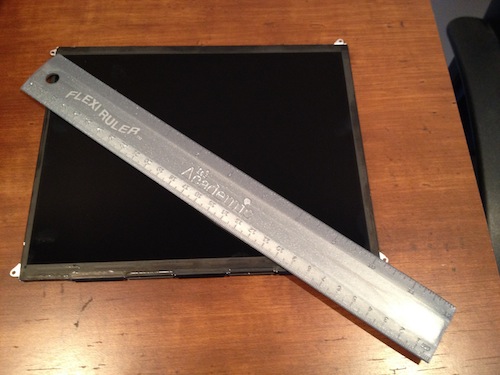
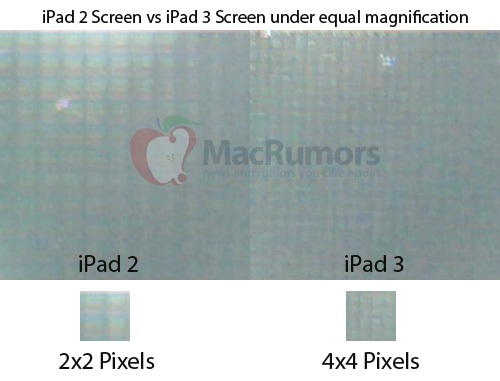
The folks over at MacRumors were able to get hold of a display module for the upcoming iPad 3, and literally examined it under a microscope.

From the MacRumors story:


Clearly, there are four times the number of pixels on the new display, and this all adds up to a resolution of 2048x1536, as compared to 1024x763 for the old model. The screen is still about 9.7" diagonally.

The Barco 3MP monitor sitting on my desk shows the very same numbers as the new iPad display.

You realize what this means, of course. The iPad has the potential to become the de facto mobile PACS platform. Of course, there are a lot of hoops to jump through before that happens, but trust me, it will happen.

I do have to add my own personal slant. I've got an iPad 1, and I'm not all that fond of it. There are a number of things it just does NOT do well, not the least being the simple writing of a simple blog by a simple radiologist. However, I did get a case with a Bluetooth keyboard, and this may help things. As far as graphic tasks, however, the iPad/iOS approach does seem to work well, and with the new Retina screen, there can be no worries about resolution. Now, contrast will be another story...will we have to only use PACS apps in the dark? Only the Shadow readers know for sure...

Friday, February 10, 2012

And The Winner Is....

I know there is a lot of pent-up desire out there to know which advanced visualization solution we chose. Now, the decision was far from easy, as any of the five contenders would have done the job. Most likely, anyway.

In the end, we gathered everyone's notes and tally sheets, spoke to as many of the attendees as possible, and tried to synthesize their opinions.

All five products have some things they do well, and some they don't. There are actually few glaring deficiencies, such as the one product that won't be able to create AVI movies until the next release. Another requires an add-on bit of software for certain functions supplied by another vendor, and I am told said add-on won't work as a thin-client, and thus must be installed on every reading station.

At the host of this little party, I have been hearing lots of interesting tales... Did I know, for example, that one company did this, another didn't do that, and by the way, this company just got thrown out of a big-name academic center in favor of that company?  Sheesh.

Now, don't bombard me with queries such as, "but why didn't you like X?" It's not that we didn't like X, but we felt that one product would satisfy our needs in a manner better than the rest. Your mileage may vary, and I urge all potential customers to check out the software for themselves.

Many thanks to all of the vendors and all of those who attended our little shoot out.

And now, the winner is....

Wait for it.....

TeraRecon


I'm looking forward to having it up and running ASAP, so I can report on how well we did with our choice. More to come!

Thursday, February 09, 2012

PeerVue Purchased By.....

McKesson!

http://www.businesswire.com/news/home/20120208006474/en/McKesson-Acquires-peerVue-Leader-Radiology-Workflow-Solutions

Today McKesson announced that it has acquired peerVue Inc., an innovative provider of solutions that simplify diagnostic medical imaging workflow, expedite communications for improved quality and efficiency, and support customer efforts to improve patient safety. The acquisition extends McKesson’s portfolio of enterprise imaging and information management systems with highly flexible workflow capabilities that address site-specific needs such as critical results management, peer review and emergency department communication for multiple disciplines.
“We can bring together new care coordination capabilities to close the gaps in workflow for clinicians and enable better health in this generation and beyond.”
“peerVue brings world-class capabilities that facilitate care coordination, which is essential for better care and better business as part of our Better Health 2020 strategy,” said Kevan Torgerson, president, Enterprise Medical Imaging group, McKesson. “By addressing critical imaging workflow needs, particularly for radiologists, our combined capabilities empower care teams to more effectively engage with one another and to make better informed decisions throughout the diagnostic workflow.”
Even McKesson folks didn't know. Good security, people!

Sunday, February 05, 2012

The Merge PACS Roadmap


When Merge bought AMICAS last year, many of us were quite worried about the path our PACS would follow, especially with the loss of the main developers and programmers. As a customer, I'm happy to say that promises made at the time are being kept, and the future looks pretty good, at least for the next few years.

I had the chance to visit Merge HQ in mid 2010, and I filed this report:
But what I really came to Chicago to discover was the future of AMICAS PACS, and I think the answer here is satisfactory. The Merge people feel that Merge and AMICAS were more complementary than competitive, except in the realm of RIS/PACS. Everyone agrees that AMICAS had a great PACS, and Merge had a good RIS. These two programs, respectively, will be the go-forward products. Everyone at the table wanted to be certain I deliver this message clearly, so I will quote verbatim: "The approach to RIS/PACS will be the consolidation of the best practices of all of the applications into a single platform workflow and viewing solution." Well, there you have it. All Merge RIS/PACS customers, including those using AMICAS PACS, Fusion PACS, or RadStream (from Emageon) WILL BE SUPPORTED, and will have an upgrade path. How much the upgrades will be wasn't mentioned. What I will call AMICAS 7 will ultimately include the best of all worlds, blending the best of the legacy products, and using the ECM as the back-end.
So far, this has indeed been the course of events. In particular, AMICAS PACS lives on. I am somewhat distressed that it is now called Merge PACS, but I suppose I'll get over it. To the victor go the spoils, and all that.

A few days ago, some of the Merge folks gave me an update on their PACS roadmap. There were no huge surprises, but a lot of nice features are here or are at least on the way.

Our AMICAS, I mean Merge Hospital is still back on AMICAS 6.0.4, the first maintenance release by Merge, and there we sit for the moment. But we are behind the times.


Version 6.1 was released early in 2011. The most important change was the option to integrate to a Vulture Vendor Neutral Archive (VNA), preferably the Merge iConnect VNA (formerly known as Emageon AMICAS Merge ECM, or Enterprise Content Management.) 6.1 also offers tagging for teaching-file creation:


If you bought Merge PACS today, and everyone was REALLY efficient at getting it up and running, you would receive Version 6.2, which was released in Q3 of 2011. While previous versions would run in a 64-bit environment, 6.2 is a native-64-bit application, which can use more memory for larger studies or more studies viewed simultaneously. Yes, it will run on 32-bit stations, too. There are several fixes as well; our version has a weird glitch involving the display of some of the cursors, and that is now history. 6.2 also includes  instant messaging via Merge Messenger (do you get the impression that they like the name Merge?) which lets users communicate with each other and link to studies in real time.


DICOM SR reports and other such objects can now be viewed. There are some mammo enhancements such as skin-line localization. 6.2 has been more optimized to be launched from an EMR as an embedded viewer.

We will soon see Version 6.3, expected to be released Q2 of this year, and there will be a number of new features available. First in my heart, anyway, will be PET/CT fusion. Actually, any two modalities can be fused, so maybe I can avoid that PET/MRI purchase after all. (It would be nice if we had PET/CT at the AMICAS Merge hospital...)


There will be even more digital mammo enhancements, with linked magnifying glass and linked binoculars view:


Digital tomosynthesis display will also be included:


One of my partners has been whining about requesting user-customized keyboard shortcuts, and his wish is now granted:


6.3 has some back-end improvements, such as LDAP support, and better study-deletion rules. Its code has been streamlined for faster operation, and improved experience on lower-end workstations.

Sometime late in 2012 we will see the next edition of Merge PACS, Version 6.4. In an attempt to consolidate Stryker Ortho customers, Merge will, umm, merge the functions of Stryker PACS into the mothership code. There will also be teaching file worklist access from iConnect. There will be a new option to upload CD-ROM data.

Sometime in Q1 2013, we should see version 7.0, code named Ability (actually, it's not, but I thought it sounded like a nice counterpart to another version 7.0). We will see native DICOM printing (which now requires an add-on such as ePhlegm eFilm to accomplish, global user preference administration, and EMPI (Enterprise Master Patient Index) support, critical for true enterprise systems. There will be some enhancements to the Real Time Worklist (RTWL) as well.

No word yet on Version 8.0.

I'm personally pleased by what I've seen. Merge PACS remains eminently usable, and continues to evolve and improve.  I'll still put it up against anybody else's software. Now, if I could only come out with a new and better version of my abilities...


Friday, February 03, 2012

Today's Best Exam History


Found on an order for an abdominal and pelvic CT:
28 yo s/p GSW to left thigh on Saturday Jan 28, 2012.  Reports evaluation at (outside hospital) showing bullet lodged in muscle.  States this morning, having BM and heard "clink", dug through stool and found bullet.
This is why I went to medical school, folks.

Wednesday, February 01, 2012

The Best Part Of The Superbowl

I'm not the world's biggest football fan, but I generally do watch the Superbowl. While I don't really have much skin in the game, so to speak, I am very distantly acquainted with the family that owns one of the teams, so I guess I'll root for them.

But the real reason I watch is for the commercials. It has become a tradition for advertisers to put their best efforts into the VERY expensive Superbowl messages.

My all time favorite is still the FedEx Caveman Commercial from 2006:


Time and technology march on, and the offerings from this year are certain to be even more incredible. The productions from several automobile manufacturers have been posted a bit early to YouTube, perhaps to catch that portion of the audience that actually watches the game and goes to the bathroom during the breaks.

First, we have Ferris Honda's Day Off:


Next, a teaser from Acura, starring Jerry Seinfeld and Jay Leno:


Now, a frosty one from Suzuki:


And something a bit more blood-curdling from Audi:


And finally, let this farce from Volkswagen outwit you:


Lexus just barely got the ad out in time for the GS debut on Friday:


I wonder what the good folks at Bud Light will come up with this year....