Saturday, August 23, 2008

Saved By Cancer

There is an old Arab saying that goes something like this: "The enemy of my enemy is my friend." Here is a medical illustration of that sentiment.

Below are three slices from an abdominal CT of a patient with known lymphoma. The most recent examination showed much less disease, and a completely normal aorta. Today, however, the periaortic adenopathy has increased markedly. But....look at the aorta!


At this point, I'm not certain if there is a small dissection, a small leak forming a pseudoaneurysm, an ulceration, or even an infectious process involving the aorta. What I do know is that the huge node mass appears to be tamponading, or sealing, the abnormality in the aorta, and quite ironically is keeping the patient from bleeding out.

The patient was to go for surgical consult; I would expect he will undergo endografting rather than any sort of open procedure.

Wonders never cease in this business.

Wednesday, August 20, 2008

GE PACS Target of FDA Warning Letter


Fair is fair. I reported on the warning letter Siemens received about its PET/CT manufacturing process. Our local GE salesperson did, after all, send out a press release publicising the embarrassing news, and it had already been published on about 100 websites by the time I got around to posting it.

While no other PACS companies have called me to make me aware of the situation, it would appear to be GE's turn on the FDA's carpet, and to be fair and balanced, this gets equal time. I first learned of this courtesy of AuntMinnie.com, with additional coverage on HealthImaging.com. The original text of the FDA's letter can be found here.

So what's the problem? Actually, there are quite a few.

The letter was sent to Mr. Vishal K. Wanchoo, President and CEO of GE Healthcare Integrated IT Solutions in Barrington, Illinois. I believe this is the site of GE's Intergalactic IT and PACS headquarters, which I visited years ago. The main product produced here is software, specifically Centricity PACS and related items. The IT shop was inspected from April 15 through May 13 of this year. Here again, as with Siemens, the "medical devices" created in Barrington were found to be
adulterated within the meaning of Section 501(h) of the Act [21 U.S.C. 351(h)], in that the methods used in, or the facilities or controls used for, their manufacture, packing, storage, or installation are not in conformity with the current Good Manufacturing Practice (cGMP) requirements of the Quality System (QS) regulation found at Title 21, Code of Federal Regulations (CFR), Part 820.
There were 12 points of failure, although the letter rather explicitly states that the list is "not all-inclusive." Most were addressed by GE, with most of the responses deemed "inadequate." The letter contains chapter and verse of the regulations that were not satisfied, with examples thereof. There were significant problems with analysis of processes, records, etc. The procedure for implementing design changes was flawed. An MDR report was not submitted with 30 days of receiving information that a device had malfunctioned and could "cause or contribute to a death or serious injury if the malfunction were to recur." Apparently, this refers to a a misdiagnosis which occurred after an incorrect patient jacket opened on a Centricity PACS workstation.

The letter concludes:

You should take prompt action to correct these deviations and to establish procedures to prevent their recurrence. Failure to promptly correct these deviations may result in FDA initiating regulatory action without further notice, including but not limited to, seizure, injunction, and/or civil money penalties. Also, federal agencies are advised of the issuance of all Warning Letters about devices so that they may take this information into account when considering the award of contracts. Additionally, premarket approval applications for Class III devices to which the Quality System Regulation deviations are reasonably related will not be approved until the violations have been corrected. Requests for Certificates to Foreign Governments will not be granted until the violations related to the subject devices have been corrected.

Please notify this office, in writing, within 15 working days of receipt of this letter of the specific steps you have taken to correct the violations, including:

• An explanation of your plan to prevent these violations from recurring.

• Any documentation of the corrective actions you have taken.

• An explanation of each step being taken to identify and make corrections to any underlying systems problems necessary to assure that similar violations will not recur.

• A timetable for implementation of corrective actions. If they will not be completed within 15 working days, state the reason for the delay and the timetable for completing the corrective actions.

Finally, you should know that this letter is not intended to be an all-inclusive list of the violations at your facility. It is your responsibility to ensure compliance with applicable laws and regulations administered by FDA. The specific violations noted in this letter and in the Inspectional Observations, Form FDA-483, issued at the closeout of the inspection may be symptomatic of serious problems in your firm's manufacturing and quality assurance systems. You should investigate and determine the causes of the violations, and take prompt actions to correct the violations and to bring your products into compliance.

I think they mean business. AuntMinnie reported GE's response:
"GE Healthcare takes the warning letter very seriously, and is actively working on providing the information requested by FDA in the warning letter and on identifying further enhancements to the site's quality systems that may be appropriate," the statement said. "GE Healthcare is committed to providing its customers and their patients with products that are safe and effective for their intended uses, and to following FDA requirements and guidance on how this can be best achieved."
I'm sure they will take care of these little problems.

This whole episode teaches us some important lessons. First off, no one and no company is perfect, even GE. Second, complaints are a critical part of the process, and must be handled rapidly and seriously. The FDA knows this, and I think every manufacturer of a medical device knows it too. There is no way to test every possible permutation of code in the lab, and the end-users will almost certainly find something unforseen. Ultimately, we all have to listen to each other. Medical device manufacturers have an even more specific duty to understand the complaints of their users. A glitch in this realm has the potential to kill, and that is not an exaggeration. Granted, there are some of us users that just like to whine, but others really are trying to help improve the product, and make it safer and and better for everyone. After all, every one of us, IT CEO's, software engineers, and even doctors, will be patients one day.

Sorry about that, Mr. Wanchoo.

So, if there happens to be a list of problems floating around on the Internet somewhere, do have a look. It could perhaps help limit the joys of a Letter of Warning.

Tuesday, August 19, 2008

Emily--She's Unreal!

From the UK's Times Online comes a fascinating discussion of a new era in computer animation. Have a look at the video below:


This amazing clip shows just how far we have come in this realm. The girl in the movie is the "output" of a computer system at Image Metrics, the folks that animated Grand Theft Auto. What you see in the movie is a completely digital rendering of actress Emily O'Brien. I can't tell the difference between the real thing and her digital doppleganger.

The data is acquired as follows:

One of the attributes that sets Image Metrics apart is their unencumbered video-capture process. Using standard or HD cameras, or a head-mounted camera, an actor's performance is perfectly captured with all of its nuances and subtleties. There are no time-consuming markers or makeup to apply. The director is free to capture the performance he or she needs, while the actor has the freedom to move unhindered about the stage. The result is spectacular performance-driven animation every time.

An actor reads the script and performs the scene as they would on stage.

A director controls the actor's performance as cameras capture it.

The actor can perform freely, without markers or makeup.

The absence of those same markers and makeup allow directors to see the subtleties of an actor's performance.

In addition to taking less time to set up, the director can get the performance he or she wants for their film.

The improvement of Image Metrics' current methods over earlier attempts is the introduction of much finer control, essentially down to the individual pixel level. Beyond this,

"Ninety per cent of the work is convincing people that the eyes are real," Mike Starkenburg, chief operating officer of Image Metrics, said.

"The subtlety of the timing of eye movements is a big one. People also have a natural asymmetry - for instance, in the muscles in the side of their face. Those types of imperfections aren't that significant but they are what makes people look real."

Technology had to catch up for this to be possible:


For many years now, animators have come up against a barrier known as "uncanny valley", which refers to how, as a computer-generated face approaches human likeness, it begins take on a corpse-like appearance similar to that in some horror films.

As a result, computer game animators have purposely simplified their creations so that the players realise immediately that the figures are not real.

"There came a point where animators were trying to create a face and there was a theory of diminishing returns," said Raja Koduri, chief technlology officer in graphics at AMD, the chip-maker.

AMD last week released a new chip with a billion transistors that will be able to show off creations such as Emily by allowing a much greater number of computations per second. "If you're trying to process the graphics in a photo-realistic animation, in real-time, there's a lot of computation involved," said Mr Koduri.

By 2020, the line between photo and photoreality may well be completely blurred. I'll bet it comes sooner than that, based on Emily.

Think of the possibilities. With the proper apparatus, you could have yourself scanned and placed in whatever movie you want....


Brave New World, ain't it?

Saturday, August 16, 2008

Virtual Servers and PACS


The thought of multiple operating systems running on one computer is nothing new. My very own Dell Outlet-Site 8Gb RAM extravaganza now can be booted into Windows XP x64, to take full advantage of those 8G's, or into XP Pro, to use the peripherals that x64 doesn't support (pretty much all of them.) One of the things computers do quite well is to run lots of different things simultaneously, although I can't with my present set-up run XP Pro and x64 at the same time.

It turns out that with the proper layer of software, such as the products from VMWare, one can simultaneously run two (or more) virtual machines on one piece of hardware. This lends itself well to servers, but it can work with desktops too.

Why would you do this? From VMWare:

  • VMware Server enables users to quickly provision new server capacity by partitioning a physical server into multiple virtual machines. With VMware Server, users can:

  • Provision a new server in minutes without investing in new hardware

  • Run Windows and Linux operating systems and applications on the same physical server

  • Increase the utilization of a physical server

  • Move virtual machines from one physical host to another without re-configuration

  • Easily migrate virtual machines to VMware Infrastructure

  • Access enterprise-class support organization

  • Efficiently provision, monitor and manage infrastructure with VirtualCenter add-on

  • Capture state of an entire virtual machine and roll back to that state with the click of a button
So what can you do with this?
  • Streamline software development and testing by allowing developers to create multiple environments with different operating systems on the same server

  • Simplify IT testing of patches, new applications and operating systems by allowing systems administrators to test in secure virtual machines and be able to roll back to a clean state by leveraging snapshots.

  • Simplify server provisioning by building a virtual machine once and deploying it multiple times

  • Evaluate software in ready-to-run virtual machines without installation and configuration

  • Re-host legacy operating systems such as Windows NT Server 4.0 and Windows 2000 Server in a virtual machine running on new hardware and operating system

  • Leverage pre-built, ready-to-run virtual appliances that include virtual hardware, operating system and application environments. Virtual appliances for Web, email, proxy and other infrastructure services are available for download from VMTN.
And how does this work?

VMware Server installs and runs as an application on top of a host Windows or Linux operating system. A thin virtualization layer partitions the physical server so multiple virtual machines can run simultaneously on a single server. Computing resources of the physical server are treated as a uniform pool of resources that can be allocated to virtual machines in a controlled manner. VMware Server isolates each virtual machine from its host and other virtual machines, leaving them unaffected if an application in a virtual machine crashes. Data does not leak across virtual machines and applications can only communicate over pre-configured network connections. VMware Server encapsulates a virtual machine environment as a file, which is easy to back-up, move and copy.


The banner at the top of the post suggests that the main impetus for this software might be green, in otherwords running fewer computers, and using less energy. If your energy bills are outrageous, you might consider this rationale. Reuters reported that a hospital in Munich, Germany, achieved a 50% energy savings in this manner. However, reducing the number of hardware servers altogether is probably a better reason. Our PACS implementation uses about 10 servers, with production, test and fail-over devices for PACS and RIS, and others for additional applications. Several of these might not require the full resources of an individual server, and the combination of virtual servers would suffice.

A whitepaper from Stratus Technologies dated June, 2008 further discusses the use of server virtualization:

Server virtualization is getting attention as hospitals and other healthcare delivery organizations increase IT usage while seeking ways to accommodate its cost. Among many other advantages, virtualization allows healthcare delivery organizations to save money by consolidating a number of applications on the same physical server. Server virtualization can be defined as the practice of using a software layer to let one physical computing server run multiple virtual machines that support multiple applications.

Why Virtualize?

Server Consolidation: Many applications in the enterprise require as little as 5-10 percent of a server’s capacity. Business enterprises that have implemented virtualization are opting to consolidate a number of these applications on a single physical server, while planning capacity for growth in the total workload.

Application Lifecycle Management: Compared with typical enterprise applications, healthcare IT applications are distinguished by the need for long lifecycles-possibly a decade or more. After the IT solution is in production, healthcare delivery organizations want to ensure stability and reduce risk by avoiding changes to the software application itself, as well as the operating system and the server hardware.

  • Speed and ease of provisioning. Server virtualization allows you to create a standard virtual machine - consisting of software files that include the application and an operating system - that can be copied onto a server in a matter of minutes when additional capacity is required. The virtual machine can be qualified and tested in advance to ensure it will work as expected.

  • Hardware and capacity upgrades. When more processing power or storage capacity is needed, virtualization can similarly let you move the virtual machine to newer hardware with no change to the application or operating system. You are not locked into older hardware.

  • Failover and disaster recovery (DR). A virtual machine’s image - including configuration state, disk state and so on - residing on one physical server can also be periodically replicated to another physical server for backup or fast restart. Healthcare delivery organizations can use this capability to support DR. Not only is it prudent to provide for recovering electronically stored health data, but also The Health Insurance Portability and Accountability Act (HIPAA) requires a DR plan to do so. Some virtualization software also allows for point-in-time rollbacks. Useful when data corruption has occurred, rollback lets an administrator revert the virtual machine to an earlier known good state.

  • Upgrades without downtime. A capability known as live migration allows for planned hardware and operating system upgrades (in cases where the operating system is not visible to the application) with virtually no interruption to the application and little perceived impact by users. Note that the operating system that can be upgraded is at the host OS/hypervisor layer; guest operating systems cannot be upgraded online.
So, it's an interesting idea, but Stratus identifies some potential problems, particularly worrisome in the health-care realm:

While consolidating applications on fewer computer servers has significant benefits, risks exist when the underlying platform (including hardware, virtualization software layer and drivers) is not sufficiently robust. A problem that affects the platform could cause downtime or performance issues for all the applications on that platform. The incident could then be followed by a long recovery time.
Stratus projects that this process will evolve into "True Utility Computing":

People want pools of servers that not only run multiple applications, but also enable dynamic and fluid use of resources. In the future, automated management capabilities - such as application-sensitive monitoring and intelligent policy making - will be necessary to bring this flexibility to the mainstream.


Until we reach this point, we'll have to be satisfied with VMWare, or other (nonfree) options such as Microsoft Virtual Server.

I haven't found many references to the use of virtual servers with PACS. Some posts on the Fuji Synapse message board suggest some hesitation:

I would not dream to install it on anything but a real server running real Windows OS. Some things like your core database you should not compromise on in the CIO / CTO'seffort to save expenses and virtualized the data center. You need a robust cluster to avoid downtimes. This I would insist and draw a line in the sand on if I were you...Same goes with your IIS ( DICOM ) Servers. Unless you can get 100 MB right up to the blade where the blade running Vmware / windows is, your performance in image transfer is going to be poor. I set up a test of this and the Vmware instance of a Fuji DICOM server would only allow users to download image to workstations at ~ 9 IPS versus a real servers speeds of 20+ IPS.
So, virtual servers might not yet be ready for PACS primetime, but certainly some of the less-demanding services, RIS, corporate email, and so on, could work well in this environment. Maybe cutting the purchase of one server won't make that much difference in your enterprise, but then again, it might, and this technique allows that possibility.

Could radiologists ever go virtual? They already have! Well, not really, but you get the idea.

Tuesday, August 12, 2008

90,000 Hits
. . .While Dalai Does Acapulco

CIMG2702.JPG

CIMG2710.JPG

A lucky reader from Mount Clemens General Hospital, in Mount Clemens, Michigan, scored the 90,000th hit on DoctorDalai.com. I'm going to have to create a contest or offer a prize for #100,000.

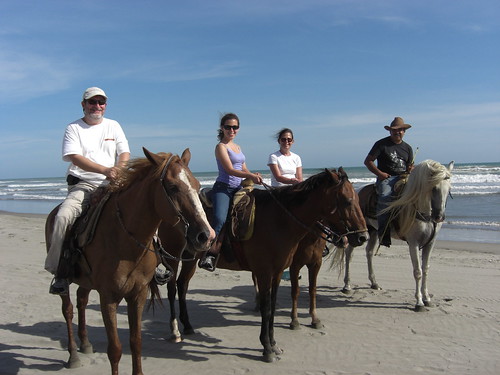
We've had several hundred hits since then. You see, I do need to get away from the world of PACS every now and then, so Mrs. Dalai, my daughter "Dolly", and I spent a few days in Acapulco. You can get some good last minute deals, and in particular, Orbitz.com was able to deliver the hotel and the flights I wanted at a very good price.

Acapulco occupies a lovely bay off of the Pacific coast of Mexico. At night, the lights go on up into the hills, and they create one of the most beautiful vistas in the world.

We returned to a place called Las Brisas, where we had stayed 18 years ago. The motto of this pink and whitewashed hillside resort is that children are "seldom seen, but often made" there. My daughter is 20, but when we told people of our prior visit, we could see the wheels turning. Not quite, folks. (There were actually a bunch of kids staying at the resort this trip, reversing the philosophy.) Each room, or "cassita," has its own pool into which the staff throws hibuscus blossoms (some rooms share a pool), and the effect is very striking:

CIMG2671.JPG

Las Brisas used to provide Jeeps to the guests for their use about the resort and in town. Sadly, traffic in Acapulco is totally unmanagable for a gringo like me, and apparently there were some incidents with the local police stopping the well-labelled tourists. Today, if you want a car, you have to rent your own. I could have had a SmartCar (not so smart in Acapulco traffic) or a non-pink Jeep, but I'm not good enough or crazy enough to drive there today.

CIMG2690.JPG

We saw the obligatory sights, including the cliff divers (no doubt there are some out there who would have encouraged me to give it a go...)

CIMG2674.JPG

I did get conned into trusting my life to this lovely horse for a ride on the beach. I won't be doing that again anytime soon...

CIMG2696.JPG

The worst part of any vacation, of course, is the return to reality once it's over. I hope you'll forgive my brief hiatus in posting, but Las Brisas is only now acquiring WiFi. So much for paradise...

Saturday, August 02, 2008

Amicas V6. . .It's Almost Here


I'm just back from Boston, having spent the past several days holed up with the developers of Amicas' latest and greatest, Version 6, or V6 for short. This was a lot more fun than you might think, as these are not only brilliant folks, but they are also some of the nicest and most down-to-earth people I know. They welcomed me and Mrs. Dalai (who was not amused by her title) to Amicas' world-wide headquarters (which is in the New Balance building by chance) and made us feel right at home.

I had the chance to simulate my workday sitting in front of a V6 workstation. As an added bonus, we were using one of the new Barco 6MP color monitors. I want one, although the $17K price tag will keep it out of my reach for a while.

HQ is a maze of cubbies and computers, much like any of the dot.coms in their heyday. There is no impending sale of the company, thank you, and work proceeds nicely on several fronts.

I cannot post any specifics on V6 at the moment, but your patience will be rewarded before too long. I will go out on a limb and tell you that its code name is "Phoenix", which is a bit of hyperbole based on the fact that this is one of a very few PACS products that has been completely rewritten from the ground up. Since its predecessors are still functioning well, the imagery of "rising from the ashes" is a little overblown. When I first saw the initial stub-laden pre-alpha version, I commented that it should be called "Freedom PACS" as in freedom from the way other big companies do things. That hasn't caught on as yet, but I keep hoping for a change of heart, and a chance at residuals for coining the name.

Since I can't tell you much about V6, I am left with telling you what it doesn't do (obviously stuff that can be found on some competing products):
  1. V6 doesn't have an unstable worklist
  2. It doesn't allow two people to be dictating the same study at the same time.
  3. It won't show the demographics for the last patient you were looking at for 20 seconds or so while displaying the images for the next.
  4. It will not show you the wrong report associated with the prior study you are viewing.
  5. It will not randomly choose a prior to show you even after you have clicked the one you do want.
  6. It doesn't have a hanging protocol setup so badly done that you don't bother using it.
  7. V6 doesn't make you wait for everything in the worklist to be cached before it lets you start viewing an image.
  8. It will not mistake "relevance" for "relevants"
  9. It will not limit me to one viewport for one series, and float the series selectors over the viewing real-estate.
  10. It will not utilize "toggling".
  11. It will not treat examinations of the same patient from different campuses of the same hospital system as coming from entirely different patients, thus impairing comparison.
  12. It will not hide functions in unexpected places.
  13. It will not be confused as to how a three-dimensional cursor should operate.
  14. It will not assume that changes (like windowing) to one slice of a CT or MR should not propagate to the rest of the series.
  15. It will not erase the search-term you last used when you click in the text-window.
  16. It does not make you open a study to see if someone else is reading it.
  17. It will not display a study that was on your worklist when you first started reading, but has since been dictated.
  18. It will not restrict you to six measurements per slice or image.
  19. It does not make you buy another client and separate program to run via the web.
  20. V6 will not be integrating someone else's software into an older version of itself to form any sort of hybrid product.
  21. It will not require additional (extra cost) software to display MPR's or VR's.
  22. It will not automatically change the parameters of a search from "all times" to "Last 7 Days".
  23. It will not restrict you to placing a series in one and only one viewport.
  24. It will not force you to use clone windows.
  25. It will not make extensive use of toggling.
  26. It will not promise individual functions (pre-cans, worklists, etc.) that somehow become system-wide and not individual at all.
  27. It will not randomly change column-widths and sorting parameters and such.
  28. It will not carry through old ideas that didn't work for anyone except for a select few members of a very focused focus group.
  29. It was not created by letting the inmates run the asylum (thank you Alan Cooper!)

V6 will show the industry how PACS should work. As with Amicas' previous offerings, it will not be perfect, but it is pretty darn good. Trust me on that.

I'll let you know more shortly.

Friday, July 25, 2008

Dineen New President of GE Healthcare
. . .becoming Hogan's Hero

From AuntMinnie.com:

John Dineen has been named president and CEO of GE Healthcare, replacing Joseph Hogan.

Dineen, 45, has served as president and CEO of GE Transportation since 2005. He will work from GE Healthcare's headquarters in Chalfont St. Giles, U.K.
Prior to GE Transportation, Dineen served as vice president and general manager of Plastics at GE Advanced Materials and held various assignments in corporate finance.

He also served as general manager of GE Power Equipment; general manager of the company's Meter business; general manager of the Microwave and Air-conditioning businesses; manager of finance for GE Asia in Hong Kong; and president of GE Plastics-Pacific during his 22 years with parent company General Electric of Stamford, CT.

Hogan, who joined GE in 1986, is leaving to become CEO of the ABB Group, a Zurich, Switzerland-based provider of power and automation products, systems, and services. ABB's U.S. headquarters is in Norwalk, CT.

Here's wishing Mr. Dineen and Mr. Hogan the best of luck in their new positions.

Saturday, July 19, 2008

Mystical Brain
. . . Virtual Theater from SnagFilms.com


The Wall Street Journal's Walt Mossberg is great at finding new technological toys and tricks. He recently discovered SnagFilms.com, which allows all of us with websites, or some semblance thereof, to participate in movie distribution:

Thousands of feature-length documentary films are produced every year, but almost nobody gets a chance to see them. A few dozen are shown to small audiences at major film festivals, and a handful make it into theaters. For every blockbuster like "An Inconvenient Truth," there are hundreds of documentaries that never find an audience.

Starting Thursday, however, there will be a new online service that aims to change all that. The service, called SnagFilms, allows anyone with a blog, a Web site, or even a page on a social-networking site, to open a virtual movie theater and show these documentaries, free. The virtual theater is a small widget that contains the film, and that can be embedded easily and quickly in a wide variety of popular social-networking services and blog platforms. No technical knowledge is needed.

For my contribution, I chose the feature "Mystical Brain", a Canadian documentary that asks:

Is it possible to shed light on the states of grace experienced by mystics and meditators? In MYSTICAL BRAIN, the documentary filmmaker Isabelle Raynauld shows us the most recent discoveries of scientific research on this phenomenon.

I was actually attracted by the PET and MRI images contained within.

Get out your popcorn and enjoy!

Wednesday, July 16, 2008

"i" Is For "iSite"
. . . and not IMPAX

It looks like Philips isn't interested in Agfa after all. From printweek.com's Simon Nias:

Agfa-Gevaert chief financial officer Kris Hoornaert has been forced to deny rumours that the company has received an offer from Dutch electronics company Philips.

Hoornaert spoke out yesterday after Agfa's share price leapt 39% to €5.65 (£4.50), following rumours that Philips might make a €9 per share offer for the Belgian company.

"Agfa-Gevaert does not know of any acquisition proposal. We are very shocked. We have not received anything in the form of a communication or piece of news," said Hoornaert.

Shares fell somewhat following Hoornaert's statement, but still closed up 24.5% at €5.06.

The news follows Agfa's appointment, in April, of German-based investment bank Lazard to conduct a strategic review of its operations, after a planned demerger of the company's three division – Graphics, Healthcare and Materials – fell through.

Agfa blamed the demerger's indefinite postponement on disappointing results, which also spurred a massive drop in its share price over the past 12 months – down 77% from a high of €19.10 to a low of €4.38.

Oh, well. Another suitor bites the dust. Romeo, oh Romeo, wherefore art thou, Romeo?

Saturday, July 12, 2008

A Nation Of Thieves?


The "Nigerian Scam" has been around for a long time, having graduated from paper-based snail-mail messages to the more modern e-mail spam version. It seems that my main e-mail address has been discovered by some of these vermin, and I'm getting a dozen such spams per day.
So what is this "Nigerian Scam" anyway? From quatloos.com comes an example and further explanation:


The scam starts with a bulk mailing or bulk faxing of a bunch of identical letters to businessmen, professionals, and other persons who tend to be of greater-than-average wealth. A typical letter might look like this:


Date
FROM: Mr. Ben Ahore

Central Bank of Nigeria

Lagos, Nigeria[Phone Number]

TO: Dupe Address

Dear Sir:

I have been requested by the Nigerian National Petroleum Company to contact you for assistance in resolving a matter. The Nigerian National Petroleum Company has recently concluded a large number of contracts for oil exploration in the sub-Sahara region. The contracts have immediately produced moneys equalling US$40,000,000. The Nigerian National Petroleum Company is desirous of oil exploration in other parts of the world, however, because of certain regulations of the Nigerian Government, it is unable to move these funds to another region.
You assistance is requested as a non-Nigerian citizen to assist the Nigerian National Petroleum Company, and also the Central Bank of Nigeria, in moving these funds out of Nigeria. If the funds can be transferred to your name, in your United States account, then you can forward the funds as directed by the Nigerian National Petroleum Company. In exchange for your accomodating services, the Nigerian National Petroleum Company would agree to allow you to retain 10%, or US$4 million of this amount.
However, to be a legitimate transferee of these moneys according to Nigerian law, you must presently be a depositor of at least US$100,000 in a Nigerian bank which is regulated by the Central Bank of Nigeria.
If it will be possible for you to assist us, we would be most grateful. We suggest that you meet with us in person in Lagos, and that during your visit I introduce you to the representatives of the Nigerian National Petroleum Company, as well as with certain officials of the Central Bank of Nigeria.
Please call me at your earliest convenience at [Phone Number]. Time is of the essence in this matter; very quickly the Nigerian Government will realize that the Central Bank is maintaining this amount on deposit, and attempt to levy certain depository taxes on it.

Yours truly, etc.

Ben Ahore

At its essence, this is a scam for those who think they are too smart for scams. The strategy is to lure one into thinking that they are actually scamming the Nigerian government, when it may be just the opposite that is occuring. Those foolish enough to follow the instructions and send money will at best lose their "investment". Should they actually be so bloody stupid as to go to Nigeria (or whatever God-forsaken place they are lured to), they may lose their life as well.
These scams are often called the 4-1-9 scam, named after the Nigerian Penal code section 4-1-9 which talks about fraudulent stuff like this. This is quite funny, really, as it seems that the 4-1-9 scam is the third (or maybe the fifth, depending upon your source) largest industry in Nigeria! Quatloos.com notes:
There have been numerous reports of high-level officials of the Nigerian government and the Central Bank of Nigeria personally participating in this scam, even to the extent of giving dupes tours through government buildings and showing them piles of cash in the vault of the Central Bank!

You have to wonder why Nigeria of all places has become the home for this garbage. Foxnews.com says:
The Nigerian government says the country is a hotbed for scammers because of mass unemployment among an educated population and large extended families for whom people have to provide for, according to an advisory issued by the Secret Service.
That could apply to any third-world country. But that doesn't for one minute justify criminal behaviour such as this. Robin Hood mentality, anyone? How about the government helping people get jobs instead of helping them scam foreigners? Somehow, this has become part of the underground culture in Nigeria, and apparently it is well-integrated into the upper eschelons as well.

For what it's worth, other scammers have adopted this approach to separating you from your money, and they operate out of a number of nations.

On a personal level, about all you or I can do is to report the spam/scam to the proper authorities (forward the email with full header to spam@uce.gov). I also use spamcop.net to report the email back to the originating ISP. Not that this will do much good if it actually comes from Nigeria, but every hole we can plug is a start.

I'm not sure there is much our government can do here. I suppose it would be possible to cut off all internet traffic to Nigeria, but in the end that would probably hurt more innocent people than criminals. Sanctioning and fining Nigerian ISP's probably wouldn't work either. I'm not sure how much aid the US sends to Nigeria, and maybe the threat of its withdrawl would get someone's attention, but again this would likely hurt those who have no involvement.

So, I guess the only solution is to report and delete. Again, and again, and again.

Wednesday, July 09, 2008

PHILIPS Eyes Agfa
. . . iSite Users Beware!

An eagle-eyed anonomyous commenter spotted THIS article from Forbes, and assumed I would be interested.

It seems that Philips NV has joined the pool of Agfa suitors, according to "independent market sources." From the Forbes article:

Dutch electronics company Philips NV may launch a bid for Belgian peer Agfa-Gevaert NV, independent market sources said.

'Agfa's (share price is) higher because we heard Philips might launch a bid,' one trader told Thomson Financial News.

Another said he had heard the bid would be priced at 9 euros per share, well above Agfa's current price of 5.23 euros.

Agfa and Philips were not immediately available for comment.

Apparently, this is not yet substantiated, but it seems to be making the rounds in Europe:

Analyst Bart Jooris at Fortis (other-otc: FORSY.PK - news - people ) said he had heard the report, saying that while he did not know if they are true, Philips had downplayed the possibility of it aquiring Agfa in the past because its 'not interested in a restructuring story'.

He said any potential buyer would have to take the healthcare, graphics, and materials units, not just one of the three divisions.

'If, as a competitor, you want to buy Agfa, you have to buy the whole company,' Jooris told TFN, noting that in the absence of a bid, it may sell some divisions to a private equity partner.

Interesting turn of events. Maybe Philips will buy Agfa and sell off the PACS division. Maybe it will keep Agfa PACS and sell iSite to someone else. Siemens still needs a PACS, maybe they would be interested?
Stay tuned for further details as they become available....

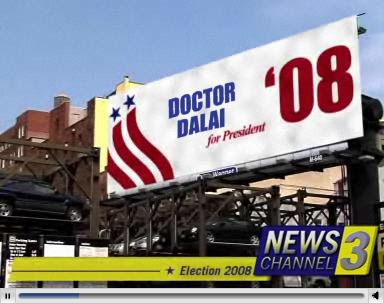
Dalai For President!!!


My friend Mike Cannavo, the One and Only PACSMan, informed me today that I am somewhat more popular than I might have guessed. It seems that there is a movement afoot to draft me for the highest office in the land. I can't say that I'm terribly surprised, as I'm sure I could do a very good job at it, and I wouldn't mind the accouterments that go with the office, such as tootling around on Air Force One.

I've even received news coverage on one of the big New York Stations, News3 as seen on THIS web-page (I can't get the video to embed properly. . .)

Vote for me and I'll deliver tax-cuts to everyone except those that work for large imaging equipment companies, I'll bring the price of gasoline down to $1 per gallon, and I'll ban all Prisuses.

Yes, anyone in America can grow up to be President! Now, all I have to do is grow up! And stop playing practical jokes on my readers. . .

Thursday, July 03, 2008

Killer SPECT/CT?

OK, wrong Hawkeye, but the title is correct.

To keep at the bleeding edge of nuclear technology, my hospital is in the market for a hybrid SPECT/CT. This latest and greatest idea in nuclear medicine recapitulates the brilliance and innovation that brought us PET/CT, and applies it to PET's cousin SPECT.

I'm going to assume that you know what these modalities are all about. PET uses positron-emitting radioisotopes to produce an image, while SPECT, Single Photon Emission Computed Tomography, uses more conventional radiopharmaceuticals, generally labelled with Technetium 99m, or Indium 111, or Gallium 67. PET is acquired with a ring detector, and SPECT uses two rotating gamma camera heads (sometimes one, rarely three) to produce an image. You really don't want me to get into the mathematics of the process, not that I really could; suffice it to say that by rotating all around the radiation source (the patient), the radioactivity detected by the heads is reassembled into a series of slices. This technology has been around for a long time.

In the early days of PET, there were attempts to modify gamma cameras to act as cheap PET scanners. We had one, the ADAC Vertex, which used thicker NaI (Sodium Iodide) crystals to stop the higher energy annihilation gamma rays (511 KeV vs 140 KeV for the main gamma emission from Technetium). It was a good way to get our feet wet, but the images weren't great.

One of the SPECT gamma-cameras that was marketed as having PET capabilities started life as the Elscint Varicam:

This was a camera well ahead of its time, with body cowling designed by Jaguar (or was it Porsche?). Its computer was a little esoteric, and I'm not sure many were ultimately sold. But with thick crystals, it could be made to do PET imaging.

In 1998, GE bought Elscint, and assimilated the Varicam into its collective product line, where it became the Hawkeye. (As an interesting historical aside, I was actually talking MRI with some of the developers at Elscint HQ in Haifa, Israel, the very week everyone else at Elscint was in Milwaukee completing the deal.)

I think the innovation to put a CT in the same machine as the SPECT gantry came from UCSF, where an old GE 9800 and a GE 600 XR/T SPECT were sort of loosely combined:


I suppose I should stop at this point to answer the question of why one would want to do this. As with PET and its marriage to CT, there are two reasons. First, the human body is inhomogeneous, i.e., it is full of things that block x-rays to varying degrees. Bones block more than watery structures (like organs), which block more than air in the lungs. To properly reconstruct a tomographic, SPECT image, the computer should know what the anatomy looks like. Most of the time in SPECT we ignore this, although in cardiac work, where chest wall or breast or diaphragmatic attenutation (blocking) could create false defects in the image of the heart, attenuation correction is critical. This correction can be accomplished by sweeping a radioactive source across the area in question, sometimes during the scan itself, or one could use CT. CT actually works much better, because it is designed to look at anatomy, not physiology. Second, linking CT and SPECT gives me a better chance to localize those pesky little hot-spots, just like we see with PET/CT.

Anyway, under GE tutilage, the Varicam became the Infinia. A bit later, a low-resolution CT was added to create the Hawkeye:


The "bump" to the right of the ring holds the x-ray tube, and the black strip to the left, inside the ring, is a detector. Thus, a rather limited CT is created. GE continues to sell this device today, and it now has 4-slice capability (Hawkeye Infinia 4).

Philips and Siemens have gone more traditional, with offerings hearkening back to the original UCSF design with a real CT scanner. The Symbia from Siemens uses their Emotion CT scanner (in various slice increments, either one, two, or six, and soon 64) mated with a dual-head gamma camera. Very pretty cowling; you have to love that Bondi-Blue made famous by the original iMacs.


Philips Precedence SPECT/CT mates a Philips CT (which is coincidentally a descendant of an Elscint design as well) to an ADAC (I mean Philips) Skylight gamma-camera:


I've heard that the Skylight, a room-sized framework suspending two gamma camera heads, was commissioned to do bone scans on racehorses, and having two in my lab (Skylights, not racehorses), I can see where this might have been the case.

So, once I get my hands on one of these, what will I do with it? The possibilities are really endless. Anything we do with SPECT, we can do better with SPECT/CT. A lesion on a bone scan can be precisely located with the CT component. The blobs of activity that are almost unreadable from a ProstaScint scan suddenly become diagnostic of nodes invaded by prostate cancer when I can see where they actually lie. Cardiac scans gain accuracy with the improvement in attenuation correction. And so on. But there is one theme common to these new and exciting applications: They depend heavily on the CT component. The nuclear literature is chock-full of reports of improvements in diagnosis when using SPECT/CT, especially with diagnostic quality CT's done with IV and oral contrast.

Which leads us into the editorial part of this opus.

The Medical University 100 miles down the road is getting four Symbias. Yes, I said FOUR. Our community hospital here in the boonies has to be competitive, but with luck, I will get one SPECT/CT scanner, so I had better choose the right one.

Equipment vendors are in the business of selling equipment, oddly enough, and they try hard to convince you that their machine is the best, and the other guy's is trash. When I was looking at PET/CT scanners, GE sent me at least a dozen articles that "proved" their older BGO crystals were better than Siemen's LSO crystals. I didn't fall for it, and I'm happy with my PET/CT choice of the Siemens Biograph. (However, I'm very UNhappy with the fact that Siemens released their higher resolution TruePoint machine within a year of our system's purchase, which can't be retrofit our older model.)

GE knows very well that I'm not a Hawkeye fan, but they continue to try to convince me of the error of my ways.

I'll make the assumption that the gamma camera (i.e., the SPECT) components are similar, and that the attenuation correction on each will yield good images. The only reference I could find indicates that the Hawkeye's SPECT resolution is slightly better than that of the Symbia series.

But.... When my Chief Tech asked about the quality of the Hawkeye's CT, she was told, "Why would you need more than attenuation correction?" Excuse me? Obviously, there is a little lack of understanding of one's product here. Attenuation correction is only part of the story, and as the interpreting radiologist, it is the lesser part. When I see hand-waving like this, I know there is something to hide. And it is indeed the CT component.
The Hawkeye's CT (we'll be generous and call it that) can acquire 4 slices simultaneously, although I'm not sure how fast it rotates. You sure as heck wouldn't want the open gantry rotating beyond a snail's pace, or someone is going to get hurt. Slice thickness is (per RT-Image) 5mm. OK, but the darn thing puts out only 1-2.5 mA with a 350 Watt generator! Compare this to the Symbia T6, with a 6-slice CT, that has a 50 KW (50,000 Watts), that can develop 20-345 mA. The Emotion CT platform can scan down to 0.63 mm. That's a real CT, with diagnostic images for correlation. In a departmental pinch, a Symbia can even be used as a stand-alone CT.

Why do I need more than attenuation correction? Because CT is what SPECT/CT is all about, folks. Yes, attenuation correction is important, and it greatly improves the image. But I need the diagnostic CT, and it needs to register perfectly with the SPECT image. In this way, I can match the anatomy to the physiology, and that is what I need to do. Sadly, GE doesn't want to acknowledge this, mainly because its product doesn't have a diagnostic CT component. No doubt they will couple their gamma camera with a proper CT someday, but until then, this little deficiency doesn't seem to bother them. In fact, their strategy takes a rather different turn:

The following link is to an article regarding the possible link between multiple CTs and cancer risks, especially in children. Aiding us in our cause for our low-dose SPECT/CT Infinia Hawkeye 4 system. Maximum patient dose with the Infinia Hawkeye 4 is 2.5ma. Why more dose for Attenuation Correction and Anatomical Mapping in Nuclear Medicine environment?

http://news.yahoo.com/s/time/20080630/hl_time/howdangerousarectscans
Maximum patient dose is 2.5 ma? I'm not quite sure what that is supposed to mean. The initials "mA" stand for milliamperes, a measure of current, or loosely, flow of electricity. The Hawkeye's tube current is indeed rated at 2.5 mA. Yes, this lower-powered tube does yield a lower radiation dose.

The article in the link discusses the supposed danger of too much radiation from too many CT scans, and was inspired by a now-infamous New England Journal article. There has been tremendous debate in our literature, both before and after this somewhat inflammatory piece, concerning the carcinogenic potential of diagnostic radiological procedures in general, and CT in particular. I won't rehash that now. But most agree that it is desireable to keep the amount of radiation to the lowest reasonable level.

GE deserves accolades for its attempts to reduce radiation exposure from its devices, especially in the realm of cardiac CT. But in the SPECT/CT venue, the argument is hollow at best. Because the Hawkeye's CT images are not diagnostic, the patient will have to undergo another CT, and the dose will be added to that from the Hawkeye. In other words, the total dose will exceed what the patient would have received had he or she been scanned on a SPECT/CT unit that had a diagnostic CT in the first place.

Now, being board-certified in both Nuclear Medicine and Radiology, I rather take offense to that last line in the quote from GE about the "Nuclear Medicine Environment". The implication here is that Nuclear Medicine doesn't need diagnostic images. Well, sorry to disappoint you guys, but likely the majority of nuclear medicine exams are read by diagnostic radiologists, and because of PET/CT, most pure Nuc Med physicians are now pretty well versed in reading CT's, so don't even think of going there.

One simply cannot justify the purchase of a SPECT/CT camera on the basis of attenuation correction alone, and that seems to be the majority of what the Hawkeye offers. So, let's not play the radiation dose card, when ultimately a patient scanned on the Hawkeye might get a higher dose than someone scanned on a Symbia or a Precedence. If the extra radiation is so dangerous, and it needs to be limited as much as possible so the scans don't turn out to be harmful (or maybe fatal?), then we need to do only one CT scan and not two, yes?

I'm anxiously awaiting the day that GE delivers a SPECT/CT camera with a real CT in the box. No doubt this will occur. But you will forgive me if I have to pass on the Hawkeye. It just isn't going to be my "killer app".


ADDENDUM


Several comments to this post have led me to look further into the Philips BrightView XCT SPECT/CT device, which will be available early 2009. From the Philips website, we learn that this device differs significantly from the other contenders:

CoPlanar FP uniquely integrates Philips BrightView SPECT in a co-planar design with advanced Philips flat-detector X-ray CT technology.
This is the only application of flat-panel detectors in this realm that I could find. Sadly, I didn't look closely at this machine at SNM, but RT-Image gives us the CT specs for the Hawkeye, the BrightView, and the Symbia T16:


I don't know how the flat-panel detector will change things, but physics is physics, and the CT appears underpowered relative to the Symbia, although it is significantly better than the Hawkeye. I'll post further when I get to see some images.

Wednesday, July 02, 2008

Agfa's TWO Suitors

The Slaying of the Suitors, image courtesy of http://www.mainlesson.com


I've written before about Agfa being for sale, and Siemens needing a PACS product. In an article yesterday, AuntMinnie.com put these seemingly disparate facts together like chocolate and peanut butter in a Reese's cup:

Agfa-Gevaert of Mortsel, Belgium, reportedly has spoken with Erlangen, Germany-based Siemens about the possibility of selling Agfa HealthCare as part of its strategic review process, according to published reports.

The Financial Times reported that Los Angeles-based equity group Gores Group also has shown interest in acquiring Agfa HealthCare. If Gores were to acquire the division, the story added that Gores is likely to leave management of the healthcare operations in place.

Gores already has holdings in the healthcare market. In July 2007, the group purchased the diagnostic imaging division of HealthSouth of Birmingham, AL. The new company, Diagnostic Health, is one of the larger imaging center chains in the U.S.

The report also noted that an acquisition of Agfa HealthCare by Gores could generate opposition from organized labor in Belgium, adding that the transaction would result in some short-term layoffs.

In 2007, Agfa HealthCare posted net sales of approximately $2.2 billion (U.S.).

Representatives for Agfa and Siemens Healthcare of Malvern, PA, declined to comment to AuntMinnie.com on the report.

Just remember, boys. As the Mossad (the Israeli equivalent of the CIA) puts it, "Never say 'No comment.' 'No comment' is a comment."

Monday, June 30, 2008

Dead Green Servers


In a recent post, I relayed the information that the GE migration to the Linux server had to take place because the Sun Solaris servers upon which Centricity had been based were now at end-of-life status. In particular, the most recent version used for Centricity, the SunFire V480, is "retired and no longer orderable" according to Sun's website.
But wait, all is not lost! It seems that the SunFire V490 is now available to meet all your Solaris needs, and you can get it from $30,995.00 (US). Could it have done the job for Centricity? More than likely:
Pack your racks with UltraSPARC IV+ processors driving this 5 RU server and get over 5x faster performance compared to UltraSPARC III based Sun Fire V480 servers. Up to four processors per box with eight threads and 64GB of memory make it ideal for securing and delivering multiple applications and business processes or distributed databases.
Yeah, I think the V490 is probably beyond the V480's capabilities:

The Sun Fire™ V480 server is designed to deliver compute density and enterpriseclass RAS features at an affordable price. Its space-efficient, rack-optimized 5RU, 24-inch-depth enclosure provides excellent value per rack unit and contains up to four 1.05/1.2-GHz UltraSPARC® III Cu processors, each with 8 MB cache(L2), up to 32 GB of memory, integrated dual 10/100/1000-Mb/sec. Ethernet, and the Sun Fireplane Interconnect operating at 9.6 GB/sec.
OK, so what's the real reason behind the upgrade? Well, I dunno. To be fair, GE has been selling the Linux servers for several years, well before the Dynamic Imaging acquisition. And far be it from me to criticize them for being willing to change some software that I was not terribly pleased with in the first place. But was it the server reaching end-of-life that forced the issue? Or the software?

Tuesday, June 24, 2008

Dalai Does Dallas


I had a rather quick turn-around last week. I arrived back home from New Orleans at 5 P.M., and had to fly out to the West the next morning. We were booked on American Airlines, and we knew this was going to be problematic when the ticket agent predicted American's bankruptcy within the next 6 months. Always reassuring before a flight. To make matters worse, I used my smartphone to check for the connecting gate in Dallas, and lo and behold, it had been cancelled. Fortunately, we were able to rebook on US Air to our destination, and all was well.

American blamed the cancellation on weather in Dallas, and truly there was a big storm there that day. However, the storm lasted less than an hour, and I personally think American was looking for excuses to suspend flights and save fuel. Maybe that's why they tell some of their gate agents to be nasty to the flying public; one less customer, one less gallon. However, given their rather unfortunate habit of letting their planes sit idling with the engines running while waiting for their gates to clear probably eats more fuel than they save with cancelled flights and lost customers. Scratch one more airline.

I actually wasn't planning to travel again quite so soon, but I received a call from Amicas asking me to fly out West to speak with some potential customers. They thought the doctor-to-doctor thing might be helpful, since the group was somewhat similar to mine, and what they wanted to do with the product was rather close to the way we use it. So, off I went. Lest anyone dare call this a junkett, I'll reiterate that I really didn't want to go anywhere at that time, and I certainly wasn't interested going West where the temperatures were well above 100 degrees. But faith in the product, and maybe a little vanity, made me decide to do it anyway.

The radiology group in question is sort of like mine, about the same size, with a few guys older than I am, and more that are younger. They are rather spread out, covering several towns rather far from their base, as do we.

Now, I won't reveal the particulars this group sought, but portability was a critical factor. They had narrowed their choices down to Amicas and another company, and they were having some trouble deciding beyond that. On the advice of my very wise, and occasionally politically-correct friend, Mike Cannavo, the One and Only PACSMan, I won't name the other company, but suffice it to say they are definitely one of the BIGGER players.

I had the chance to speak briefly with some of my counterparts in this Western group, as well as their IT guru. It became clear that they saw the viewers of both PACS as equal. They made the assumption that both could serve their needs, but they still had some hesitation about Amicas as a smaller company vs. the "security" of the BIGGER company. I'm not sure I got all of my points across in person, but I'm told that many of them read this blog, so here is everything I should have said, just in case I didn't.

First and foremost, Amicas is a scrappy little company that isn't going anywhere. I'm always seeing something on AuntMinnie.com about how little PACS companies are going to either die or be taken over. That's true for some, but I don't include Amicas in that pile. They have a great deal of money in the bank, the company is buying back its stock, and 20% of revenue goes into R&D. It is acquiring new technology such as RadStream (the acute-event reporting software from Cincinnati Children's that I have discussed elsewhere.) Sure, if some company like Siemens offered them double what they are now worth, I'm sure they would sell out (I would), but I don't see that happening any time soon. Let's put this takeover idea to bed for today, shall we?

Somehow, there has emerged the illusion that there is safety with purchasing from the BIGGER company. Hmmmmmm... Just ask anyone who bought Centricity in the last few years how safe that is. Or the old Philips PACS made by Sectra. Sadly, the BIGGER folks have an easier time of buying some new technology and requiring a forklift upgrade (usually hardware needs replacing as well as software in these circumstances) for you and me to get it. And, they are not worried (at least not as much as they should be) about whether or not you and I will pony up the charge for the next latest and greatest. After all, the BIGGER company was the safe bet, wasn't it? I can't see that we are particularly worse off dealing with a smaller company that isn't looking to swap out its product for something new, rather than improve and grow what it has. There are those who still believe the old "no one gets fired for choosing BIGGER" philosophy, but I guess I'm not in charge of their particular operation.

Only a few of the BIGGER folks have totally web-based technology, but most don't, and that is the case with the BIGGER company in question here. Is that a problem? Well, it depends upon how many software clients you wish to play with. Amicas has just one GUI, called LightBeam, which is deployed over the web to anywhere you happen to have a computer and broadband. To be totally accurate, there is a second client called LightView, that is simply LightBeam without a couple of features such as spine labelling. Which client and features are activated depends upon your status as a radiologist, clinician, tech, etc. Our friends at the BIGGER company seem to use several clients, some thin, some thick, and as I understand it, I could not put the thick client on my computer myself without help (authorization, I guess) from IT or the PACS team. Hmmmm.

How does the system distribute images? Most everyone is now going to a central repository. Amicas basically ties a web-server to a SQL database. (Note: Amicas now uses the IBM DB2 database which in turn runs SQL.) Why reinvent the wheel? This architecture works pretty well for other web applications, so why not use it? Is this what the BIGGER company does? Well, to some extent, but there seems to be a lot more complexity added, without necessarily getting a lot of additional advantage. This could be quite critical to my new friends out West, as their enterprise spreads far and wide, and the way the system deals with connectivity (or the lack thereof) could make or break the system. Amicas will allow a modality to automatically resume sending once a broken communication line is repaired. It seems that the BIGGER company requires a manual resend in this situation. Could be a problem.

Service should be a given. I've had a few glitches with Amicas service, but our downtime on our group's system has totaled only an hour or two in two years, and most things get caught before they cause chaos. I sure can't say that about some of the BIGGER companies I deal with daily. As for the BIGGER company I'm referring to here....well, I'll let someone else answer for them.

To me, the background operations don't matter as much as the actual interface, the client, the GUI. I like the way Amicas works. It doesn't get in my way, and it lets me bang through studies as fast as I feel comfortable doing so. Can we say this about the BIGGER GUI? I guess it depends upon which one of the options you actually use in practice.

Bottom line here is that BIGGER is not necessarily better. Look honestly at the products themselves, with no preconceived notions about BIGGER companies being safer than smaller companies, and the like. See what works for you and your group, and be sure they all get time on the GUI before you sign on the line. You might find that smaller works for you. I have lived through situations where the purchase was directed to the BIGGER, "safer" choice, and for three times the expenditure, we got half the product.

And no, I don't get a commission, so I have no vested interest in which way my friends out West decide to go. But I'm sure they will make an informed choice. They DO read my blog, after all!

P.S. No, the BIGGER company in question is not the one you think it is. I would have said bigGEr were that the case.

NO RIP for eRAD


According to a very reliable source, eRAD had given up the corporate ghost. HOWEVER, I just heard from a friend at eRAD that they are alive and kicking, so word of their demise is premature. Glad to hear it! My sincerest apologies to eRAD and my friends there, but I promise my source was trustworthy in the extreme! Perhaps his/her unimpeachable source needs to be impeached.
It seems that I have more readers than I ever will admit to myself, and it seems that a bunch of them were burning up the lines to eRAD. I've learned my lesson, I think, about posting unsubstantiated rumours.
To further my mea culpa, I will reproduce an e-mail from Seth Koeppel, eRAD's Senior VP of Sales:

All is well at eRAD, no danger of going out of business. With roughly 220 customers (300+ sites) of various shapes and sizes we're fortunate to be able to sustain ourselves (at a pretty full staff I might add) on residual support contracts, upgrades, expansions and add on sales from existing customers.

With this said I will tell you it's a tough market. Lots of opportunity but not a lot of checks being written right now. So we took the painful step a few weeks ago of reducing staff by a whopping 4 heads (2 direct sales, 1 apps and 1 field support) to ensure we can run at a 'zero footprint' or break even. One of the sales guys went back to work for our best reseller where we originally hired him so no real loss there and a better fit for him. If sales pick back up we'll add the heads back.

We continue to see steady activity from our network of resellers which has been erad's primary sales vehicle. While distributing through resellers can be a challenge it does have some advantages in a down market. If you stop and consider where much of the spend is in pacs right now its the small community hospitals and non-critical care access providers that haven't yet gone digital. There are literally thousands of ortho, multi-specialty, urgent care, etc. Clinics and small imaging centers that have yet to go digital and these are best served by the resellers who've been supplying film, chemistry and service to them for years. I just don't see how a company can afford a direct sales force to reach this market? Particularly with the cost of fuel/travel being what it is I think the regional guys have a huge advantage from a 'cost of sales' perspective and the margin on the low end systems aren't all that appealing for the big guys.

Then there's the replacement market. Talking to Ben Brown from KLAS at SIIM (you were missed by the way) he shared an interesting bit of info with me. He indicated they surveyed both the vendors and the hospitals on what they felt the replacement market is. The vendors weighed in at 40%+ and the hospitals 10%. I think there is some merit to this disconnect. The pacs the hospitals paid big bucks for just a few years ago does what they need it to do. Its the rads and the referrings who are beating the drum for web-based and remote reading to become more efficient and frankly I don't see the hospitals giving a hoot. Certainly not enough to spend the big dollars to make the rads more efficient so they can make more money.

This brings me back to my hot button of 'enterprise reading' or 'worklist consolidation'. I think the market is going to realize that A) hospitals aren't going to rush to upgrade and B) if they do the rads are still left reading from multiple disparate systems which doesn't allow for maximum efficiency of the most expensive resource in the production line. I've seen enough large groups pursuing purchasing their own system and requiring images be sent to it to know this is not just a passing fad but a reality of how groups will need to work in order to grow their reading base and improve efficiency.

This is where our direct sales efforts come in to play as the HL7 interfacing and complex workflow require a certain acumen and experience.

ERAD's technology is very progressive and very configurable so we have a big advantage in this space with some experience vis-a-vi our telerad providers and others whom have endeavored.

Then there are still some of the big guys who need a web based system (Cerner, McKesson, Siemens) to name a few not to mention companies like Sage/Medical Manager who still sell DI integrated to their RIS which is now owned by GE.....a direct competitor. Than there is the whole world of EMR companies who will no doubt want a web based image management component for their customers who do in office imaging and want to access images directly from the EMR in the context of the patient record and not have to go search a pacs worklist. Our API web interface allows this and we're seeing growing interest.

So I see lots of opportunity for a company with a solid platform, good developers, support infrastructure and 9 years of operating history.Everyone is feeling the pain with GE announcing a reduction of 400 heads in their imaging division today and Emageon's management losing its proxy fight with its investors which will no doubt result in a sale to the highest or for that matter any bidder.

So we're still here and will be for the foreseeable future. Hard to convince the world a small little company in Greenville SC can challenge the big guys and win but if anyone stops long enough to dig into the details they too will learn what several others have.

Hope to see you soon!

Seth

And that's all I have to say about that.

Tuesday, June 17, 2008

A Nuclear Oasis

I told a minor mistruth in the last post. It seems that a company called Segami has a product called Oasis that does much of what MIMVista's fusion product offers. I'll let you peruse their literature via this link.

Seeing it in action is impressive, but somewhat less so than the MIMVista product. Yes, it would link two studies, but some of the landmarks did not quite match as well as those on the MIMVista demo product. Could MIM have used better scan data? Maybe. Some of the tools on Oasis were a bit less intuitive at first blush, especially those that are used to alter the registration that I would have hoped to have been perfect when performed automatically. It did propogate ROI's from the old study to the new, as does MIM's, but not quite as well. There seems to be no deforming option, nor is there use of gradient-based edge detection.

I was told the system was web-based, and if you have more than one user, it is sold as a client-server operation. I didn't get a price on the PET module itself.

However, as it turns out, Segami writes the software for the Philips JETStream computer, which replaced the venerable ADAC Pegasys machines. We need a bunch of them, as our Pegasyses (Pegasi?) are rather old and decrepit at the moment, and Sun Workstations are just so 1990's. I was quoted a price for the client-server software, an adequate number of licenses, and the PET/CT product thrown in which was less than the price of one and one-half JETStream workstations from Philips. Now, whether the Segami product can do some of the special things offered by Philips, such as the rapid-acquisiton ASTONISH protocol, is yet to be determined.

As for PET/CT, I'll give MIMVista a 9.5, and I'll give Oasis an 8.5, based on limited exposure. You can rest assured, there will be more to come on this topic.

(MIM)Vistas of New Orleans


The annual meeting of the Society of Nuclear Medicine is held in various cities, including New Orleans, San Antonio, Philadelphia, Orlando, and Toronto. This year's meeting is rather poignant, as this is the first time the SNM has returned to New Orleans since Hurricane Katrina. The Morial Convention Center is in great shape; you would never know of the tragedies that occured within its walls and nearby. However, within a few miles of the convention center, and only a mile or so from the French Quarter, lies the Ninth Ward, and there we found that all is not well with New Orleans. Much destruction remains, and rebuilding is slow and patchy. Further north, near Lake Ponchatrain, there is even more devastation, and three years after Katrina, little has been fixed. Locals tell us that over 60,000 people left New Orleans, never to return, and their homes will sit barren for the foreseeable future, testaments to a complete failure of government at all levels, especially local.

Bourbon Street is as lively as ever, perhaps slightly cleaner than it was on my last visit several years ago. Alcohol flows freely, and the strip clubs dominate the landscape. My fourteen-year-old son (who looks fourteen) was offered Jello-shots, among other things, which he wisely declined, as Mrs. Dalai and I were looking on. One of the street hawkers asked me if I wanted to buy my son his first lap-dance. I smiled and didn't respond, but I reviewed the possible answers: "No, he's only fourteen." Or, "No, but when do I get my first lap-dance?" Or, "Let him buy his own!" Mrs. Dalai was not amused. She was even less amused when a stripper outside a club called to her, "Hey, I'll play with you too, baby-doll!" There is no place like Bourbon Street. I like to come here every five to ten years just to remind myself why I don't want to come here any more often than that.

I'm somewhat surprised that this city exists at all, let alone the fact that it survived the one-two punch from Katrina and Rita. There's a joke around these parts: "Look up. What do you see? Sea level." Yes, New Orleans sits anywhere from 1 to 15 feet below sea-level. Minor problem, eh? But, the spirit here is strong, the levees and pumps have been repaired, and the rebuilding goes on. Eventually, I predict New Orleans will return to its former grandeur.

But now, back to things medical.

I had the chance to speak with several folks from MIMVista, including the fellow that wrote the software for the iPhone 3G application. The company was kind enough to give me the link to the presentation at WWDC08 in San Fransisco:


As it turns out, the iPhone app cannot be demo'ed at this point due to some pesky NDA's MIMVista signed with Apple. But as per the last post, the software should launch with the iPhone 3G itself.

The real news here is the core MIMVista software itself. For us PET/CT readers, what they offer is nothing short of revolutionary. To understand this, you have to realize what it is I do when I read PET's. If I'm looking at a new study, I try to find the "hot spots," and determine if they are physiological or pathological. If the latter, I need to determine how hot they are, a measurement called SUV, or Standard Uptake Value, which is a ratio that tells us how hot the lesion is relative to the total distributed dose. A somewhat arbitrary value of 2.5 has been assigned to badness; in other words, if a lesion is 2.5 or more times hotter than the "average" activity in the body, we should worry that it is malignant, or at least infectious or inflammatory.

MIMVista's software won't actually find the hot spots for you (no doubt they are working on that) but once you locate them, MIM does the rest. Simply focus in on the lesion, and let the PET edge tool take over. It will find the contour of the lesion in three dimensions, and report back all the needed statistics such as minimum and maximum SUV, HU's (density from the CT component), and the volume of the lesion. MIMVista uses a unique, proprietary edge detection system that uses a gradient-based algorithm as opposed to the constant threshold algorithm used by everyone else in the business. See this paper if you want the details.

This would be adequate in and of itself. But as Apple's Steve Jobs himself says, "Oh, and one more thing...." The bane of my existence as a PET/CT reader is the comparison of the current study to one or more priors. MIMVista has attacked this problem, and has the only real solution I have encountered. This is multi-faceted, and very, very well thought-out. The system will automatically match the old study to the new. Voxar told me years ago that they were working on this, but they have yet to deliver it. In addition, the system will propagate the contours around the lesions from the prior study to the lesions on the current study. That may not sound like much, but trust me, this could be an absolute miracle for us readers. The lesion contours can be transferred rigidly, or can be deformed, and will automatically adjust to the new pattern of the finding. This is what the clinicians (and sometimes the patients themselves) want to see. Tell me the progression of the SUV and the size of the lesion. Measuring all of this manually for every lesion for every study is incredibly tedious and prone to error. I'll take every bit of help I can get, and MIM is offering me a heck of a lot of assistance.

MIMVista's system is made up of modules,

which as I understand it can be used separately, or together, with or without the "PACS" storage server. The "viewer" is a thin client, but supposedly not for diagnosis. However, the "thick" fusion module should work on all workstations with a fairly open license agreement. As of now, there is no integration to Agfa, which I would need for reading PETs done at my Agfa. Let's get to work on this, Agfa and MIM. Quickly. I really, really want to get my hands on this software.

I looked briefly at the Cardiac package, which would be great for those doing multimodality PET perfusion/CCTA scans. At the moment, it doesn't have the high-level CCTA angiographic controls and so forth that we need for readout of CCTA alone.

I didn't demo the Neuro package, but I have been told by other docs that it is quite advanced.

I was asked not to mention numbers, but I can say that the value for the price is absolutely phenomenal. This is a bargain folks, and I don't say that often. PET/CT readers, have a look. You'll be glad you did.

Disclosure statement: The folks at MIM gave me a UniBall pen, worth approximately $1.